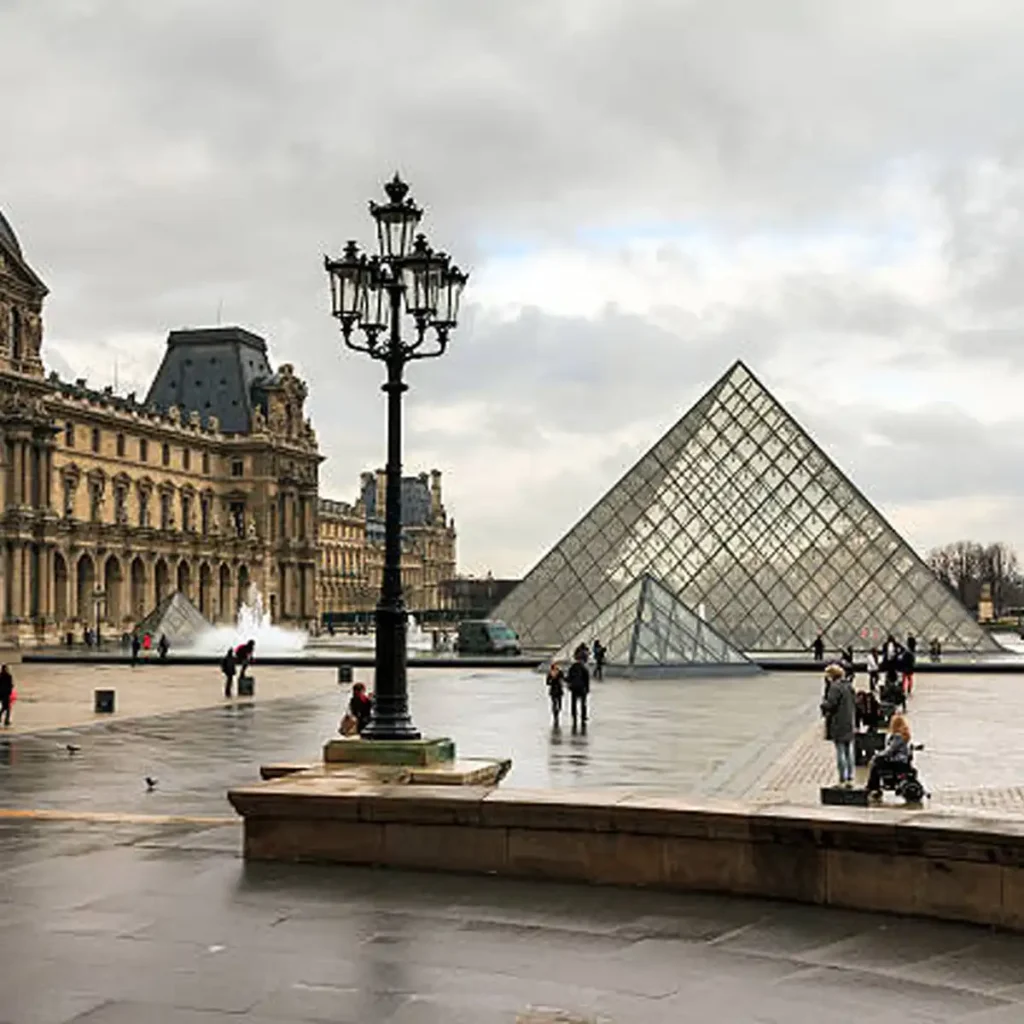
On Sunday, 19 October 2025, thieves breached the Galerie d’Apollon at the Musée du Louvre and removed selected Napoleonic jewels in a rapid, tightly choreographed operation. Officials placed the timeline between 4 and 7 minutes. The entry point was a second-floor window in the Denon Wing, reached by a vehicle-mounted basket lift positioned beside construction works on the riverside façade. The alarm sequence triggered on contact with the window and vitrines. Security intervened within minutes. The offenders escaped on high-powered scooters, abandoning and damaging the Crown of Empress Eugénie during the flight. The museum closed for the day while police secured tools, recordings and witness statements.
How The Thieves Exploited Construction And Urban Camouflage
The team used Parisian street furniture to hide in plain sight. A cherry picker, high visibility vests and a work zone under scaffolding created a believable work scene. The lift masked intent while delivering speed and reach. The site choice neutralised routine scrutiny because the kit looked appropriate to the environment. The approach also avoided weapons and confrontation, which reduced legal exposure and public risk, yet preserved operational tempo. The method shows a clear reading of city psychology and the way humans filter everyday stimulus.
Inside The Breach Tools Targets And A Rapid Exit
Battery-powered angle grinders and cutters opened the window and then the vitrines. Once inside, two members moved directly to pre-selected cases holding 19th-century imperial parures. Video later captured a suspect cutting glass while visitors continued to pass. Ministers described the team as professional and well-rehearsed. The difference between 4 and 7 minutes likely reflects the span from lift deployment to departure, not just time on the gallery floor. That split matters. It shows the plan centred on a predicted guard response window. The crew grabbed what could be moved fastest and cleanest before extraction.
The Lost Napoleonic Jewels What Was Taken And Why It Matters
The thieves ignored the Regent Diamond, which sits behind superior, object-specific protection. They selected complete sets where possible and then switched to whatever could be removed as alarms escalated. The cultural loss is severe. Public statements used the term “priceless” to capture the heritage value. Commercially, the pieces are almost unsellable intact. The most likely criminal pathway is dismantling, melting historic monuments, and recutting stones to erase identity. That route destroys context, provenance and art historical meaning. It also seeds the legitimate market with altered stones whose past is invisible.
Inventory Of Stolen And Recovered Pieces
The following list groups items by historic owner and set. It reflects public confirmations to date.
Parure Of Empress Marie Louise. Commissioned as a wedding gift in 1810 and made by Etienne Nitôt et Fils.
• Emerald And Diamond Necklace. Set with 32 emeralds and 1,138 diamonds, mounted in gold and silver. Status: stolen.
• Emerald And Diamond Earrings. Matching pair from the same parure. Status: stolen.
Sapphire Parure Linked To Queen Hortense And Queen Marie Amélie.
• Sapphire And Diamond Tiara. Set with 24 large sapphires and 1,083 diamonds. Status: stolen.
• Sapphire And Diamond Necklace. Collar style with 8 large sapphires framed by diamonds. Status: stolen.
• Single Sapphire And Diamond Earring. One of the pair removed in haste. Status: stolen, one left behind.
Jewels Of Empress Eugénie.
• Tiara Of Empress Eugénie. 212 pearls, 1,998 brilliant cuts and 992 rose cuts. Status: stolen.
• Large Corsage Bow Brooch. François Kramer, 1855, with diamond tassels. Status: stolen.
• Reliquary Brooch. Diamond jewel from the Empress’s suite. Status: stolen.
Targeted But Recovered.
• Crown Of Empress Eugénie. Alexandre Gabriel Lemonnier, 1855. Gold with eagle and palmette motifs, 1,354 brilliant cut diamonds and 56 emeralds. Status: recovered from damage after being dropped during escape.
Where Security Failed And How Museums Can Fix It
This incident was not a single failure. It was an alignment of weaknesses across perimeter control, detection, and human resources. The exterior work site created an exploitable seam. Window protections on an upper floor offered less resistance than fortified doors. Camera coverage in parts of the Denon Wing was reportedly thin, which reduced deterrence and post-event evidence. Alarm response was quick enough to force errors, evidenced by the dropped crown, yet not quick enough to prevent removals.
Correction requires layered solutions. Strengthen perimeters during renovation. Treat scaffolds as temporary critical risk zones. Fit vibration, acoustic and break sensors to historic fenestration with reversible fixings. Upgrade vitrine glazing to laminated or polycarbonate stacks specified against power tools. Expand camera coverage with overlapping fields of view and analytics tuned for out-of-hours gear near façades. Train teams to run construction-specific patrols and drills. Refer to the guard roster to peak visitor flows. Balance marquee object protection with equitable coverage for secondary galleries that hold high-value suites.
Insurance Implications For High Value Jewellery
Major thefts move the market. Expect higher premiums, stricter clauses, and mandatory upgrades. Underwriters will press for central station monitoring, documented patrol patterns, and explicit renovation protocols. Vitrine specifications will become binding conditions, not guidance. Sums insured will be reviewed against current valuations to avoid underinsurance in a rising market for top stones and signed pieces. Clients who cannot evidence hardened risk controls can expect higher deductibles and tighter sub-limits, especially for display outside vault hours.
For private clients, family offices and boutique dealers, the message is direct. Update valuations on a fixed cycle. Document security with dated photographs and service logs. Store archival-quality images of every piece. For stones over a defined threshold, add laboratory reports and laser inscriptions. These records support recovery and claims. They also preserve knowledge if the object is ever destroyed.
What Jewellers And Collectors Must Do Now
There are four practical pillars that protect value and reputation.
1. Documentation. Keep a complete pack for every important item. Include laboratory reports, invoices, maker’s marks, repair notes and high-resolution photography from multiple angles. For diamonds, verify GIA or equivalent grading and consider laser inscription. For coloured stones, record geographic origin findings where offered, such as Ceylon for sapphires or Colombia for emeralds.
2. Storage And Display. Separate day display from night storage. Use time delay safes out of public view. Fit seismic, contact and tilt sensors. For retailers trading engagement rings and diamond earrings, specify laminated glass and lockable trays with unique serial control.
3. Movement And Transit. Use insured carriers, tamper-evident packaging, and GPS-tracked hand carries for exhibition loans. Avoid routine routes and times. Pre-clear delivery and collection zones with building management and record who authorises access.
4. People And Process. Run background checks where lawful. Rotate tasks so no one person controls inventory lists and packing. Rehearse incident response with local police contacts. Assign a single decision maker for lockdown calls during an alarm.
Fun fact: The Galerie d’Apollon inspired the Hall of Mirrors at Versailles, so visitors standing under its gilded ceiling are looking at the architectural prototype of France’s most famous ceremonial gallery.
Lessons For Retailers And Watch Boutiques
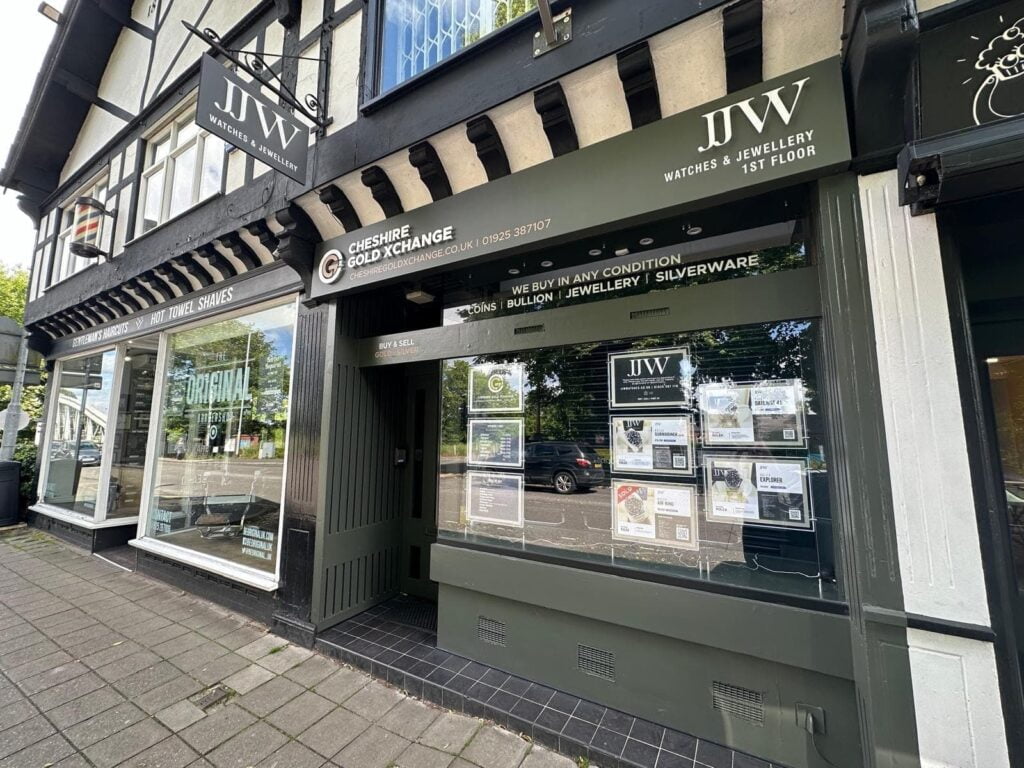
The heist will echo in high street and flagship security. Mixed-use streets with scaffolds, pop-up works, and deliveries create visual noise that offenders can use. Boutique managers should maintain a renovation register for their block, not just their own unit. When scaffolding appears, increase door staffing, vary opening routines, and review sightlines from the cash desk to the entrance. If you sell luxury watches, apply the same layered thinking. Secure cases to structure, not just flooring. Protect winding rooms and after-sales desks where high-value pieces cluster. Ensure your website, which drives footfall for Rolex, Patek Philippe and comparable brands, mirrors in-store diligence by removing staff names, travel times and predictable patterns from public pages.
Paris In Context How This Heist Compares
Paris has seen headline robberies before, from Place Vendôme smash and grabs to the Harry Winston case in 2008. Those events often used weapons and intimidation. The Louvre incident took a quieter path, using construction cover to bypass confrontation. It shares elements with the Dresden Green Vault burglary in 2019, especially the speed and window entry, and with organised networks known for meticulous scouting. The takeaway is that threat actors learn from each other. They copy working patterns, refine them, and look for similar building seams in other cities.
Practical Risk Controls For 2025 Buyers
Affluent clients purchasing heirloom-level jewels can bring museum-grade thinking into private life without turning homes into fortresses.
At Home. Place a safe in a concealed, structurally anchored location. Connect to a monitored alarm with cellular backup. Install discrete cameras with privacy-friendly zones. Keep cases and travel packaging out of casual sightlines.
On The Wrist Or Neck. Vary routines. Avoid predictable social posts that timestamp locations with recognisable pieces. For luxury watches, fit quick-change straps for neutral looks during travel and keep original bracelets for controlled use.
In The Paperwork. Maintain current valuations and schedule updates with your insurer every 12 to 24 months. Ask for conditions in writing and keep evidence of compliance. Photograph stones and settings after each resize, claw retip or polish.
In The Safe Deposit. For items worn rarely, split storage across two institutions to reduce single-point exposure. Keep an inventory with images and last seen dates. Share it with one trusted person and your broker.
Buyer Confidence Why Documentation Drives Value
Strong documentation increases liquidity and confidence at resale. It supports fair pricing, accelerates due diligence, and can lift the achievable price band. For diamonds, consistent diamond certification reduces dispute risk and improves buyer comfort with lab-grown diamonds versus natural stones when that comparison arises. For coloured stones, origin evidence and reputable reports narrow uncertainty around heat, clarity enhancement and diffusion. For signed jewellery, original boxes, hand-drawn designs and archive extracts complete the story buyers want.
Curatorial Balance Public Access And Protection
Museums must hold two truths at once. Public access is the mission. Protection is the duty. The answer is dynamic risk management. That means constant reassessment during building works, temporary barriers that move with the project, and staffing models that reflect the visitor curve. It also means resisting the “marquee effect” where flagship works receive every resource while other treasures remain vulnerable. The Galerie d’Apollon shows how quickly a gap can be found. The fix is not to close the doors. It is to design security that adapts faster than the offender’s creativity.
What This Means For Searchers Of Rings And Watches
People searching for the best engagement rings, diamond rings London, emerald engagement ring, antique jewellery, or pre-owned luxury watches are also searching for assurance. The lesson from the Louvre is that assurance is built before purchase. Choose retailers who publish security credentials, who use independent grading, and who will document your piece properly. Ask how they secure items after hours. Ask to see the workshop protocols that protect your ring during resize. These questions are part of modern luxury service.
Conclusion Protecting Beauty And History In Plain Sight
The Louvre case is a watershed. It shows that the most famous museum on earth can be hit in minutes by offenders who used ordinary city equipment and a temporary building seam to devastating effect. For institutions, this is a call to rebalance security and invest in dynamic layers that follow construction and crowds. For insurers, it is a prompt to link cover to verifiable controls and current values. For jewellers, collectors and luxury buyers, it is a reminder that documentation, storage and procedure safeguard beauty as much as money does. In the trade, as in life, forewarned is forearmed.