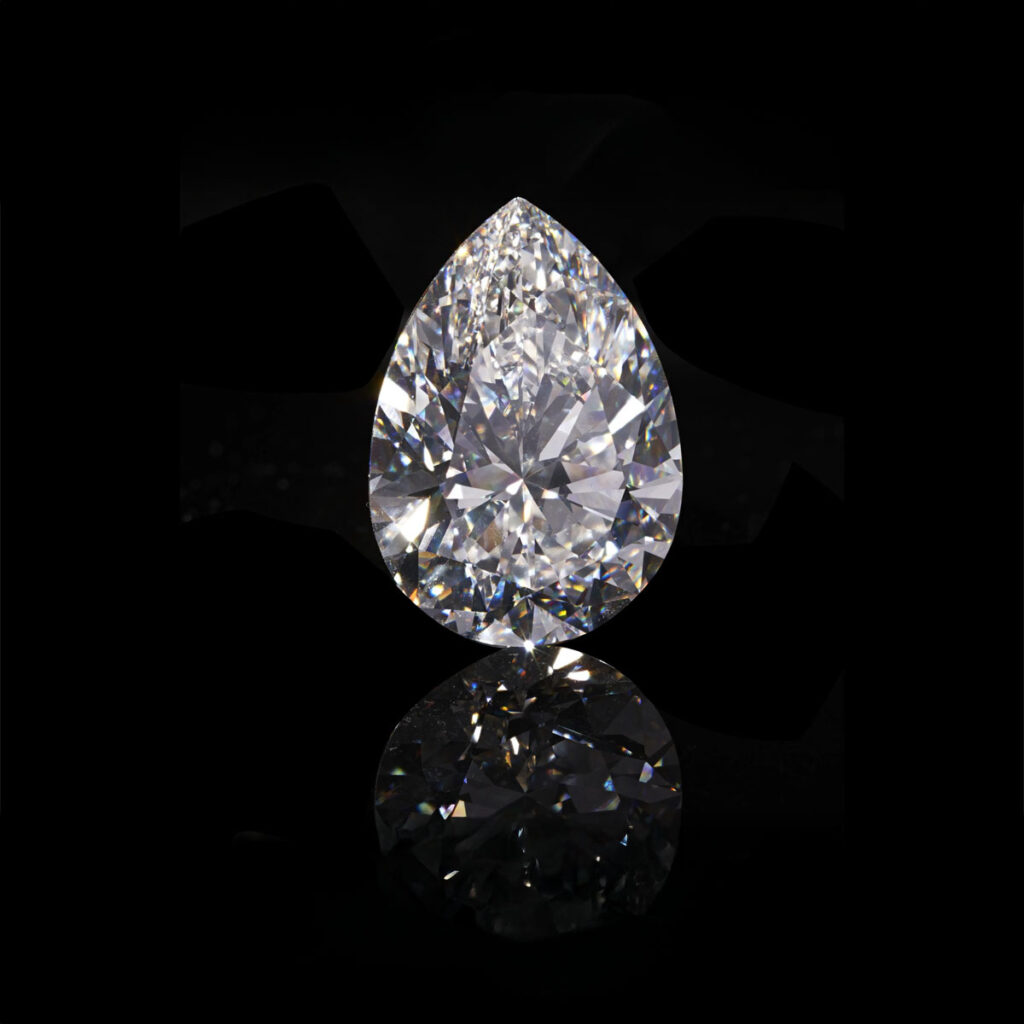
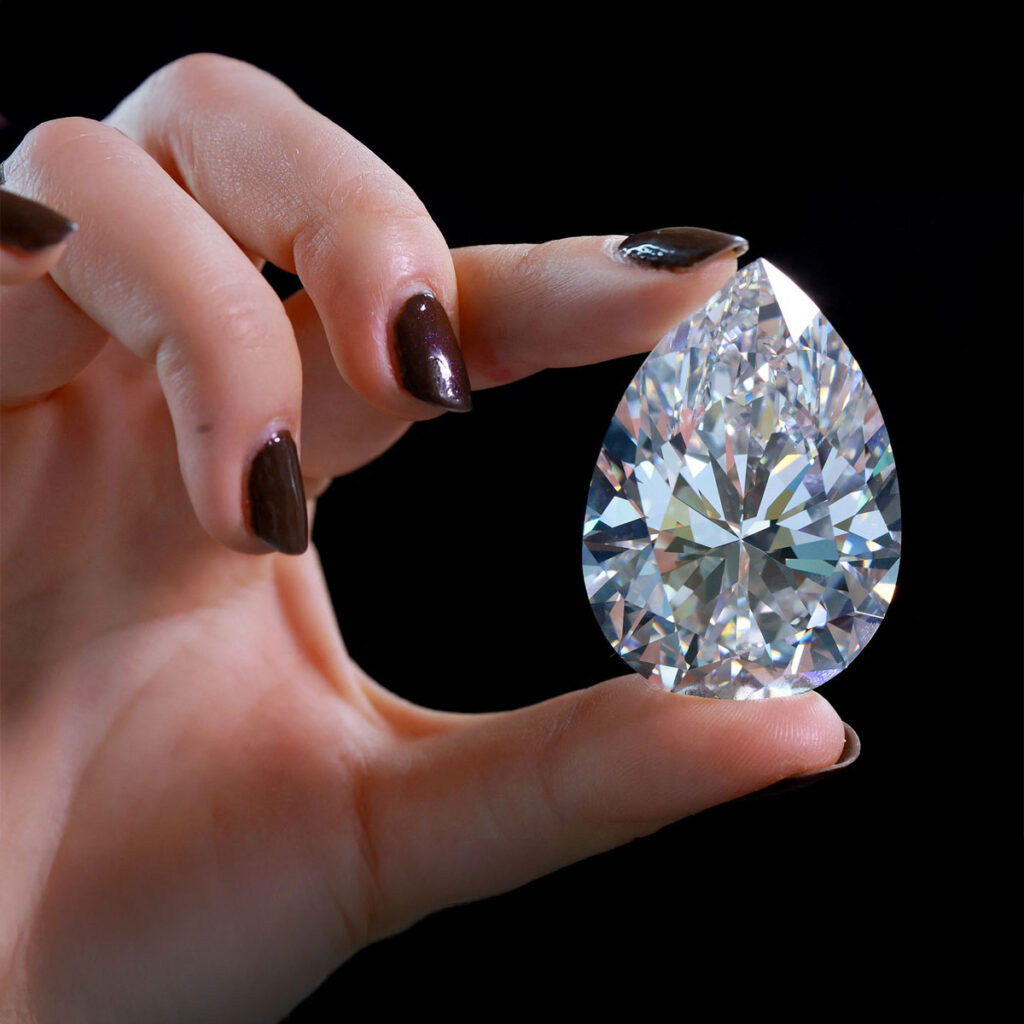
When a diamond weighing more than 228 carats appears on the open market, it doesn’t just make headlines—it reshapes them. Known simply as “The Rock,” this extraordinary pear-shaped gemstone captivated collectors, industry veterans, and auction watchers across the globe. And no, before you ask—it’s not Dwayne Johnson making a surprise cameo at Christie’s. At 228.31 carats, this geological marvel became the largest white diamond ever sold at public auction, earning its place in the upper echelons of gemological history. Far from being just another rare stone, its arrival at Christie’s Geneva in May 2022 turned into a cultural event, one that went well beyond the typical parameters of a luxury sale.
The auction wasn’t merely about price. It was about perception, provenance, and prestige. A diamond of this magnitude offered an unmatched window into the dynamics of the global luxury jewellery market, and for serious collectors, it was the opportunity of a generation. The sheer size—described by some as larger than a golf ball—combined with its Christie’s pedigree, guaranteed “The Rock” would not only draw attention but also provoke debate about how rarity is defined, priced, and valued in today’s ultra-high-net-worth circles.
Its significance lies not only in its weight but in its public presentation. Larger diamonds do exist, most notably the Cullinan I, housed in the British Crown Jewels, but they’ve never faced the transparency of an open auction. “The Rock” did. And in doing so, it set a benchmark for future giants yet to be uncovered or released from private vaults.
The Anatomy of an Exceptional Diamond
A diamond’s value is rarely about one factor. The intersection of many: size, clarity, colour, shape, and polish determines its status. In the case of “The Rock,” nearly every detail elevated it to elite standing.
Weight and Cut: Magnitude Meets Elegance
At 228.31 carats, “The Rock” ranks among the top ten largest white diamonds ever recorded. Its pear brilliant-cut combines the elegance of a round with the elongation of a marquise, giving the stone a teardrop silhouette that sparkles with intensity. This shape not only flatters the finger when set in a ring but also maximises brilliance through precise faceting.
The GIA’s report confirmed the diamond’s excellent polish and symmetry, which are vital in delivering the kind of light performance that separates extraordinary diamonds from the merely beautiful.
Colour Grade: G – A Near-Perfect Balance
Graded G on the GIA D-to-Z scale, “The Rock” falls within the “near colourless” range. While not at the icy apex of D colour diamonds, G offers a striking whiteness to the unaided eye. In large stones, even the subtlest hue becomes more visible, so a G rating in a diamond this size is both rare and impressive.
A lesser-known nuance: G colour is the highest achievable grade within the near-colourless category, making it a prime choice for those seeking optimal beauty without venturing into the ultra-premium D–F pricing tier.
Clarity: VS1 – Crystal Clean at Scale
Clarity is often sacrificed when size is this substantial. Yet “The Rock” achieved VS1 clarity, meaning its inclusions are so slight that they are barely visible even under 10x magnification. In a diamond of over 200 carats, this clarity is exceptional. The likelihood of imperfections increases with carat size, making a VS1 grade at this scale an engineering marvel of nature.
Certification and Prestige
Alongside its primary grading report, the GIA issued a separate letter of significance, identifying “The Rock” as the largest D-to-Z colour range pear-shaped diamond ever assessed by the laboratory. It’s a subtle yet powerful endorsement—one that underscores not only the stone’s dimensions but also its distinction in the global gemological record.
Fun Fact: A polished diamond of this size must start from a rough crystal likely weighing over 400 carats. Planning and cutting such a stone can take several months, and a single mistake could render the piece unsellable.
From Earth’s Core to International Showrooms
Every diamond tells a story that begins deep below the Earth’s crust. For “The Rock,” that journey began in South Africa, a country long associated with diamond lore—from the discovery of the Eureka Diamond to the monumental Cullinan.
Though details about the specific mine remain elusive, it is known that the diamond was both discovered and cut around the year 2000. South African cutters, whose expertise in handling high-value roughs is world-renowned, shaped the stone into the dazzling pear brilliant form we see today. That the identity of the cutter remains unknown is not unusual in the diamond trade—especially when discretion can protect both the artist and the eventual owner.
For more than two decades, “The Rock” was held in private hands, away from public view. Its owner, believed to be a North American collector, had the diamond mounted into a Cartier platinum pendant, adding a further layer of desirability. Cartier’s involvement doesn’t just signify luxury—it authenticates the piece’s importance in high jewellery culture.
A Calculated Introduction to the Market
Before it took the stage in Geneva, “The Rock” went on a world tour worthy of a priceless treasure. Its stops—Dubai, Taipei, New York, and finally Switzerland—were strategic. These are not just cities; they’re wealth hubs, each with a concentrated community of collectors and luxury investors.
The pre-auction viewings weren’t merely promotional. They were invitations. By offering direct access to potential bidders across continents, Christie’s maximised exposure and built international anticipation. It was a marketing campaign that played to the psychology of rarity: this is your chance, and it may never come again.
Such touring isn’t just reserved for artwork or royal relics. In today’s climate, jewels of this magnitude are positioned as alternative assets—portable, tangible, and emotionally charged. For many collectors, they are not just decorative objects but investments with enduring prestige.
Under the Hammer: Geneva 2022
When “The Rock” finally reached the auction block at Christie’s Geneva on 11 May 2022, it did so as the centrepiece of the Magnificent Jewels sale, an event known for setting records and drawing global attention.
The bidding opened at CHF 14 million, with the final price reaching CHF 21,681,000, or roughly $21.9 million. While this fell within the expected range, it did not surpass the high estimate, leading some observers to question whether the market had fully recognised the diamond’s scale and rarity.
Yet within its own category—white diamonds sold at auction—this was an unprecedented moment. It set a new benchmark by carat weight and highlighted the shifting dynamics of wealth, collecting, and market psychology.
Anonymity and International Appeal
The winning bidder participated via telephone, and their identity remains undisclosed—a common occurrence in high-value sales. What was unusual, however, was the demographic breadth of the event. Christie’s reported that 50% of new registrants were millennial buyers, a telling sign of how a younger generation is beginning to influence the upper tier of luxury asset markets.
Buyers from 20 countries across four continents participated, underscoring the truly global appeal of this singular diamond. Its sale wasn’t just about one collector’s ambition; it was a reflection of international fascination with rare tangible assets in an age of digital intangibility.
Measuring Against the Greats: Where The Rock Stands
To place “The Rock” in proper context, it’s essential to measure it against other diamonds of historic calibre. While its record-breaking weight at auction made headlines, value in the diamond world is shaped not just by size but by a combination of quality, rarity, and backstory.
The Rock vs. Auction Titans
- The Art of de Grisogono, Creation I (163.41 carats, D colour, Flawless clarity): Sold for $33.7 million in 2017. Though smaller, its perfect grading and incorporation into a bespoke necklace elevated its price beyond that of “The Rock.”
- The Winston Legacy (101.73 carats, D colour, Flawless): Sold in 2013 for $26.7 million. Despite being less than half the size, its top-tier grading fetched a much higher price per carat.
- The Cullinan I (530.4 carats): While never sold, this D-Flawless diamond remains the largest clear-cut diamond in existence. It is set in the British Sovereign’s Sceptre and is deemed priceless.
These comparisons demonstrate a key reality in the ultra-rare diamond market: D-Flawless quality commands immense premiums. “The Rock,” at G/VS1, offered remarkable size with high—but not ultimate—grading, positioning it within a more accessible tier for billionaires rather than oligarchs.
Colour vs. Character: The Rise of Fancy Colour Diamonds
While massive white diamonds garner admiration, the upper echelon of diamond pricing is often dominated by fancy colour stones. Vivid pinks and blues, especially those with natural saturation, have achieved astronomical figures at auction.
- The Williamson Pink Star: 11.15 carats, sold for $57.7 million.
- The Oppenheimer Blue: 14.62 carats, achieved $57.5 million.
Even the Red Cross Diamond, a 205.07-carat Fancy Intense Yellow sold during the same 2022 Geneva auction as “The Rock,” fetched CHF 14.18 million. These results show that colour, when combined with rarity and history, can surpass even the mightiest white diamonds.
However, “The Rock” retains its unique position: the largest white diamond to be offered and sold at public auction. This distinction, while specific, is both defensible and significant in the world of investment-grade jewels.
Why “The Rock” Matters
Beyond its numerical achievements and auction theatre, “The Rock” holds broader implications for the jewellery world and for cultural perceptions of wealth.
Geological Rarity
Natural diamonds over 200 carats are geological anomalies. Many are believed to originate deep within the Earth’s mantle, forming under immense pressure and emerging through volcanic eruptions over billions of years. Achieving high clarity and near-colourless grading in such large stones is even more improbable.
Cultural Symbolism
Large diamonds have always been totems of wealth, permanence, and power. “The Rock” exemplifies this with:
- Opulence: Its size alone marks it as a trophy stone.
- Purity: Despite not being D-colour, its brilliance and VS1 clarity offer a striking impression of cleanliness.
- Legacy: As a certified record-holder, it enters the historical canon of celebrated gems.
- Status: Its name, simplicity itself—The Rock—invites comparison with other iconic diamonds such as The Hope, The Regent, and The Star of the South.
Its sale during a week that also featured the record-setting auction of Warhol’s “Shot Sage Blue Marilyn” highlighted a crucial curatorial move by Christie’s: positioning “The Rock” as not just a gem, but a work of art, a collectible on par with museum-grade masterpieces.
Reading the Market: What “The Rock” Tells Us
The CHF 21.7 million result placed “The Rock” squarely within expectations, but below speculative highs. A few key observations help explain this:
- Grading matters: D-Flawless diamonds will always command higher per-carat prices.
- Capital constraints: Buying a diamond this size is a multi-million-pound decision, one few are in a position to act on, even among the ultra-rich.
- Strategic positioning: G/VS1 grading may have widened its buyer pool slightly—making it appealing to those seeking size without absolute perfection.
Christie’s confidence in the diamond was demonstrated by its minimum price guarantee, a financial assurance offered to the seller regardless of final bid. Such guarantees are only offered to consignments deemed especially desirable or historic.
Demographic Shifts and the Rise of Younger Collectors
Perhaps the most striking outcome of the sale was the demographic makeup of new bidders. With 50% of new registrations coming from millennial collectors, the traditional high jewellery market appears to be undergoing a generational shift.
For younger ultra-wealthy buyers, diamonds may represent a form of portable legacy asset—part art, part investment, and part personal branding. Auction houses are already adapting their marketing to suit this digitally fluent demographic, emphasising provenance, rarity, and certification over more traditional social cues.
Investment Potential: Trophy Stones as Tangible Assets
There’s growing recognition of large, certified natural diamonds as alternative investments, not unlike fine art or classic cars. They combine:
- High value density: Easily transported, yet worth millions.
- Intrinsic rarity: Cannot be manufactured or reproduced naturally.
- Stability: Resistant to inflation and currency fluctuation.
Lab-grown diamonds, despite their increasing presence in the general market, have not impacted the investment value of stones like “The Rock.” The distinction lies in natural origin and geological history. No matter how identical the lab-grown version might appear chemically, it lacks the gravitas and mystique of a billion-year formation.
A Lasting Legacy
“The Rock” may not have achieved the highest per-carat price or the most breathless pre-sale buzz, but its legacy is cemented. It is now a market benchmark for near-colourless diamonds above 200 carats. Future stones in this category will inevitably be compared to it—in both scale and auction performance.
Its journey, from the depths of South Africa to the illuminated halls of Christie’s Geneva, encapsulates everything that makes rare diamonds compelling: mystery, magnificence, and meaning.
Whether another will emerge to challenge its title remains unknown. But for now, “The Rock” stands not only as a geological marvel but also as a reflection of our ongoing fascination with what lies beneath the Earth—and what we choose to prize most above it.