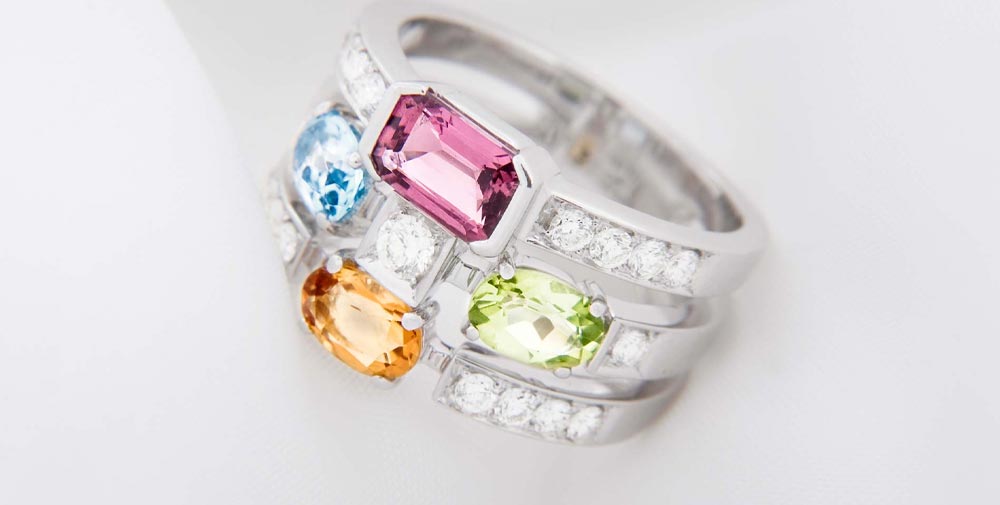
There is a particular confidence in walking into a jeweller’s studio with nothing more than an idea. A colour that has stayed with you for years. A gemstone seen once in a magazine and never forgotten. The outline of a design sketched on a phone screen at midnight. Bespoke dress rings are where those private instincts become fine jewellery, built to specification, worn on your terms, and owned in the truest sense of the word.
Unlike an engagement ring or wedding band, a bespoke dress ring carries no ceremonial obligation. It is chosen for the right hand as an act of pure self-expression, and that freedom changes everything about how it is designed. At Smith and Green Jewellers in Hatton Garden, the commissioning process begins with exactly that freedom. The brief can be as detailed or as open as the client brings it. What matters is that every decision, from the choice of precious metal to the final stone-setting sequence, reflects the person who will wear it.
The UK fine jewellery market is forecast to reach approximately £7.8 billion in 2025, driven in part by growing demand for custom jewellery London buyers are commissioning rather than selecting from stock. Understanding what the bespoke process genuinely involves is the clearest path to a piece you will wear for the rest of your life.
What Is a Bespoke Dress Ring and Why Does It Matter
A bespoke dress ring is a ring designed and made from scratch to the specific requirements of a single client. It is not a modified stock piece. Every element, the metal, the stone selection, the profile of the band, the setting style, and the surface finish, is chosen deliberately and built by a skilled bench jeweller from raw materials.
The distinction from a ceremonial ring matters practically as well as aesthetically. A dress ring worn on the right hand is freed from the conventions that govern engagement and wedding jewellery. There is no expectation around stone type, colour, or scale. A buyer seeking a bespoke sapphire ring in a wide 18ct yellow gold band can have exactly that. Someone drawn to a cluster of cognac diamonds in a low-profile bezel setting can commission precisely that piece. The latitude is genuine, and a skilled maker works to it fully.
The term bespoke is used loosely in the jewellery trade, so it is worth understanding what it means at the level of a serious commission. A truly bespoke piece involves consultation, original sketching, CAD (computer-aided design) rendering for proportion review, wax or resin model approval, casting in precious metal, hand-finishing by the bench jeweller, and then stone setting by a master setter. The piece exists nowhere until it is made for you.
Which Gemstones Work Best in a Bespoke Dress Ring
The single most consequential decision in a bespoke gemstone ring commission is the choice of centre stone, because the stone determines the light character, the colour story, and ultimately the profile of the finished piece.
Sapphires remain the most requested coloured stone for dress ring commissions in 2025. Their hardness of 9 on the Mohs scale makes them well suited to everyday wear, and the range of natural colours extends far beyond the classic cornflower blue to include padparadscha, teal, violet, and pale pink varieties. A Ceylonese or Madagascan sapphire in a claw or collet setting with a clean 18ct gold band is a combination that has remained consistently strong in London’s independent ateliers throughout this year.
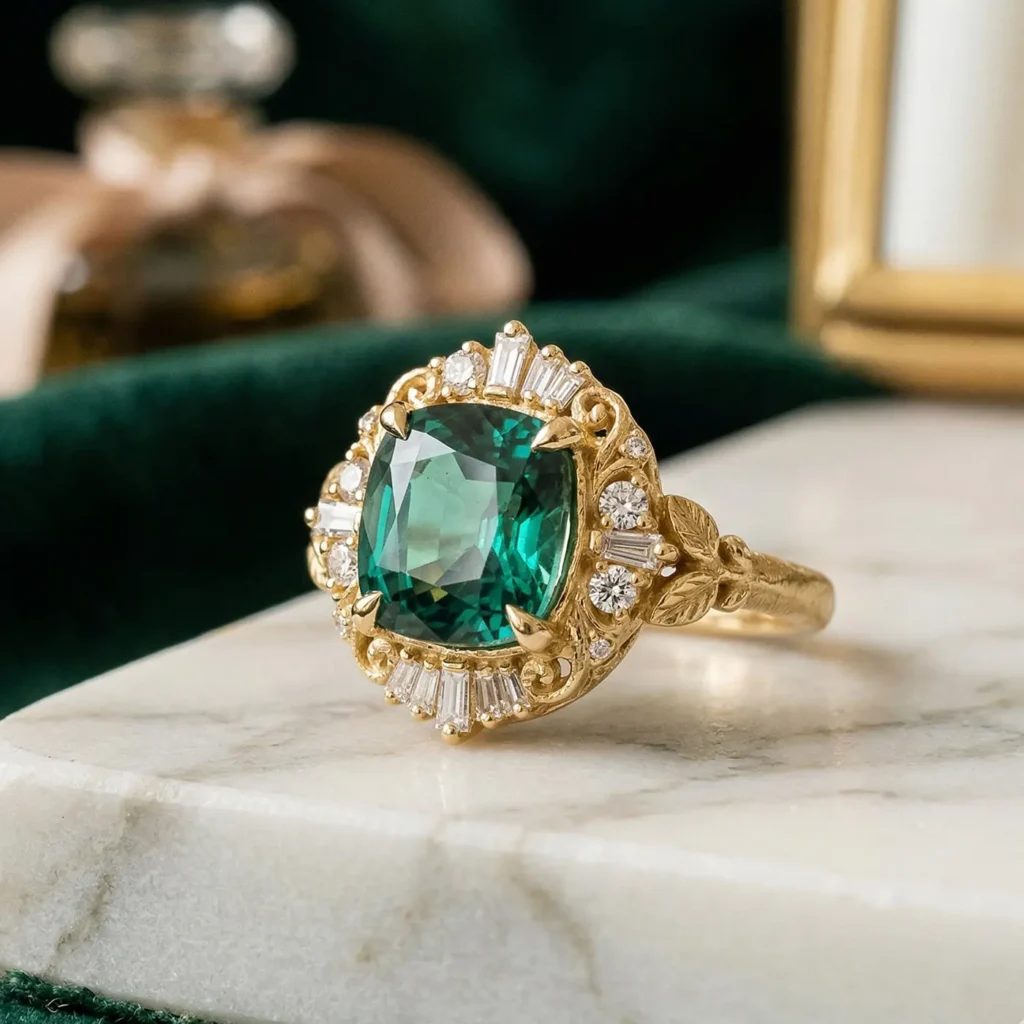
Emeralds carry a different logic. Their natural inclusions, known in the trade as jardin, are part of the stone’s character rather than flaws, and a well-chosen emerald in a bezel or four-claw setting in 18ct yellow gold produces a piece with genuine visual authority. Colombian emeralds remain the benchmark for prestige, though Zambian stones offer a deeper, cooler tone that suits certain design intentions better.
For buyers drawn to diamonds in a dress ring context, the 2025 preference runs clearly toward elongated cuts: oval, emerald cut, and marquise shapes in east-west settings, where the stone is laid horizontally across the band rather than pointing up the finger. This orientation is contemporary without being fleeting and suits a wide range of hand shapes. Cognac and champagne diamonds are also gaining ground as an alternative to colourless stones, particularly in yellow gold mounts where the warmth of the metal and the depth of the stone create a distinctive richness.
Lab-grown diamonds and sapphires are legitimate options at this level of the market. They offer identical optical and physical properties to natural stones, hold their London Assay Office hallmark status, and free up budget for a more complex setting or a heavier metal weight. Whether to choose natural or lab-grown is a decision the buyer makes on values and preference rather than quality alone.
Fun fact: The emerald cut was not originally designed for emeralds. It was developed in the Art Deco period of the 1920s as a step-cut shape that reduced pressure on the stone during the cutting process, and its long, open facets became associated with geometric sophistication rather than maximum brilliance.
How to Choose the Right Setting for a Statement Dress Ring
The setting is where the engineering and the aesthetic meet. A stone can be selected with great care and then undermined by a mount that neither holds it correctly nor suits its proportions. In a bespoke diamond dress ring or coloured stone commission, the setting conversation is as important as the stone conversation.
Claw settings remain the most optically effective for maximising light return in a faceted stone. A four-claw mount in 950 platinum or 18ct yellow gold lifts the stone away from the finger, allows light to enter the pavilion, and produces the sharpest brilliance. The number and profile of the claws changes the character considerably: fine, rounded claws read as delicate; heavier, square-profile claws give a more architectural quality. A collet setting, where a continuous metal collar holds the stone, suits round or oval shapes where a clean, uninterrupted silhouette is the priority.
Bezel and rub-over settings have been the most talked-about choice in 2025 across London’s independent jewellers. A bezel setting encases the full perimeter of the stone in a precise metal border, providing superior protection and a graphic, modern edge. For an active wearer, this offers a practical advantage without sacrificing visual quality. Partial bezels, which leave portions of the stone’s crown exposed, create a hybrid between the security of the full bezel and the brightness of an open-claw mount.
Pavé settings introduce a secondary visual logic to a dress ring. Where a large centre stone provides the primary impact, a pavé-set band or halo surround adds a layer of reflected light that changes how the ring reads under different conditions. Micro-pavé, using stones as small as 1 to 1.2mm, requires a master setter and adds meaningful cost, but the result is a surface that appears to dissolve into light rather than sit as a visible physical mount.
Metal choice binds the setting together. 18ct yellow gold has dominated London bespoke commissions in 2025 across all ring categories, with 950 platinum gaining ground for clients who prefer a white metal and want the density and durability that rhodium-plated white gold cannot match over time. Palladium remains a lighter, more affordable alternative to platinum for those with weight sensitivity. Under UK law, all precious metal rings above the minimum weight threshold must carry a hallmark from an approved Assay Office, such as the London Assay Office, confirming the metal’s fineness mark and sponsor’s mark.
What the Bespoke Dress Ring Commission Process Involves
Understanding the sequence of a commission removes uncertainty from what can feel like a significant investment decision.
The first consultation establishes the brief. A good jeweller will ask about your wearing habits, the style of clothing you typically pair with fine jewellery, your preference for bold or restrained scale, and your timeline. This is not a sales conversation. It is the information-gathering stage that shapes every decision downstream. At Hatton Garden jewellers with workshop access, this conversation typically happens alongside sample rings that you try on to calibrate size, height, and comfort against your hand.
Following the initial brief, the maker produces sketches and then a CAD rendering that shows the ring from multiple angles in a realistic three-dimensional view. This is the moment to interrogate proportion. A stone that reads elegantly on screen may sit higher off the finger than expected in reality; the CAD file allows for adjustments before any metal or stone costs are committed. A wax or resin model follows. Trying on the physical model gives a direct answer to questions of scale, comfort, and balance that no digital render can fully resolve.
Once the model is approved, the mount is cast in the specified precious metal using the lost-wax casting process. The bench jeweller then files, shapes, and cuts seats for the stones by hand before passing the mount to the setter. Stone setting is a separate specialism. A master setter positions each stone to maximise light return and security, checking bearing angles and seat depth against the specific dimensions of each stone. Final polishing proceeds through multiple stages before the hallmarked piece is delivered.
Bespoke dress ring commissions at London independents typically require 6 to 10 weeks from confirmed brief to delivery, though complex multi-stone pieces or designs requiring specialist engraving or grain-set pavé work can extend this timeline. Building in additional time before a specific occasion is straightforwardly advisable.
How Much Does a Bespoke Dress Ring Cost in London
Price transparency is a practical concern in any fine jewellery commission, and it is worth addressing directly. Bespoke jewellery London commissions carry costs that are genuinely different from buying a stock piece, and those differences have structural reasons. The design stage involves skilled time from a jeweller and a CAD technician. The model stage is a physical object made and potentially adjusted. Casting, bench work, and setting are each specialist processes with their own labour costs, separate from material costs. The hallmarking fee from the London Assay Office adds a small but real line item. None of this is inflated; it reflects the true cost of one-off craft production.
A bespoke sapphire ring in 18ct yellow gold with a quality natural stone in the 1 to 2 carat range, set in a clean claw or bezel mount, typically requires an investment that your chosen jeweller will quote precisely on consultation once the stone is selected. The variation between quotes at this level of the market reflects stone quality, complexity of the setting, and the jeweller’s overhead structure. Hatton Garden jewellers in the EC1N area operate with lower retail overheads than their equivalents near Bond Street or Burlington Arcade, which provides meaningful value without any compromise to stone quality or workshop standards.
It is worth asking directly about certification. Natural sapphires and coloured stones above a certain value benefit from a certificate from a recognised independent gemmological laboratory confirming origin, treatment status, and quality grade. Diamonds should carry a certificate from the GIA (Gemological Institute of America) or the IGI (International Gemmological Institute) to confirm cut, colour, clarity, and carat weight independently. These certificates protect value, support insurance valuation, and give the buyer objective information rather than the jeweller’s subjective assessment alone.
Where pricing is not published, which is common for bespoke commissions because every stone and setting combination is unique, the correct approach is to request a written quote following consultation. Any reputable jeweller in Hatton Garden EC1N will provide one without obligation.
Who Should Consider a Bespoke Dress Ring from Smith and Green Jewellers
A custom ring Hatton Garden commission is not only for experienced jewellery buyers. First-time buyers often find the bespoke process clarifying precisely because it requires decisions to be made explicitly rather than selected from pre-existing options. The process forces a useful conversation about what you actually want, and a skilled jeweller reads that conversation and reflects it back through the design.
Smith and Green Jewellers in Hatton Garden are known for their precision craftsmanship and commitment to ethical sourcing, qualities that carry direct relevance to a dress ring commission. Ethically sourced stones and responsibly smelted metals are not a premium addition at this level of the market; they are a baseline expectation that the best London independents meet as a matter of course.
The timing decision matters practically. London bespoke jewellers receive higher volumes of commission enquiries in the months before Valentine’s Day, Mother’s Day, and Christmas. Lead times extend during these periods, and stone availability in preferred sizes can tighten. Planning a commission with at least 10 to 12 weeks of clear lead time gives the process room to produce the best possible result. The reward for that planning is a ring that fits your hand, your intention, and your wearing life precisely.
Aftercare should be confirmed before completing a commission. A well-made dress ring in 18ct gold or platinum with properly set stones requires cleaning and an annual check to confirm setting integrity. The Consumer Rights Act 2015 applies to purchases made from UK retailers, and for high-value stones, an independent insurance valuation from a NAJ-accredited valuer within 6 months of purchase is a sound precaution.
The Right First Step Towards a Ring Made Entirely for You
A bespoke dress ring is one of the few fine jewellery purchases where the process itself is as rewarding as the finished piece. The decisions that feel difficult at the start, what stone, which metal, how bold, how restrained, resolve naturally once you are holding loose stones under a jeweller’s light and trying wax models against your hand. The result is a ring that fits your intention exactly, carries a London Assay Office hallmark confirming its metal and quality, and holds its value over time as a fully documented, certified piece.
For buyers considering a custom dress ring London commission, the clearest first step is an initial consultation with Smith and Green Jewellers in Hatton Garden, a short walk from Chancery Lane station on the Central line. Bring references, bring questions about stone certification, and ask to see loose stones in your preferred colour range against your skin in natural light. Ask about current lead times and request a written quote before committing. The consultation costs nothing and answers every question the process raises before a single decision is made.