Most people arrive at the idea of a bespoke ring before they arrive at the confidence to commission one. They have seen something a detail in a photograph, a setting style that does not exist in any ready-made collection and they know what they want is not sitting in a display case. Then the anxiety starts. How does this actually work? What am I agreeing to when I book an appointment? What if I change my mind halfway through? What if I cannot describe what I want clearly enough?
These are completely normal questions. The bespoke engagement ring process at Smith and Green is designed around them. It is a structured journey from first conversation to finished ring, with defined stages and real decision points where the client approves everything before production moves forward. There are no surprises. Here is exactly what happens.
The First Consultation: What to Bring and What to Expect
The first appointment is a conversation, not a commitment. At 9 Hatton Garden, EC1N 8AH easy to reach from Chancery Lane or from Farringdon on the Elizabeth line a specialist sits with you to understand two things: what you want the ring to look like, and how you will live in it.
Bring whatever you have. Screenshots from Instagram, a photograph of an heirloom piece, a sketch on the back of an envelope, or simply a sense of the feeling you are after vintage and romantic, modern and architectural, understated and wearable. All of it is useful. Nothing needs to be polished or precise.
The conversation will move naturally from aesthetic to practical. How is the ring going to be worn? Every day, without thought, through physical work and exercise? Or more carefully, for occasions and events? Are there lifestyle factors that affect setting choice active hands, a job that involves gloves or machinery, sensitivity to metal height? These questions shape the design recommendations that follow.
By the end of the first consultation, you will have a clearer sense of the design direction, a shortlist of stone types and setting options, and a realistic cost range. Nothing is agreed. Nothing is paid. The appointment is free.
Stone Selection: How the Right Diamond or Gemstone Is Found
Once the design direction is established, the stone search begins. At Smith and Green, this is not a matter of pointing at stones in a display case. For a bespoke commission, stones are sourced to match the specification a specific carat range, colour grade, clarity grade, and cut quality for a diamond; a specific colour, origin preference, and treatment status for a coloured stone.
The client sees the shortlisted stones in person, side by side if possible, in the controlled lighting of the Hatton Garden showroom. This is where the certificate becomes a supporting document rather than the primary evidence. The stone in front of you, in real light, is the thing you are buying. A G VS1 round brilliant that performs exceptionally under real lighting is worth more to the wearer than an F VVS2 that performs less well.
For clients choosing between a natural and a lab-grown diamond, both options are shown together where the brief allows it. The differences in face-up appearance are negligible the differences in price and sourcing are significant and worth discussing clearly. Smith and Green's team does not steer this decision. They explain it.
Fun fact: The lost-wax casting technique used in jewellery production today is essentially unchanged from the process used by goldsmiths in ancient Egypt over 5,000 years ago. The physics of wax burning away cleanly from a metal mould has not improved on itself.
The CAD Stage: Seeing Your Ring Before It Exists
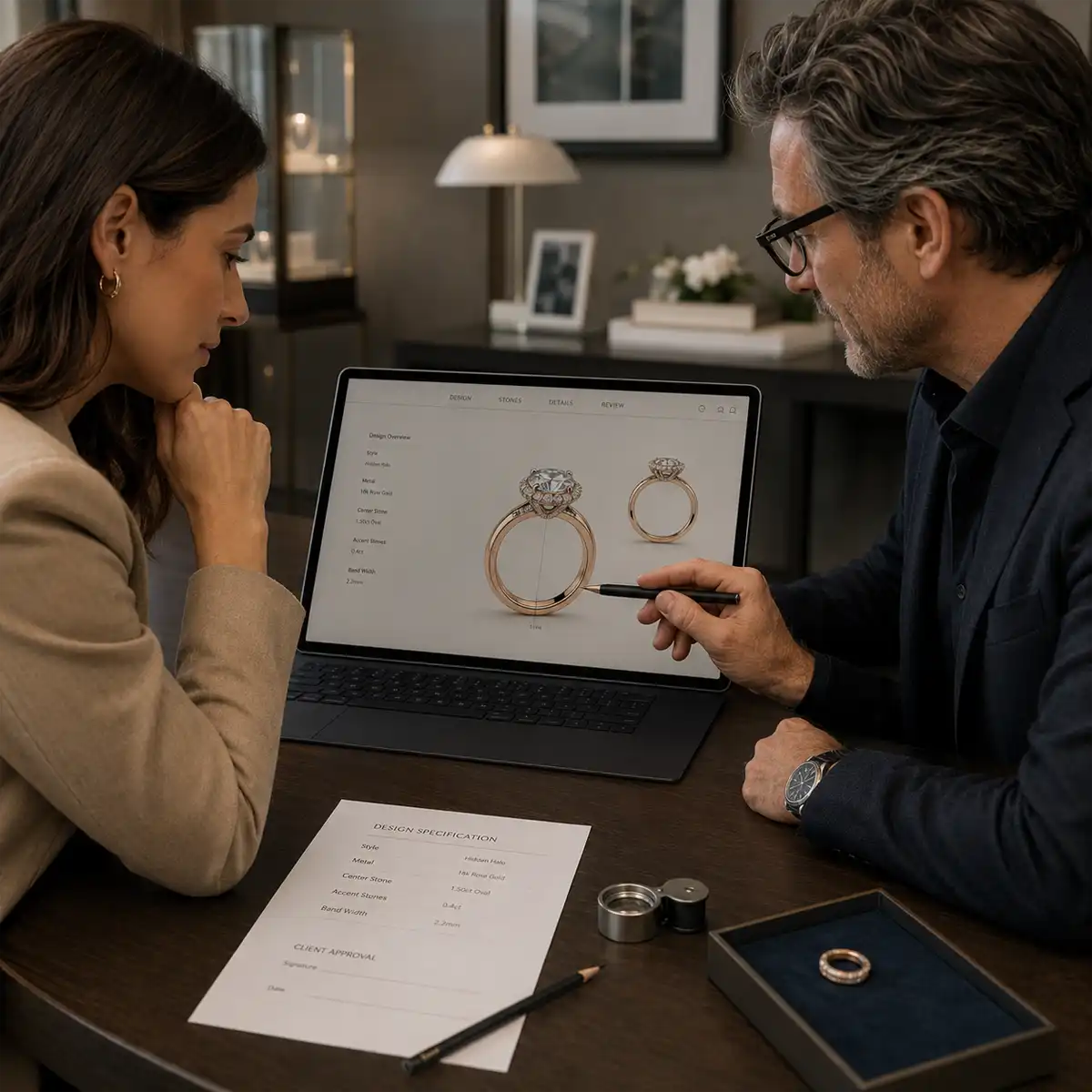
Once the stone is chosen and the design direction confirmed, the design is built in CAD (computer-aided design). You will receive accurate three-dimensional renderings of your ring from multiple angles top, side, three-quarter with precise measurements shown to the tenth of a millimetre.
This is where most clients are surprised. The CAD rendering is not an artist's impression. It is the exact specification of the ring that will be cast. Every dimension, every claw angle, every millimetre of band width and shoulder profile is visible and adjustable at this stage. If the shank feels too narrow in the rendering, it is widened. If the halo stones sit too high relative to the centre stone, the prong height is adjusted. Changes at the CAD stage cost nothing and take days, not weeks.
You will not approve a CAD you are not happy with. No production begins until you confirm the specification in writing.

From Approval to Casting: What Happens in the Workshop
Once the CAD is approved, the ring moves into production. The process follows a defined sequence: a wax model is produced from the CAD file, the wax is inspected against the specification, and then the lost-wax casting process is used to produce the metal form. The wax model is invested in a plaster-like material, the wax is burned away, and molten metal is cast into the cavity it leaves.
After casting, the ring is cleaned, inspected, and refined by hand. The stone is set a process that requires a skilled setter to work the metal carefully around the stone's girdle and pavilion without stress or movement. For pavé work, each small accent diamond is set individually. For a four-claw solitaire, the claws are adjusted to the exact stone and burnished to a clean, consistent height.
The finished ring is then polished and sent to the London Assay Office for hallmarking. The hallmark confirming metal purity, assay office, and year is struck into the inner shank. This is the legal confirmation of what you are receiving and the last independent check before the ring returns to Smith and Green.
Lead Times: Planning Around Your Proposal
The typical timeline for a bespoke commission at Smith and Green is four to eight weeks from stone approval to collection. Complex setting designs, rare stone sourcing, or production backlogs can extend this. Simpler commissions a round brilliant solitaire in a standard four-claw platinum setting with a straightforward stone can move faster.
The practical implication: if you have a proposal date in mind, work backwards. Allow eight weeks from first consultation to collection as your planning assumption. Allow twelve weeks if you are choosing a coloured stone that may need sourcing. Come in six months before your planned proposal date if you want to be certain and relaxed. Come in three months if you are comfortable with a tighter timeline.
If you have a fixed date and a tight window, say so at the first consultation. The team will tell you honestly whether the timeline is achievable and what design choices will keep the project on schedule.
What Aftercare Looks Like After Collection
A bespoke ring is a long-term relationship with a Hatton Garden jeweller. Smith and Green's aftercare services cover professional cleaning, prong checks, re-rhodiuming for white gold, resizing if your finger size changes, and remodelling if your taste or circumstances evolve years from now.
Ask for an independent insurance valuation at the point of collection or shortly after. The ring should be insured from the day you take it home. The purchase invoice and the grading certificate for the centre stone are the documents your insurer will ask for; the valuation provides the replacement value figure for the policy.
The workshop at Smith and Green's Hatton Garden premises handles all aftercare in-house. The people who made your ring are the people who service it. That is not a small thing.
Conclusion
The bespoke engagement ring process is less complicated than most people fear and more rewarding than most people expect. The first consultation is free and commits you to nothing. The CAD stage gives you complete visual control before a gram of metal is cast. Production is tracked and transparent. The finished ring is hallmarked, certified, and exactly what you approved.
Book your first appointment online or by calling Smith and Green directly. Come to Hatton Garden, EC1N, anytime Tuesday to Saturday. Bring your ideas in whatever form they exist. The conversation does the rest.
Continue Reading
The Hatton Gazette
Delivered weekly to your inbox
Join 12,000+ Hatton insiders