You already know the alternative. A flagship store on Oxford Street or Regent Street, bright lights, a trained sales associate in a pressed suit, a ring in a velvet tray that two thousand other people have looked at this month. It is not a bad experience. It is a perfectly competent one. The ring will be real, the certificate will be legitimate, and the box will be beautiful.
But you will pay a retail premium that funds the lease, the brand advertising, and the shareholder dividend. You will choose from a range that was designed by a committee for the broadest possible market. And when you walk out, there will be no meaningful ongoing relationship between you and the person who made the ring because that person is working in a factory in another country and has never heard your name.
Hatton Garden operates on a different model. It has done since the 14th century. Understanding why that model produces a better result for a serious engagement ring purchase is straightforward. Here it is.
The Pricing Structure Is Fundamentally Different
A high street jewellery retailer carries the full cost of a national property portfolio, above-the-line advertising, and a supply chain with multiple margins built in. Every stone that passes through a mine, a cutting centre, a wholesaler, a national distributor, and then a retail operation arrives at the counter having absorbed a margin at each stage.
An independent Hatton Garden jeweller like Smith and Green at 9 Hatton Garden, EC1N 8AH, operates a much shorter chain. Stones are sourced directly from the wholesale market that has existed in this postcode for generations. The margin between wholesale cost and retail price is transparent and discussed openly. When you sit down with Smith and Green's team for a consultation, they will tell you what the stone costs at the grade you are considering and how the setting, metal, and craftsmanship add to that figure.
This is not charity. It is a structural advantage. A buyer spending £5,000 on a diamond engagement ring in Hatton Garden will typically receive a materially better stone or setting than the same budget delivers in a branded high street environment.
The Expertise Is Not a Sales Script
A high street jewellery associate is trained. That training covers the brand's product range, the upsell structure, and the key messages from the marketing brief. It is not gemmological education. The person recommending a stone to you has probably never held a loupe or read a GIA grading report in detail.
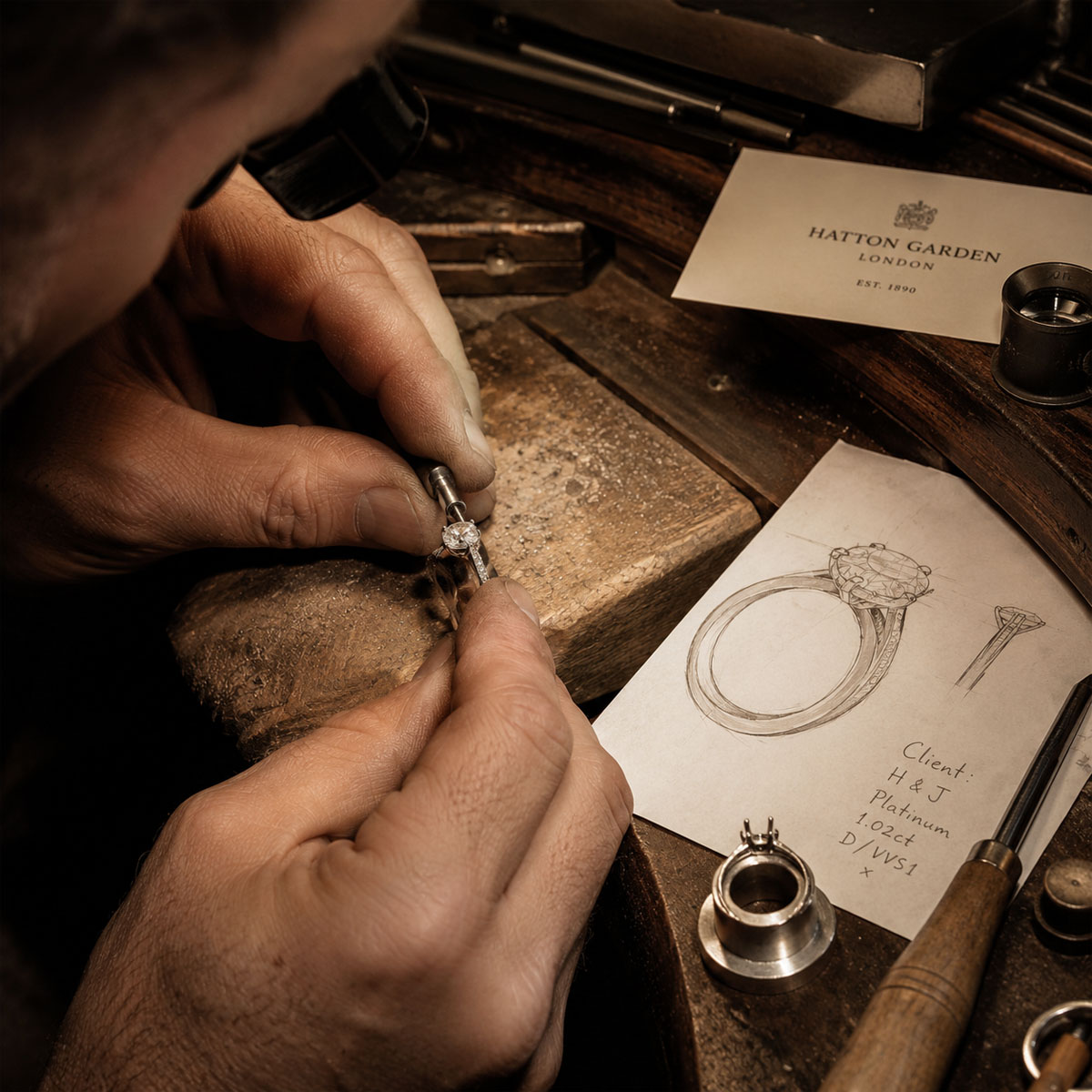
A Hatton Garden jeweller who has been working in EC1N for years has spent that time handling stones, reading certificates, understanding the difference between a well-cut stone and a technically graded one, and commissioning bespoke pieces for clients with specific, demanding briefs. The knowledge is practical, earned, and specific to what you actually need to know before spending significant money on a diamond. [INTERNAL LINK: what a bespoke consultation actually looks like | bespoke process article]
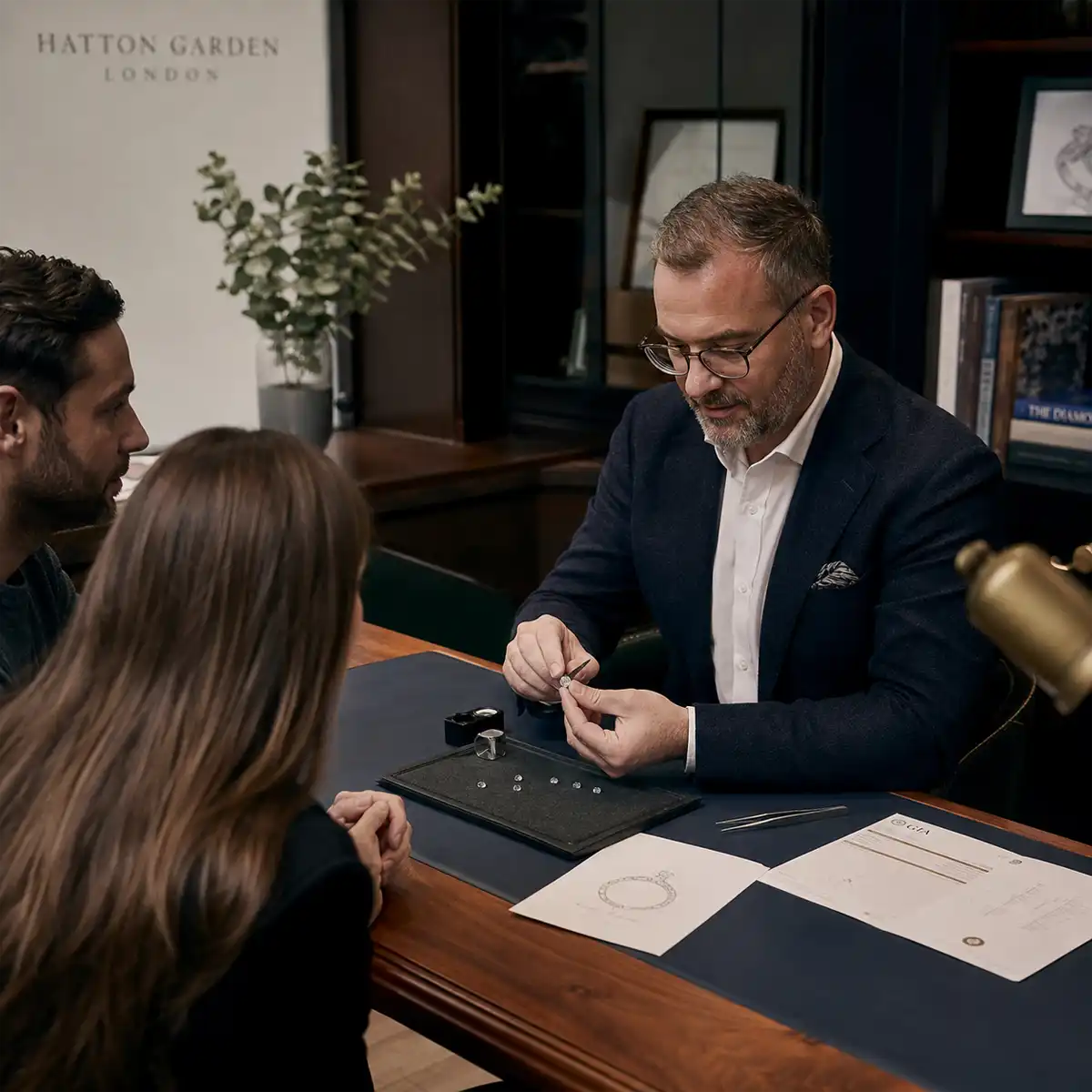
At Smith and Green, the consultation is not a tour of a display case with a price card attached. It is a conversation about what you want, what the options are, and what the trade-offs mean for your specific brief. That conversation does not happen in a high street store because the staff are not equipped to have it.
Customisation Is the Default, Not the Premium Option
At most high street retailers, bespoke or made-to-order is a premium-tier offering that adds cost, time, and complexity. The default is a ring from the existing range. The width, the claw style, the shoulder profile, the stone shape these are all fixed by the designer who created the range, not by you.
In Hatton Garden, customisation is the operating model. Smith and Green's workshop operating between Greville Street and Bleeding-Heart Yard in the heart of the EC1N jewellery quarter builds rings to specification as standard. If you want a round brilliant in an eight-claw setting on a cathedral shank in 950 platinum, that is what is made. If you want the same stone in a low-profile bezel on a flat comfort-fit band, that is made instead. The design is yours, not a catalogue entry you have selected from.
Fun fact: Hatton Garden takes its name from Sir Christopher Hatton, a favourite of Elizabeth I who occupied the original garden estate on this land in the 1570s. The jewellery trade arrived in the 19th century and has remained concentrated here ever since one of the longest-running specialist trades in any single London street.
The Certificate Conversation Happens Differently Here
In a high street store, the certificate if one is provided is typically presented as confirmation rather than subject to discussion. Here is the ring, here is the box, here is the certificate. The grades are stated. The conversation ends.
At a Hatton Garden independent, the certificate is a starting point. You will be shown the grading report and walked through the relevant fields. If you want to understand why a G VS1 performs as it does compared with an F VS2 at a higher price, that conversation is available. If you want to see the stone under magnification before buying it, that option is on the table. If the fluorescence entry on the report concerns you, it will be explained. [INTERNAL LINK: the metals high street retailers rarely stock properly | platinum vs white gold article]
This is not a minor courtesy. For a purchase of several thousand pounds, the ability to interrogate the evidence before committing is significant. High street retail does not offer it because the incentive structure does not support it.
The After-Sale Relationship Is Worth Considering Now
The engagement ring purchase is the beginning of a long-term relationship with a piece of jewellery. It will need prong checks. It may need resizing. The white gold will need re-rhodiuming. Decades from now, it might benefit from remodelling. You will need an insurance valuation.
A high street chain will handle basic servicing, but the relationship is transactional. The ring goes in, the service is performed to a standard, the ring comes out. There is no continuity of care and no knowledge of your specific ring's history.
At Smith and Green, the aftercare relationship is with the workshop that made the ring. The team knows the stone, the setting, the metal specification. When a prong needs rebuilding or the band needs sizing, the work is done by people who understand the original commission. That continuity has a practical value that is difficult to quantify but easy to feel when something goes wrong.
Who the High Street Actually Suits
Fairness requires this to be said: the high street suits some buyers very well. If you want a branded piece from a house whose aesthetic you have loved for years, the high street is the right place to buy it. If the ring is a lower-value piece where customisation and gemmological depth are less relevant, a reputable chain store is entirely appropriate. If you need the certainty of a nationally known name for a gift purchase with minimal personalisation, go there.
But if you are buying an engagement ring — a piece that will be worn every day for decades, that carries significant personal meaning and a significant budget, and that deserves to be exactly right rather than approximately right — Hatton Garden, and specifically an independent maker like Smith and Green, is the correct environment for that purchase.
Conclusion
Hatton Garden prices out better, customises by default, and provides expertise that high street retail cannot match at a structural level. The after-sale relationship is ongoing rather than transactional. The certificate conversation is open rather than closed. And the ring you collect is the ring you designed, not the ring the brand designed for a market it was trying to reach.
Book an appointment at 9 Hatton Garden, EC1N 8AH. Come via Chancery Lane or Farringdon. Bring your brief and your questions. The comparison will make itself.
Continue Reading
The Hatton Gazette
Delivered weekly to your inbox
Join 12,000+ Hatton insiders


