Most first-time diamond buyers arrive at a Hatton Garden workshop with a hierarchy of priorities in the wrong order. They have spent weeks reading about colour grades and clarity grades, they have memorised the difference between VS1 and VS2, and they believe they are ready to assess a stone on the 4Cs. Then the jeweller places two round brilliants side by side under daylight-balanced lighting. One is a 0.90 carat G-colour VS2 with an Excellent cut grade. The other is a 1.00 carat D-colour Internally Flawless with a Good cut grade. On paper, the second stone is dramatically superior. In person, the first stone is visibly more beautiful, and the buyer is confused by their own reaction.
That moment reframes the entire decision. Cut is the C that determines whether a diamond actually sparkles, and cut is the C that consumer content covers least thoroughly. Hatton Garden sits in EC1N between Chancery Lane on the Central line and Farringdon on the Elizabeth line, and the quarter’s independent jewellers have been making this exact demonstration to buyers for decades. Walking from Greville Street to the northern end of Hatton Garden, any serious diamond dealer will show stones in natural light rather than the warm retail lighting that flatters weak cuts. The difference is measurable, and once a buyer has seen it, the way they read a grading report changes permanently.
What Cut Actually Means On A Grading Report
Cut on a GIA report is not the same as shape. Shape refers to the outline of the stone, round, brilliant, oval, cushion, emerald, pear, princess, marquise, and so on. Cut refers to the quality of the facet work, the proportions, the symmetry, and the polish that together determine how light behaves when it enters the stone and returns to the viewer’s eye. A well-cut diamond returns most of the light that enters it back through the crown, producing the brightness, fire, and scintillation that define a brilliant appearance. A poorly cut diamond leaks light through the pavilion or the girdle, appearing flat and lifeless even if colour and clarity are high.
GIA grades cut on round brilliants at five levels: Excellent, Very Good, Good, Fair, and Poor. The grade combines three measured factors. Proportions assess the angles and ratios of the crown and pavilion against established ideal models. Symmetry measures how precisely the facets align with each other and with the overall stone geometry. Polish assesses the surface finish of each facet under magnification. A stone graded Excellent across all three sub-categories is often marketed as Triple Excellent, and these stones represent roughly the top 3% of cut quality in the market.
Fancy shapes are not graded on cut by GIA in the same way. Ovals, cushions, pears, and other non-round shapes receive Polish and Symmetry grades but no overall Cut grade, because the geometry of these shapes does not lend itself to a single ideal proportion set. This creates a trade-level problem that buyers should understand: fancy shape cut quality must be assessed by eye rather than by report, and the burden of that assessment falls on the jeweller and the buyer rather than the grading laboratory.
Why Cut Drives More Visible Difference Than Colour Or Clarity
The trade rule that every Hatton Garden dealer will confirm is this. Spend the budget on cut first, size second, and colour and clarity third. The reason is not aesthetic preference. It is physics.
Light performance is the variable that makes a diamond look like a diamond rather than a piece of glass. When the cut is excellent, the stone returns bright white light back through the crown and disperses spectral colours across the full facet surface. When the cut is weak, the same rough stone produces a dull return that no colour grade or clarity grade can rescue. A D-colour Internally Flawless stone with Poor cut will look lifeless next to an H-colour SI1 stone with Excellent cut, and the reason is that cut governs the optical behaviour that defines the category.
Colour matters at the boundaries, but the visible difference between adjacent colour grades is subtle. A trained gemmologist can distinguish D, E, and F colourless grades under controlled lighting with the stone face down against a neutral background. Most buyers cannot distinguish these grades in a mounted stone under normal lighting conditions. The same is true of G, H, and I near-colourless grades. The pricing differential between D and H is meaningful, but the visual differential on a set stone in a yellow gold mount is minimal. Buyers who insist on D-colour in a yellow gold setting are paying for a grade that the setting itself masks.
Clarity operates similarly. The industry grades from Flawless through I3, with commercial-range stones typically falling between VVS1 and SI1. The question that actually matters for a buyer is not the grade but whether the inclusions are eye-visible under normal viewing conditions. A GIA report that plots inclusions as small crystals at the pavilion will often produce a stone that is eye-clean at arm’s length, even at SI1 grade, and a buyer who accepts SI1 for eye-clean performance rather than insisting on VS2 or higher can redirect significant budget toward cut quality or stone size.
What An Excellent Cut Actually Delivers In Person
A diamond with an Excellent cut grade produces three specific optical effects that a buyer can see and evaluate without specialist training. Brightness is the return of white light from the stone’s surface and interior. Fire is the dispersion of white light into spectral colours across the facets. Scintillation is the pattern of flashing light and dark as the stone moves relative to the viewer or the light source.
Brightness is the first and most important effect. In daylight-balanced lighting, a well-cut round brilliant returns a consistently bright appearance across the entire crown, with no dark areas or visible leakage through the pavilion. A buyer can check this by holding the stone at arm’s length and rotating it slowly; brightness should remain consistent through the rotation. If dark patches appear as the stone turns, the cut is compromised.
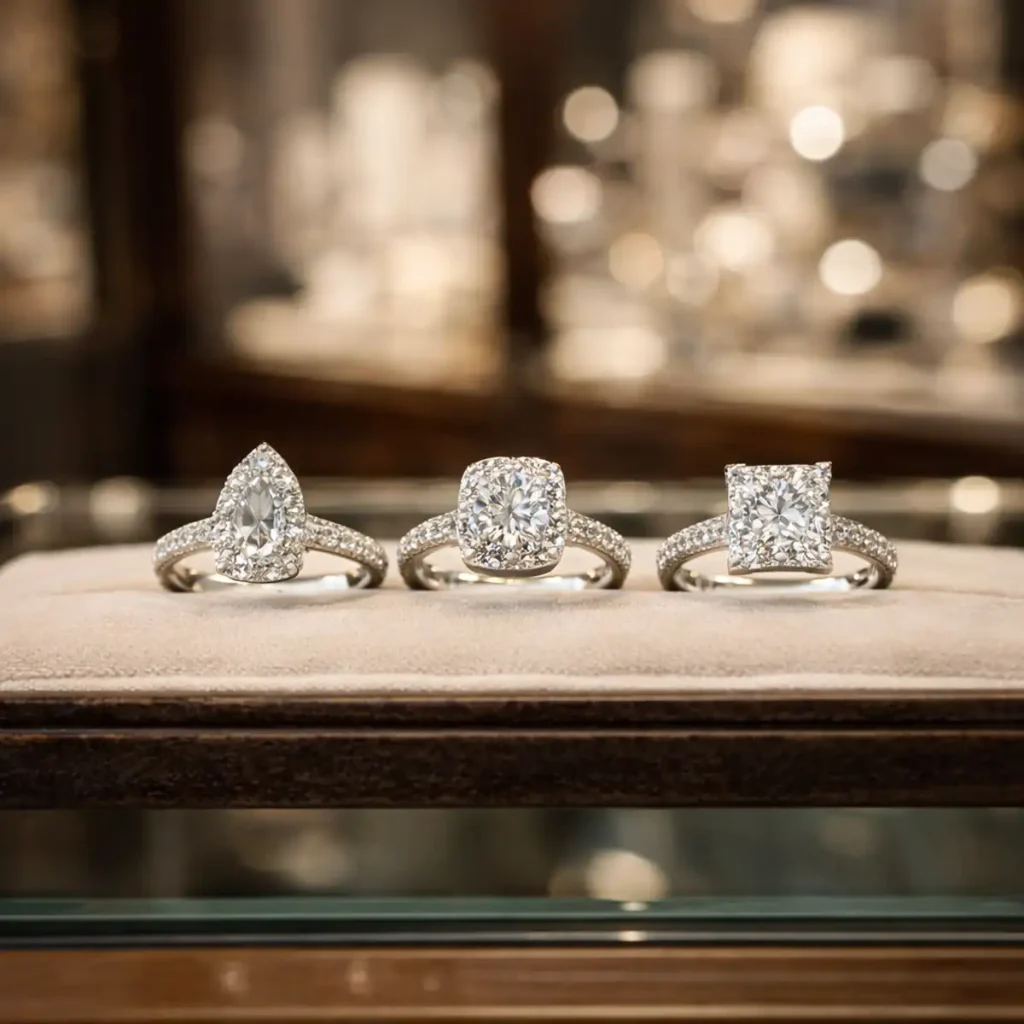
Fire is more dramatic but less consistent across lighting conditions. In direct sunlight or under spot lighting, a well-cut stone throws rainbow colours across a wide arc around the viewer. In diffuse indoor lighting, the fire is subtler and more contained within the facet pattern. Buyers assessing fire should do so under a mix of lighting conditions rather than relying on a single showroom environment.
Scintillation is the pattern of alternating bright flashes and contrasting dark facets as the stone moves. A well-cut round brilliant produces a balanced scintillation pattern with bright flashes of roughly uniform size, distributed evenly across the crown. A poorly cut stone produces either a muddled pattern with no clear contrast or a stark pattern with oversized dark areas that dominate the visual impression.
Fun fact: The modern round brilliant cut was mathematically optimised by Marcel Tolkowsky in his 1919 doctoral thesis at the University of London, and the ideal proportion set he derived remains the benchmark against which GIA Excellent cut grades are measured more than 100 years later, with only marginal refinements to the original calculations.
What Very Good And Good Cut Grades Actually Look Like
The practical question most Hatton Garden buyers face is not whether to buy Excellent cut but whether to trade down to Very Good cut and redirect the savings elsewhere. The answer depends on the specific stone, the setting, and the buyer’s priorities, and a trade perspective is more useful than a blanket rule.
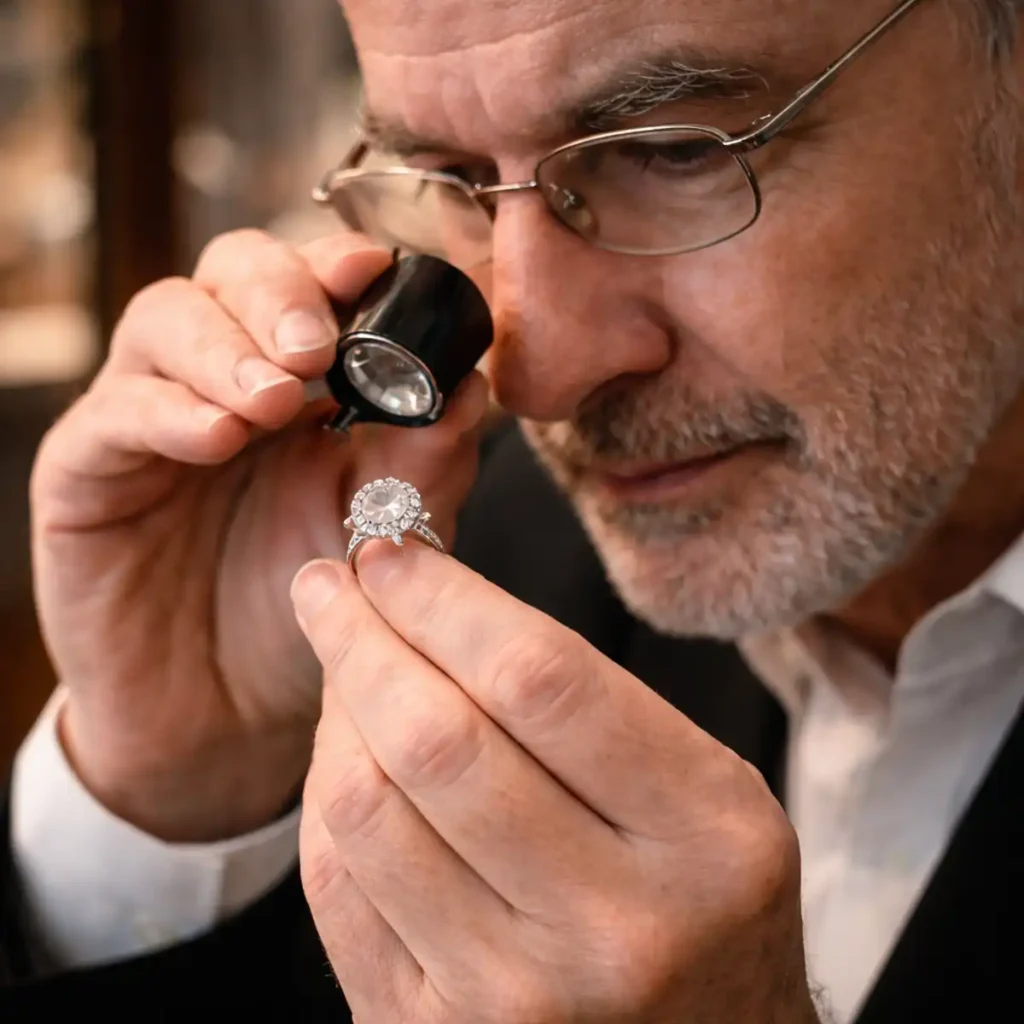
A very good cut on a round brilliant typically delivers 95% of the visible brightness of an Excellent cut under most lighting conditions, at a price reduction of 5% to 10% for an otherwise identical specification. For many buyers, trading Excellent for Very Good on a 1-carat stone saves enough budget to move from G colour to F colour, or from VS2 clarity to VS1, or to increase carat weight by 0.05 to 0.10 of a carat. A trained gemmologist can often identify the difference between Excellent and Very Good side by side under magnification, but the difference in casual viewing is subtle, and many buyers who see both stones under showroom conditions cannot reliably tell them apart without being told which is which.
Good cut introduces visible compromises. Light leakage becomes apparent in certain viewing angles, scintillation becomes less even, and the stone’s overall brightness drops perceptibly relative to a better-cut comparison stone. Good cut stones exist in the market and are sold legitimately, but a Hatton Garden jeweller will typically recommend against them for an engagement ring centre stone unless the buyer is working within a very constrained budget and has explicitly chosen to prioritise size or another factor over cut quality.
Fair and Poor cut stones should be avoided for engagement ring purposes at any price. These grades typically appear in the industrial or commercial stone market rather than in fine jewellery settings, and a reputable Hatton Garden dealer will not stock them for bridal work.
What To Ask The Jeweller About the Cut
The single most useful question a buyer can ask a Hatton Garden jeweller when comparing stones is this. Can I see this stone under daylight lighting, at arm’s length, with my eyes at roughly 30cm from the stone? The request sounds simple, but it reveals more about the stone than any report detail. Daylight-balanced lighting neutralises the warm showroom lighting that flatters weak cuts. Arm’s length removes the extreme close inspection under magnification that can obscure light performance. Normal viewing distance matches how the stone will actually be seen on a hand in real-world conditions. A jeweller who welcomes this request and has daylight lighting ready is a jeweller who is confident in the cut quality of their stones. A jeweller who resists or redirects the conversation toward certification papers or laboratory reports is signalling that the stones are better on paper than in person. Hatton Garden buyers who apply this single test during consultations across 3 or 4 independent workshops will develop a calibrated eye within a single afternoon, and the confidence that eye provides is worth more than any amount of online research. Ask to see stones loose before they are set, compare them side by side rather than sequentially, and prioritise the stones that look bright and alive under the light that will meet them on a real finger in real conditions rather than the stones that score best on paper