Anyone buying a diamond in Hatton Garden in 2026 will sooner or later be handed a grading report, usually from GIA or IGI, and asked to decide partly on the basis of what it says. The report looks authoritative. The grades look consistent. Yet the trade knows, and has known for 20 years, that grading is a human practice carried out by specific labs in specific ways, and that the difference between a GIA report and an IGI report on the same stone can be material at the point of purchase. The usual starting frame for the GIA vs IGI question is consumer-facing and tends to flatter IGI or dismiss it. Neither is useful to a buyer walking along Hatton Garden between Chancery Lane and Farringdon, 2 minutes from the Elizabeth line exit, trying to decide which report to trust on a stone worth several thousand pounds. The purpose here is to set out what each laboratory actually does, how Hatton Garden dealers use each report in practice, and where the grading gap matters for a real purchase decision.
What the GIA and IGI reports actually certify
A GIA report is issued by the Gemological Institute of America and grades a loose diamond on cut, colour, clarity, carat, polish and symmetry, with a plotted inclusion diagram for stones above 1 carat. An IGI report is issued by the International Gemological Institute and grades the same parameters with the same vocabulary. Both are third-party, non-vendor documents. The difference sits in grading consistency, lab location and trade reputation.
GIA was founded in 1931 and developed the 4Cs framework that every subsequent laboratory now uses. It operates major grading facilities in Carlsbad, New York, Mumbai, Antwerp, Bangkok and Hong Kong, and its reports for natural diamonds are the global benchmark for trading and auction. IGI was founded in 1975 in Antwerp and runs labs there alongside New York, Mumbai, Bangkok, Dubai, Tokyo and Shanghai. IGI is the primary grading body for lab-grown diamonds and issues the majority of reports for stones manufactured through CVD and HPHT processes. Both laboratories grade natural diamonds; both grade lab-grown.
Where the reports diverge is in grading rigour. GIA's internal cross-checking is performed by multiple independent graders, with final sign-off requiring consistency across their independent grades. The trade observation, accumulated over 2 decades of submitting the same stone to both labs, is that IGI grades tend to read 1 colour grade and 1 clarity grade softer than GIA on a like-for-like basis. The gap is not universal and has narrowed since IGI tightened its processes in 2024, but the directional pattern is consistent enough that Hatton Garden dealers’ price it into stock when they buy.
How Hatton Garden jewellers use each report in practice
Walk into any reputable Hatton Garden jeweller and ask to see a GIA-graded round brilliant of 1 carat, G colour, VS2 clarity, Excellent cut. You will be shown a stone, a paper report and a laser inscription on the girdle that matches the report number. The GIA report is treated as definitive for the stone's grade. A resale transaction between trade parties in the quarter, via the London Diamond Bourse or directly between dealers, will be priced off the GIA grade with very little discussion. GIA is the currency of the natural-diamond wholesale market.
Ask for the same stone with an IGI report and the conversation changes. The dealer will typically explain that the IGI grade may read slightly flattering compared with GIA, and will often quote a modest discount to the GIA-grade equivalent. This is not a criticism of IGI; it is the trade pricing in the observed grading gap. For natural diamonds, Hatton Garden jewellers generally recommend GIA over IGI for stones above 0.50 carat, because the resale and valuation market treats GIA as the reference. Below 0.50 carat the cost of the certification relative to the stone value shifts the calculation, and IGI is a reasonable choice.
For lab-grown diamonds the calculation inverts. IGI is the standard certification for lab-grown stones and covers roughly 80% to 90% of the lab-grown market. GIA does grade lab-grown diamonds, but its reports until recently used descriptive colour and clarity terms rather than the full grade scale, which the trade read as GIA signalling that lab-grown grading sits in a different tier. GIA introduced full grade-scale reports for lab-grown in 2023, and the trade response has been cautious adoption. In practice, a buyer choosing a lab-grown centre stone in Hatton Garden in 2026 will most often be shown an IGI report, and that is the appropriate certification for the product.
lab-grown diamonds in Hatton Garden
Where the grading gap matters for a real purchase decision
The practical question is this. If a GIA-graded G VS2 and an IGI-graded G VS2 sit side by side, how much should a buyer care about the difference? For a natural diamond intended as an engagement ring, the answer is that the buyer should care enough to either request GIA certification or to price in the grading gap at the point of purchase. A stone graded IGI-G may face-up equivalent to a GIA-H, and the price should reflect that. A reputable Hatton Garden jeweller will make this adjustment voluntarily; a less reputable one will not, and the buyer who asks the question protects themselves.
The gap narrows in several circumstances. On cut grade, both laboratories apply tight tolerances and a GIA-Excellent and an IGI-Excellent round brilliant typically perform equivalently face-up. On clarity at the top of the scale, IF and VVS1 grades are stable across both labs because there is less subjective judgement involved. On colour at the bottom of the scale, from K downward, the grading gap becomes less financially material because the price per colour step compresses. The gap matters most in the middle of the scale, from G to J on colour and from VS1 to SI1 on clarity, which is exactly the price band where most Hatton Garden engagement ring purchases sit.
A second factor is the fluorescence grade. Both laboratories record fluorescence on the report, and both recognise the same intensity grades from None through Very Strong. The gap here is in how the trade interprets the grade. GIA's internal research has been transparent about fluorescence typically having no visible face-up effect in most stones, including those graded Strong or Very Strong. IGI reports state the grade without commentary. Hatton Garden dealers, who see hundreds of fluorescent stones a year under proper lighting, tend to agree with the GIA research and price the Strong Blue fluorescence discount more conservatively than consumer-facing online content would suggest.
diamond fluorescence in the Hatton Garden trade
How the Hatton Garden trade verifies a report on the spot
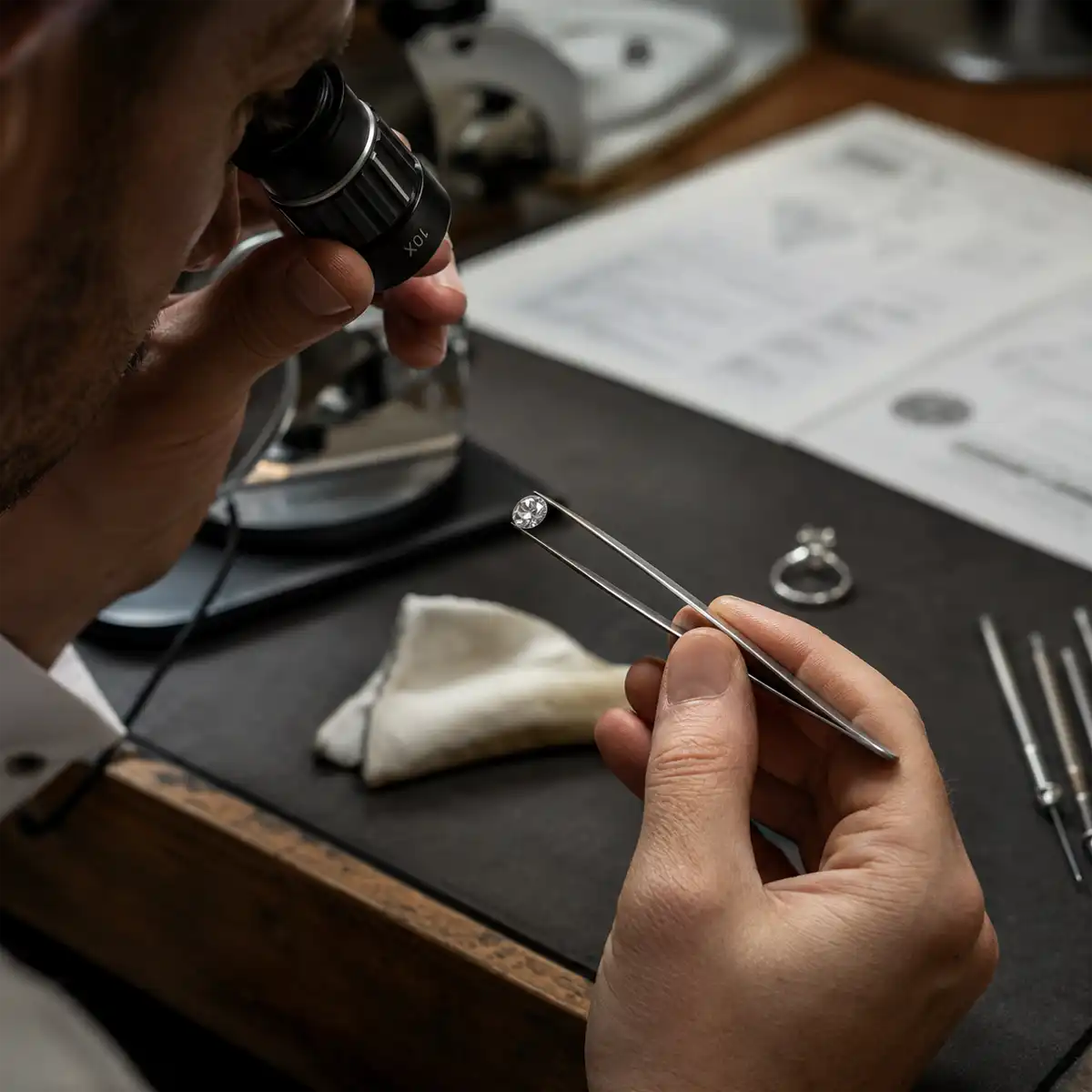
Both GIA and IGI laser-inscribe the girdle of the graded stone with the report number. A Hatton Garden jeweller will show the buyer the inscription under 10x magnification using a loupe or a microscope, confirming that the stone in hand matches the report in hand. This is the single most important verification step a first-time buyer can watch for, and any jeweller unwilling to demonstrate it on request is not a jeweller worth buying from. Both laboratories also offer online report verification through QR codes or report-number lookups, and the jeweller should be willing to pull up the record during the consultation.
For larger stones, above 1 carat, the plotted inclusion diagram on the report can be matched against the inclusions observed under magnification. This is trade-standard practice and is the clearest way to confirm that a specific stone corresponds to a specific report. Reports for stones below 1 carat may not include a plot but will still show the grade and the fluorescence. The absence of a plot is not a red flag; it is a function of stone size, not report integrity.
Sealed stones and mounted stones add a wrinkle. A diamond in a tamper-evident sealed pack is graded, inscribed and verified at the laboratory, and the seal carries the matching report number. Breaking the seal for the first viewing is normal practice at the jeweller's bench, typically in front of the buyer. A mounted diamond, already set into a ring, can still be verified by inscription provided the setting allows a 10x inspection of the girdle. If the inscription is not visible because of the setting design, the verification chain depends on documentation and the jeweller's own record of the mounting work.
What to ask the jeweller and what to check on the report
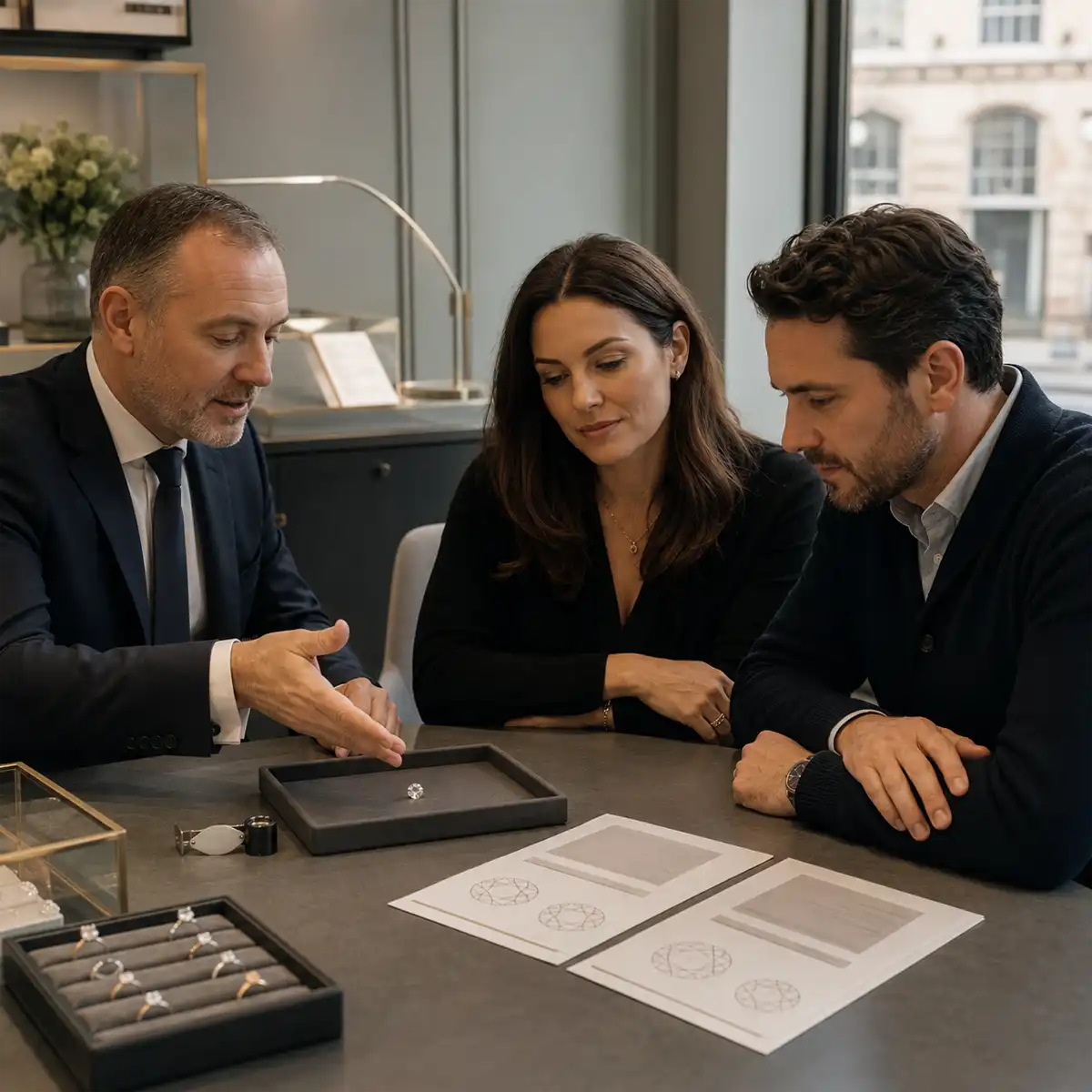
A concise first-consultation sequence works well. Ask which laboratory issued the report and why. Ask to see the laser inscription matched to the report number under 10x magnification. Ask for the cut grade to be stated and, for a round brilliant, confirm Excellent as the benchmark; anything below is a trade-off worth understanding. Ask about fluorescence and how the jeweller prices the specific grade on the stone in question. For lab-grown diamonds, ask whether the stone is CVD or HPHT, and ask whether the laser inscription includes the lab-grown designation, which is a trade standard in 2026. For natural diamonds, ask whether the report is recent, because grading standards have evolved and a 15-year-old report can carry legacy grades that a fresh report would assess differently.
Fun fact: The Gemological Institute of America's G-colour grade is numerically defined by a master set of stones that sits in Carlsbad, California, and every GIA grader is calibrated against that same reference set, which is one reason GIA grading consistency is tighter than most laboratories that grade by descriptive comparison alone.
The report itself is worth a few minutes of unhurried reading. Check that the buyer's name and the jeweller's name do not appear on the report, because a grading report is a property of the stone, not of any transaction. Check the date of issue, which is relevant for valuation updates over the life of the stone. Check that all 6 grading parameters are present: cut, colour, clarity, carat, polish, symmetry. Confirm the report number matches the laser inscription. A report that is missing any of these elements, or that looks photocopied or altered, should be rejected and a fresh report requested.
why Hatton Garden is cheaper than the high street
What the report means for a Hatton Garden purchase decision
For a Hatton Garden buyer in 2026 deciding between a GIA-graded and IGI-graded stone at equivalent paper grades, the single most useful question to ask the jeweller is how the trade prices the grading gap between the two laboratories on stones in this specific size and quality band. A jeweller who answers substantively on that question demonstrates trade literacy; one who does not is worth a second thought. For natural diamonds above 0.50 carat intended for long-term ownership, GIA certification is the safer reference. For lab-grown diamonds at any size, IGI is the appropriate certification and GIA is a secondary option. Confirm the laser inscription under 10x magnification before agreeing any purchase, and request a fresh report if the documentation is more than 15 years old. The report is the paperwork; the stone is the asset.
Continue Reading
The Hatton Gazette
Delivered weekly to your inbox
Subscribe for the latest from Hatton.