If you already know what you want, stop here. If you do not, read on. There is a question every UK engagement ring buyer asks themselves in the week before they walk into their first showroom, and almost nobody answers it honestly in print. Should you buy from a Hatton Garden specialist, or from a high-street chain. The trade does not want to give you a straight answer because the trade is full of people with skin in the game. This article is the straight answer. Hatton Garden vs high street jeweller is not a close call once you understand where each business model actually makes its money, what each one is structurally able to offer you, and which buyer profile each one genuinely suits. By the end of this you will know which side of that decision you belong on, and you will know why.
The structural difference nobody explains
A national high-street jewellery chain and a Hatton Garden specialist are not two versions of the same business. They are two different businesses entirely. The starting point for any honest comparison is to understand what each one actually does for a living.
A high-street chain operates a retail model. The shopfront is the product. Multiple identical showrooms in shopping centres across the country, standardised stock ordered centrally, staff trained to a corporate script, margin built into every item to cover rent on prime retail real estate, head office overheads, national advertising budgets, and shareholder returns. The chain's job is to sell rings from existing inventory, efficiently, at scale, to a customer who walked in off a high street.
A Hatton Garden specialist operates a workshop and consultancy model. The product is the ring and the relationship with the maker. Single showroom, usually owner-operated or directly managed, stock built around what the owner believes in rather than what corporate buying decided, margin shaped by direct trade access to stones and metals rather than by retail markup, overheads concentrated on the workshop rather than on retail real estate. The specialist's job is to design and produce the right ring for the specific buyer in front of them.
These are not better-and-worse models. They are different-and-different models. Each suits a different buyer. Understanding which model fits your purchase is the entire point of this comparison.
Where your money actually goes in each model
The most honest way to compare any retail proposition is to follow the money. In a high-street chain, the price you pay covers four cost layers before the ring itself. The premises, typically a shopping centre unit costing six figures a year in rent. The head office, with its directors, buyers, marketing teams, and corporate functions. The national advertising spend, which funds the brand recognition that brought you through the door. And the shareholder return, because the chain is usually a public or private equity-owned business with returns to deliver. After these four layers, the remaining margin pays for the staff, the stock, and the manufacturing cost of the ring.
In a Hatton Garden specialist, the cost stack is shorter. The premises, a single showroom in EC1N, which costs significantly less than a shopping centre unit in a major retail destination. The workshop, including the goldsmiths, setters, and polishers who actually make the rings. The stock, which the specialist holds at lower volume but higher quality per piece. Marketing exists but is a smaller line, because the specialist's reputation is built through repeat business and recommendation rather than national television advertising.
The arithmetic is straightforward. For the same price paid, a Hatton Garden specialist can put more of your money into the actual ring. Or, for the same ring, you pay less than you would at a national chain. This is not a marketing claim. It is structural. The chain has more cost layers to fund before it reaches the stone in your hand. To see this difference in person, what to expect when you arrive in Hatton Garden.
What each model is structurally good at
Honesty cuts both ways. The high-street chain has genuine advantages that a Hatton Garden specialist cannot match, and they should be stated plainly.
A chain offers ubiquity. You can walk into a branch in Cardiff, Newcastle, or Aberdeen with the same ring and have it cleaned, inspected, or resized. For a buyer who moves frequently, lives outside London, or values being able to walk into any branch on any high street, this is a real benefit.
A chain offers brand familiarity. For a buyer whose family has bought from the same chain for two generations, the continuity matters. There is comfort in the recognisable logo and the standardised experience, and that comfort is a legitimate purchase consideration.
A chain offers consumer protection that some shoppers value, including formal returns policies and the perceived backstop of a large corporate entity behind the transaction. These protections also exist at reputable Hatton Garden houses, but the chain's scale makes them feel more institutional.
The high-street chain is genuinely good for a buyer who wants a ring from existing stock, who values brand recognition, who lives nowhere near London, and who is comfortable with the price premium that funds the retail model.
The Hatton Garden specialist is genuinely good at things the chain cannot do at all.
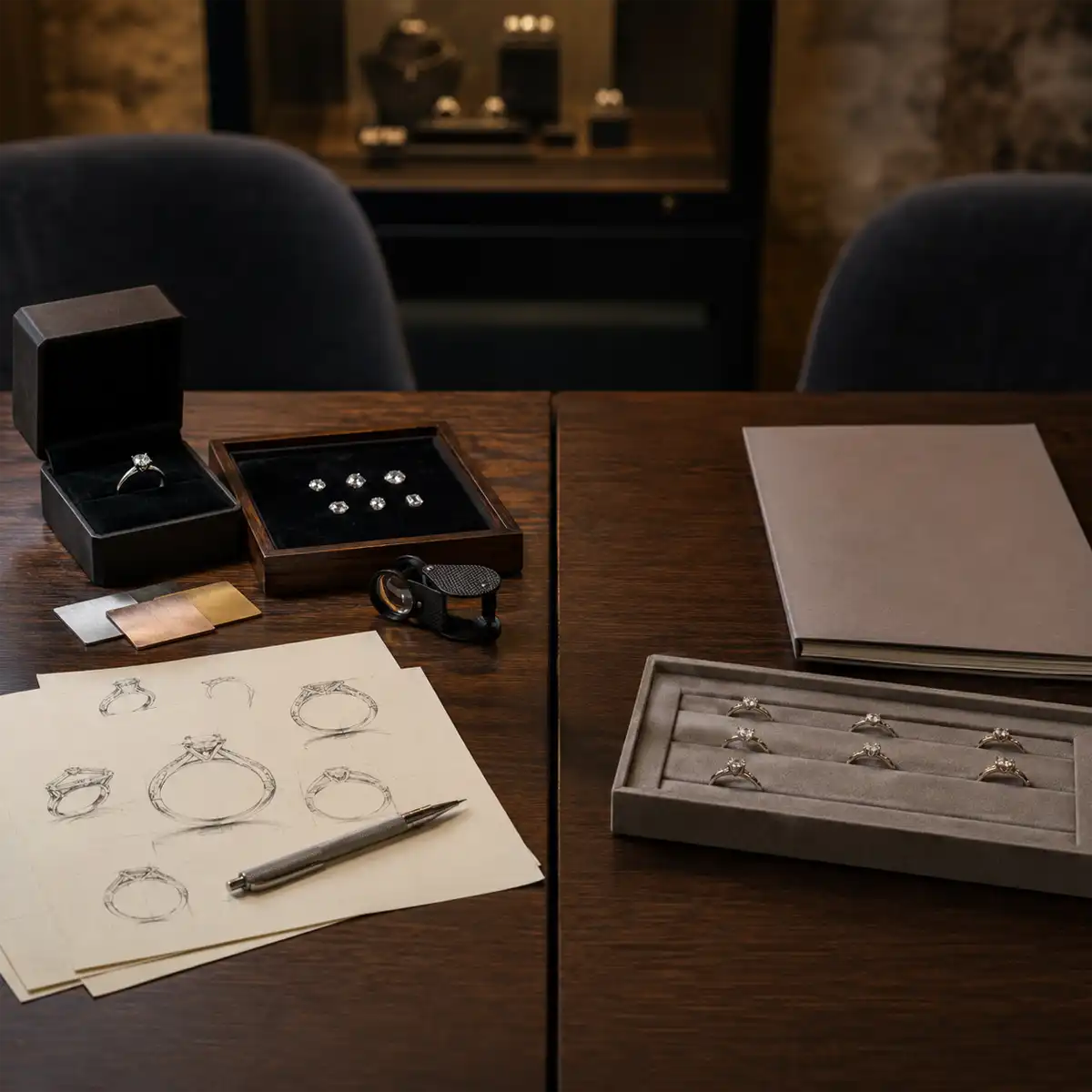
A specialist offers bespoke commissioning. Real bespoke, not catalogue customisation. The ring is designed for you, the stone is sourced for your specification, the setting is built by named craftsmen in a workshop you can visit. National chains do offer a bespoke option, but it is usually executed by a third-party workshop subcontracted by head office, not by an in-house bench.
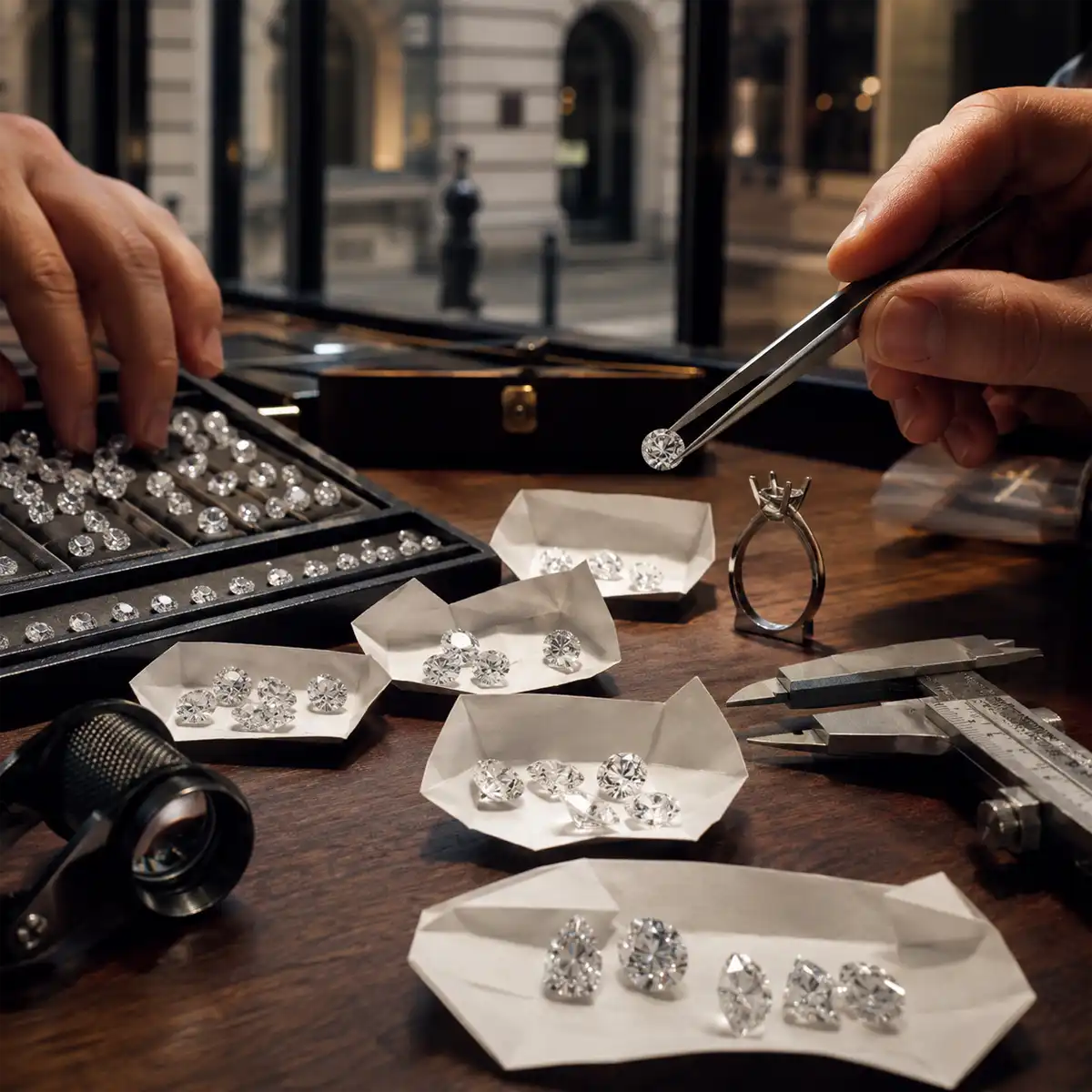
A specialist offers stone choice depth. A typical Hatton Garden house can show you fifteen 1 carat diamonds in your specification on the same afternoon, sourced from the immediate trade network on Greville Street, Leather Lane, and the surrounding streets. A high-street chain can show you the diamonds in the local branch's stock, which is a fraction of that selection.
A specialist offers price flexibility because the cost stack is shorter. The ring you can afford at a specialist is consistently more ring per pound than the equivalent at a chain, on like-for-like specification.
A specialist offers direct access to the maker. The person you negotiate the design with is often the person responsible for the workshop that makes it. The accountability is in the room.
The certification and stone quality question
The most important comparison point for any serious buyer is not the price but the stone itself, and this is where the comparison shifts decisively.
Both models can supply GIA-certified stones. The certificate, where present, is the certificate. A GIA report from a chain and a GIA report from a Hatton Garden specialist describe the same stone to the same standard.
The difference is depth of selection. A national chain's local branch typically holds 10 to 30 engagement ring centre stones in any given specification. A Hatton Garden specialist working within the EC1N trade network has access to several hundred stones in the same specification on the same day, and can have them in the showroom for you to compare within hours.
The depth of selection matters because diamonds at the same nominal specification are not the same diamond. Two 1 carat G VS1 excellent cut round brilliants from different stones can perform visibly differently in light. One may have a marginally better proportion. One may have a marginally better polish. One may simply look more alive on the finger. The buyer who chooses from 30 stones is choosing from a narrower pool than the buyer who chooses from 300, and at this level of purchase that depth matters.
For more on what makes one certified stone perform better than another, comparing lab and natural at a specialist.
The aftercare comparison
Aftercare is the long tail of any engagement ring purchase, and the two models handle it very differently.
A high-street chain offers aftercare through its branch network, typically including complimentary cleaning, periodic inspection, and resizing within a stated window. The work is sent to a central service workshop and returned, usually within two to three weeks. The quality of the work is acceptable but not exceptional, and the ring leaves your hands for the duration.
A Hatton Garden specialist typically offers aftercare in-house. The cleaning happens at the showroom while you wait. The resize happens at the in-house workshop, often within five to seven working days. Prong checks, polish refreshes, and rhodium re-plating happen on the premises by the same goldsmiths who made the ring originally. The continuity of the workmanship is consistent across the ring's life.
For the buyer who values their ring as a long-term piece rather than a transaction, the specialist's in-house aftercare is materially more valuable. The ring stays close to its maker.
Fun fact: Hatton Garden is the only street in the UK formally recognised by Companies House and the Greater London Authority as a designated jewellery district, with planning protections that have prevented its conversion to general office or residential use specifically to preserve the concentration of jewellery trade businesses in EC1N.
When the high-street chain is genuinely the right call
Honest comparison means saying when the other option wins. There are buyer profiles for whom a high-street chain is genuinely the better choice, and pretending otherwise would be dishonest.
If you live outside London and a Hatton Garden visit involves significant travel and overnight stay, the cost of that visit eats into the price advantage. For very modest budgets where the saving is small in absolute terms, the high-street chain in your local town may be the more practical answer.
If you have a clear preference for a specific chain's design aesthetic and you have already decided which ring you want from their catalogue, you are not really shopping. You are collecting. Hatton Garden cannot improve a decision that has already been made on aesthetic grounds.
If you genuinely value the corporate continuity and brand reassurance of a large national retailer, that preference is legitimate. Some buyers are more comfortable with institutional sellers than with owner-operated specialists. The choice is yours, and there is no virtue in pretending otherwise.
If your budget is below approximately £1,500 total, the Hatton Garden price advantage is real but small in absolute pounds. At higher budgets the advantage scales. At very modest budgets the high-street chain may be the simpler practical answer.
When the Hatton Garden specialist is the right call
For every other buyer profile, the answer is clear.
If your budget is £2,500 or above and you want maximum ring for the spend, Hatton Garden wins materially on stone quality per pound and on setting craftsmanship.
If you want a bespoke ring or a heavily customised design rather than something from existing inventory, Hatton Garden is the only option that does this properly. Chain bespoke is usually subcontracted catalogue customisation rather than genuine design work.
If you want depth of choice on the centre stone, Hatton Garden's access to the local trade network is structurally unmatched.
If you value direct contact with the maker, the workshop, and the goldsmiths responsible for the ring, only the specialist model offers this consistently.
If you live in London or within reasonable travel distance, the visit cost is negligible and the advantage is unalloyed.
If you are buying for the long term and intend to wear the ring for decades, the in-house aftercare proposition makes the specialist the more sustainable choice.
Where Smith and Green sits on this comparison
We are a Hatton Garden specialist with a single showroom at 9 Hatton Garden, a short walk from Chancery Lane station, Farringdon Elizabeth line, and Leather Lane market. We hold our own curated diamond inventory, we have direct trade relationships with the major UK diamond suppliers on the street, and our workshop produces the rings we sell rather than subcontracting to a third party. We will not pretend that we are the right choice for every buyer, because we are not. For a buyer in Aberdeen on a £1,200 total budget, your local high-street chain is the practical answer. For a buyer in London on a £3,500 budget, the comparison is not close. The ring you can have for that money at our showroom is materially better than the ring you will leave a national chain with at the same price, and we will show you exactly why on the consultation table. Bring a quote from a chain. We will sit it next to our equivalent and let you see the difference in front of you.
Conclusion
Hatton Garden vs high street jeweller is a real comparison, not a marketing tagline. The high-street chain wins on ubiquity, brand familiarity, and convenience for buyers outside London on modest budgets. The Hatton Garden specialist wins on price-to-quality ratio, depth of stone selection, bespoke capability, direct access to the workshop, and long-term aftercare. The right answer depends on your budget, your location, and what you actually value in the purchase. If you live near London, your budget is £2,500 or above, and you want the best ring your money can produce, the comparison is decisively in favour of the specialist. Book a consultation, bring any quote you have already received from a chain, and let us put the two options in front of you on the same desk under the same light. You will see the difference in 15 minutes, and you will know which side of this question you belong on.
Related reading: Why Hatton Garden costs less than the high street brands.
Continue Reading
The Hatton Gazette
Delivered monthly to your inbox
Subscribe for the latest from Hatton.