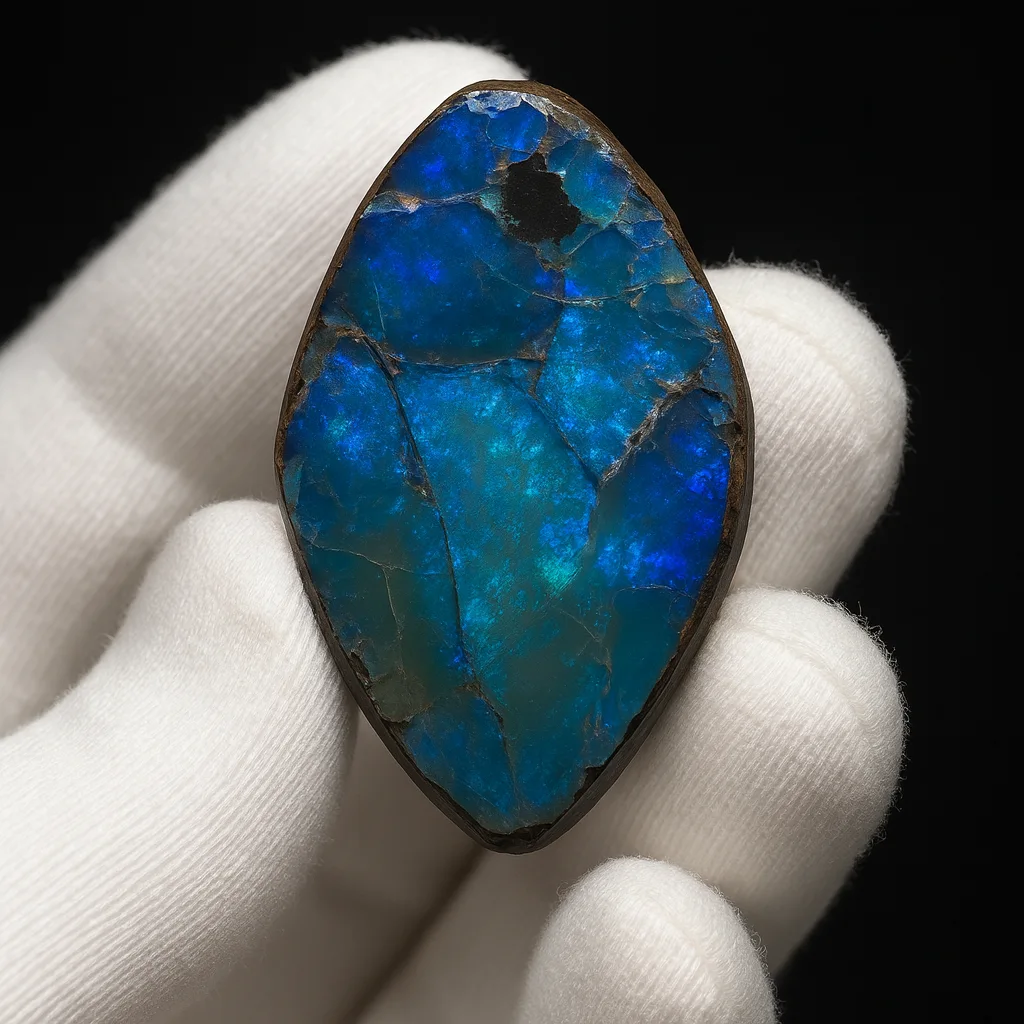
The Pandora Stone is not simply a spectacular black opal. It is a fossilised blade bone from a Cretaceous marine reptile, transformed into a 711 carat gem and carried from the Australian outback to the auction rooms of London. For collectors and clients weighing an important opal engagement ring or a serious specimen gemstone, Pandora offers a rare, real world case study in how geology, human decision making and international trade can converge in a single stone.
Discovered in 1928 at the Angledool field near Lightning Ridge, the Pandora Stone began life as the scapula of a plesiosaur, lying in marine sediment for over 100 million years before silica-rich water replaced the bone cell by cell. In the mid 20th century it resurfaced as a headline specimen in London, passing through Hatton Garden jewellers and Sotheby's at a time when the capital effectively controlled the international Australian opal trade. Today, even though the stone now sits in private hands, its story still shapes how serious buyers think about rarity, provenance and long term value in fine jewellery and watches.
For a modern client choosing between investment grade coloured gemstones, statement black opal and high horology, Pandora provides a lens through which to read quality. Its journey illuminates what makes a stone exceptional, how the market responds to that rarity and why provenance can matter just as much as carat weight when you are planning a meaningful purchase.
What Makes The Pandora Stone So Important
At its core, the Pandora Stone matters because it is three things at once: a significant opalised fossil, a museum scale black opal specimen and a documented actor in the commercial history of the London trade. Few stones manage even one of those feats.
First, Pandora is not a random lump of colour; it is a preserved plesiosaur scapula from the Early Cretaceous, turned to opal through an exceptionally specific chain of geological events. Secondly, it displays what every collector hopes for in Lightning Ridge black opal: a dark body tone, powerful red and multicolour play of colour and a large, flat face that shows that colour cleanly. Finally, its route from a lone miner's claim to Sotheby's, and then into a private collection, can be traced in surprising detail across letters, auction catalogues and specialist books.
For affluent clients, this combination of scientific, aesthetic and historical interest is precisely what separates a pleasant luxury purchase from a truly important acquisition. Pandora demonstrates the upper limit of what an opal can be. When you look at a finely cut opal ring, a signed vintage watch or a rare coloured diamond in a London showroom, you are in dialogue with the same ecosystem that once determined the fate of this fossilised blade bone.
How A Prehistoric Sea Forged A Black Opal Bone
To understand why Pandora can never be replicated, it is worth stepping back to the conditions that formed it beneath the Australian interior. During the Albian stage of the Early Cretaceous, much of central Australia lay beneath the cool, shallow waters of the Eromanga Sea. Around modern Lightning Ridge, those waters left behind the Griman Creek Formation, a layered mix of sandstones, siltstones and claystones that would later host an extraordinary concentration of opal.
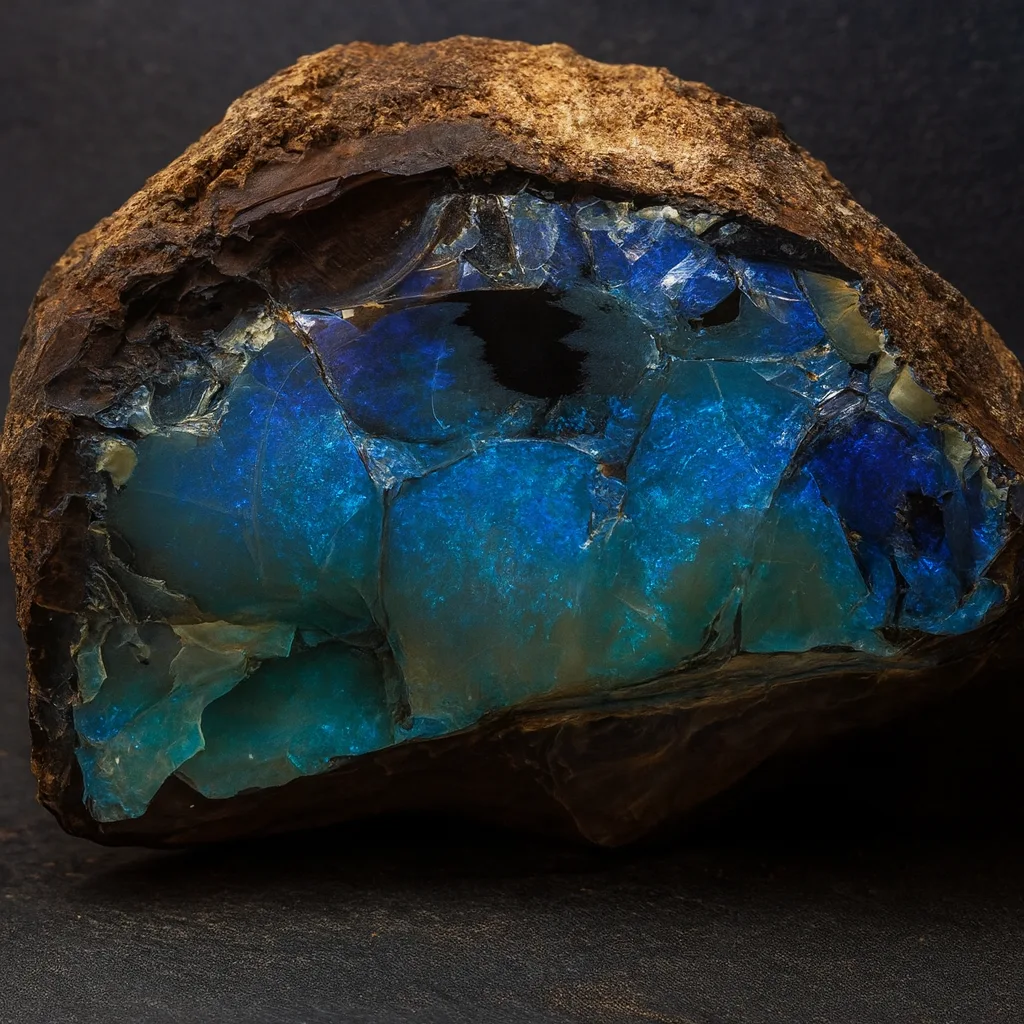
Within that formation sits the soft, pale clay that miners call opal dirt. Here, feldspar-bearing rocks weathered, releasing silica into groundwater that moved through the beds as the inland sea advanced and retreated. In most cases that silica filled cracks and cavities, producing the familiar opal seams and rounded nodules known as nobbies. In Pandora's case, the solution met the buried skeleton of a marine reptile. The original organic tissue dissolved while microspheres of amorphous silica took its place, preserving the external form of the bone but changing its internal structure completely.
The result is a biological shape with a gemmological interior. The flat expanse of the scapula allowed a continuous bar of colour to develop, rather than the knobbly outlines associated with vertebrae or smaller bones. Later accounts describe Pandora as dark bodied with strong red and multicolour flashes and even a "peacock tail" effect along one end, language that speaks directly to the rolling pattern collectors prize in top black opal. In strict mineralogical terms it is hydrated silica. In practice it is a snapshot of the Cretaceous sea floor that now behaves like a luxury gemstone.
Fun fact: Lightning Ridge and its satellite fields are among the very few places on Earth where large vertebrate bones have been preserved as precious opal, making every sizeable opalised reptile bone globally significant.
From Jack McNicol To Depression Era Hardship
The human story of Pandora begins with one man, a pick, and a decision that would haunt him. In 1928, miner Jack McNicol was working the Angledool field north of Lightning Ridge. He was what the outback called a "gouger" an independent miner relying on hand tools, experience and stubbornness rather than company capital. At the time he was boarding locally, scratching a living from a field that had already seen its first rush fade.
McNicol found the stone not in a fresh tunnel but in a pillar of untouched ground left to support the roof of an older working. As he chipped into that pillar he struck something harder than the surrounding clay. Patiently he worked around it and uncovered a thick bar of dark opal roughly the length of a man's hand. The same pocket held additional stones worth a substantial sum in their own right, suggesting a concentrated flow of silica into that tiny zone.
News spread quickly. On the fields, a single great find could change a life overnight. Within a short time, serious buyers were on the scene. Contemporary accounts record at least one offer of £1,000 in cash and another of £1,000 plus a motor car eye watering sums when the average annual wage lagged far behind. McNicol declined, judging that the stone's size, colour and distinctive shape justified still more. He placed Pandora in secure storage in Sydney and waited for the right moment.
The right moment never came. The Wall Street crash of 1929 and the global depression that followed crushed demand for luxury jewellery. By the time McNicol eventually sold his stone for £400, the figure was less than half of the sum he had once been offered. He died in poverty, having briefly held in his hands one of the most significant opals ever mined. For modern buyers the lesson is uncomfortable and clear. Even the finest stone can be hostage to timing and to the wider economic climate.
Hatton Garden And The Rise Of Australian Opal
If Pandora's early life played out in the outback, its middle years belonged to London. From the late 19th century onwards, Hatton Garden became the principal European hub for Australian opal. Agents and dealers built regular routes from fields such as Lightning Ridge, White Cliffs and Coober Pedy to the offices and cutting rooms of EC1. London firms bought rough in quantity, had it worked locally or in Idar Oberstein and placed the finished stones before European and American jewellers.
By the 1940s and 1950s the capital's gem merchants had refined their expertise to the point where they did not only handle pretty stones for rings. They also assembled collections of unusual minerals and fossils, often acquiring spectacular pieces that fell somewhere between jewellery and natural history. In that world, a large opalised reptile bone with rich red play of colour would have been instantly recognisable as something out of the ordinary.
Archival references indicate that after McNicol's forced sale, Pandora travelled via at least one intermediary in Sydney before making its way to London. There it reportedly changed hands more than once for figures around £2,000. That rise in price captures both the post war recovery in demand for important gems and the ability of experienced Hatton Garden jewellers to position such a stone as a specimen object, not simply cutting material. Instead of being sliced into dozens of small cabochons for rings, Pandora was carefully polished as a single freeform that retained its fossil shape.
For a modern client visiting a high end London showroom, that history matters. It explains why the area still carries particular weight when it comes to black opal, diamonds and coloured stones. The same streets that now house sleek boutiques once held the dealers who recognised, preserved and placed the Pandora Stone.
Inside The Sothebys Sale And London Collector Years
The most visible moment in Pandora's commercial life came in the mid 1960s when it appeared at Sotheby's in London. Though contemporary catalogues grouped fossils with antiquities or objects of vertu rather than with traditional fine jewellery, the decision to send Pandora to auction signalled that it had crossed a threshold. This was no longer merely a dealer's specimen: it was an object that could stand alongside antiquities and museum grade curiosities.
The catalogue entry presented a polished opalised blade bone from Lightning Ridge, weighing 711 carats and showing strong play of colour against a dark body tone. The buyer of record was described as a Hatton Garden jeweller, a phrase that likely masks an individual or firm well known in the trade at the time. Given the pattern of the period, that buyer may have been acting either for a serious private collector in Europe or North America or for a specialist house with an interest in both jewellery and natural history.
Price records from that era suggest that a four figure hammer price for a single opal specimen was significant but not yet sensational. The true transformation lay not in the number itself but in the reclassification of the stone. Once catalogued and sold under the Sotheby's umbrella, Pandora effectively joined the ranks of named opals that circulate in specialist literature. From this point on, it was spoken of in the same breath as the Fire Queen, the Flame Queen and other giants of the Lightning Ridge story.
For clients weighing important purchases today, the episode illustrates how auction history contributes to an object's standing. A signed dial on a vintage chronograph, a maker's mark on a platinum ring or a Sotheby's catalogue reference for a specimen opal all play similar roles. They fix the piece in a documented chain of custody and support its position in the broader hierarchy of notable objects.
Where The Pandora Stone Sits Among Famous Opals
Even in the illustrious company of other named Australian opals, Pandora holds a distinctive place. Many of the most famous stones, such as the Fire Queen or Halley's Comet, are classic nobbies or seams impressive in size and colour but not tied to any particular piece of anatomy. Pandora is different. It is both a substantial opal and a recognisable bone from a known group of marine reptiles.
In weight terms, its 711 carats put it firmly in the top tier of museum scale black opal specimens. In aesthetic terms, the dark body tone and persistent red play of colour meet precisely the qualities that collectors seek in top Lightning Ridge material. The bar like form of the scapula offers a broad, flat surface that displays that colour cleanly, without the visual interruptions that can occur in more rounded nodules. Accounts describing a "peacock tail" effect on one end suggest that as the stone is moved, arcs of colour sweep across the surface in a way more reminiscent of a luxury dial than of a typical cabochon.
What also sets Pandora apart is the quality of the documentation surrounding it. The finder's name, the original mining field, early offers, later resale, the decision to polish rather than saw and the Sotheby's sale all survive in accessible records. When compared with many stones that simply appear in dealers' trays with little more than a place name attached, this helps explain why Pandora continues to fascinate gem writers and collectors long after it disappeared into private hands.
Comparative Gemology and Status
To understand the Pandora's standing, we must compare it to the other "Monarchs" of the opal world.
The Pantheon of Named Opals
The Pandora belongs to an elite class of named stones from Lightning Ridge.
| Stone Name | Discovery | Weight (Rough/Cut) | Nature | Provenance Notes |
| The Pandora | 1928 | ~790 / 711 ct | Plesiosaur Bone | Found by McNicol. Sold Sotheby's 1964. |
| The Fire Queen | 1906 | ~900 ct | Nobby / Seam | Found by Dunstan. Sold to J.D. Rockefeller.26 |
| The Flame Queen | 1914 | 261 ct | Nobby ("Poached Egg") | Distinct red/black eye. Sold Bonhams 2008.27 |
| The Light of the World | 1928 | 252 ct | Nobby | Contemporary of the Pandora.28 |
| Halley's Comet | 1986 | 1982 ct | Nobby (Uncut) | Guinness Record holder.28 |
| Eric (The Pliosaur) | 1987 | Complete Skeleton | Opalised Skeleton | Purchased by Australian Museum.7 |
Why Pandora Matters To Modern Engagement Ring Buyers
For a contemporary couple looking at a black opal engagement ring in a London showroom, the Pandora Stone might feel distant in time and scale. Yet the same principles that made Pandora exceptional are the ones that should guide a considered purchase today.
First, body tone and colour are paramount. Pandora's prestige rests on its dark base and vibrant red and multicolour flashes. When you examine a modern opal ring, look for a similarly convincing contrast and a play of colour that holds up across the whole face of the stone, not just in one corner. Second, cut should respect the material. Just as the London dealers chose to polish Pandora sympathetically to preserve the scapula outline, a contemporary cutter should work around the strongest colour bar rather than chasing carat weight at any cost.
Third, provenance brings both reassurance and additional interest. Pandora's documented path from Angledool to Hatton Garden gives it a narrative weight that a random stone cannot match. In the same way, knowing where your opal was mined, how it was cut and who set it tells you that the piece on your finger has a life story, not just a price tag. This holds true whether you are commissioning a bespoke opal ring, selecting a rare coloured diamond or choosing a limited edition luxury watch whose dial quietly echoes the shimmer of a Lightning Ridge stone.
Finally, Pandora reminds buyers that real rarity often sits at the intersection of beauty and scientific interest. An opal that is simply pretty may delight for a season. An opal that also feels intellectually and historically rich can hold its place in a collection for decades.
Pandora Stone Legacy For Serious Jewellery Collectors
Today, the Pandora Stone is widely believed to sit in a private collection outside Australia, its exact location known only to a handful of specialists. What is certain is that it continues to occupy an outsize place in the conversation around Australian opal, fossil jewellery and the history of the London trade. From a dusty pillar in an abandoned Angledool drive to the bright lights of a Sotheby's saleroom, its journey mirrors the broader ascent of opal from curiosity to coveted luxury material.
For collectors of important stones and watches, Pandora offers a quiet template. Seek pieces whose beauty is anchored in something deeper than fashion; insist on quality of material and cut; pay attention to documentation; and remember that market sentiment can move quickly, but genuine rarity is slow to form. The scapula that once propelled a plesiosaur through the Eromanga Sea took over 100 million years to become a black opal. A thoughtful purchase need not be quite so patient, but it should respect that timescale.
In the end, Pandora's story is a reminder that every stone on a tray and every watch in a cabinet carries an invisible backstory. Some are brief. A few, like this opalised bone, stretch from prehistoric seas to London vaults. Choosing well is less about chasing the loudest headline and more about learning to read those hidden narratives, in much the same way a seasoned buyer reads the shifting colours across a fine opal, searching for the moment when light, structure and history fall into perfect alignment.
References And Auction Sources
For readers and researchers who want to explore the documentary trail behind the Pandora Opal, the following published sources and archival materials provide useful context and support for the chronology outlined above:
- Ion L Idriess, Lightning Ridge, Angus and Robertson, Sydney, 1940.
Narrative account of the Lightning Ridge fields, including contemporary references to major opal finds associated with Angledool and early mentions of the Pandora Stone story. - Ion L Idriess, Stones of Fire, Angus and Robertson, Sydney, 1958.
Semi factual treatment of Australian opal that reprises the Pandora narrative, with descriptive detail on the size, appearance and early offers made for the stone. - Andrew Cody, Australian Precious Opal A Guide Book for Professionals, Cody Opal, Melbourne, 1991.
Technical reference that lists Pandora as a named Lightning Ridge opal, recording its cut weight, type and status as a significant specimen within Australian opal history. - Charles Sturt University Regional Archives, opal fields and Lightning Ridge collections.
Archival notes and correspondence documenting Jack McNicol, the Angledool diggings and the chain of custody from the original discovery through early sales. - Rocks & Minerals journal, correspondence section, mid 1960s.
Letters and notes discussing major Australian opals, including material relating to McNicol and brief summaries of Pandora’s early sale history. - Sotheby’s, London, Antiquities sale, 24 February 1964, catalogue entries for fossils and natural history specimens.
Likely auction context for the sale of the Pandora Opal to a Hatton Garden jeweller, providing the key public market reference for the stone’s transition from trade specimen to documented heritage asset. - British Museum and Gemmological Association publications and reports mentioning donations and activities of London gem merchants active in Hatton Garden in the 1950s and 1960s.
Background material on the firms and individuals who handled unusual opal specimens and supported museum collections during the period in which Pandora was in London.
For our most complete and up-to-date advice on this topic, read the October birthstone guide to opal and tourmaline.
Continue Reading
The Hatton Gazette
Delivered weekly to your inbox
Subscribe for the latest from Hatton.