The scrap gold price on a Hatton Garden counter comes from 3 things: the London fix, the fineness of the piece and the buyer's margin. On 13 October 2026, 2 price lists published on the street quoted 9 carat gold at £36.95 and £32.00 a gram. Same metal, same day.
Both figures were read from the buyers' own websites on that date, and both appear below with the arithmetic. They matter more than usual this month.
The World Gold Council reported on 7 October 2026 that gold ETFs, the exchange-traded funds that hold bullion in vaults, took in a record $31 billion between July and September, yet the metal ended September cheaper than it began. A seller who reads only the first half of that sentence may expect a better offer than the second half allows.
Hatton Garden, London EC1N, has no single buying price. Our page of live precious metal prices shows the market figure. What follows shows how far a counter offer can sit from it, why a hallmark moves the number, and what a record quarter for funds does and does not mean for a chain in a drawer.
What is the scrap gold price in Hatton Garden today
On 13 October 2026 the scrap gold price for hallmarked 18 carat gold was £73.91 a gram on the trade counter list of Landale Limited at 57 Hatton Garden, and £64.00 a gram on the daily list of Hatton Garden Metals at 19-20 Hatton Place. Fine gold stood at £98.44 a gram on that morning's London fix.
Landale states on its price page that its gold prices are based on the AM fix, which it gave as £3,159.84 a troy ounce on 13 October 2026. A troy ounce is 31.1 grams, so the fix works out at £98.44 for a gram of pure gold. As a cross-check, the BullionVault order board showed gold changing hands at about £100.90 a gram on the evening of the same day.
Nobody is paid the fine price for jewellery, because jewellery is an alloy. A 9 carat alloy is 375 parts gold in 1,000, which makes its metal content worth £36.92 a gram at that fix. An 18 carat piece is 750 parts, or £73.83. At 22 carat the figure is 916 parts, or £90.17. Those numbers are the ceiling. Every scrap gold price on the street is a percentage of them, quoted per gram, in sterling, for metal sold to a dealer.
Two Hatton Garden price lists compared
Set the 2 lists side by side and a pattern appears. One tracks the metal almost exactly. The other pays a steady fraction of it.
Landale Limited Precious Metals describes its list as scrap metal counter buy prices and labels the gold column as trade, per gram. On 13 October 2026 it showed 9 carat at £36.95, hallmarked 18 carat at £73.91 and hallmarked 22 carat at £90.27. Each is within a few pence of the full metal content at the morning fix.
Hatton Garden Metals publishes daily gold prices for the public, with a price guarantee of 2 working days. On the same date its list showed 9 carat at £32.00, 18 carat at £64.00, 22 carat at £78.17 and 24 carat at £85.34. Divide each by the metal content and the answer is the same every time: about 87%.
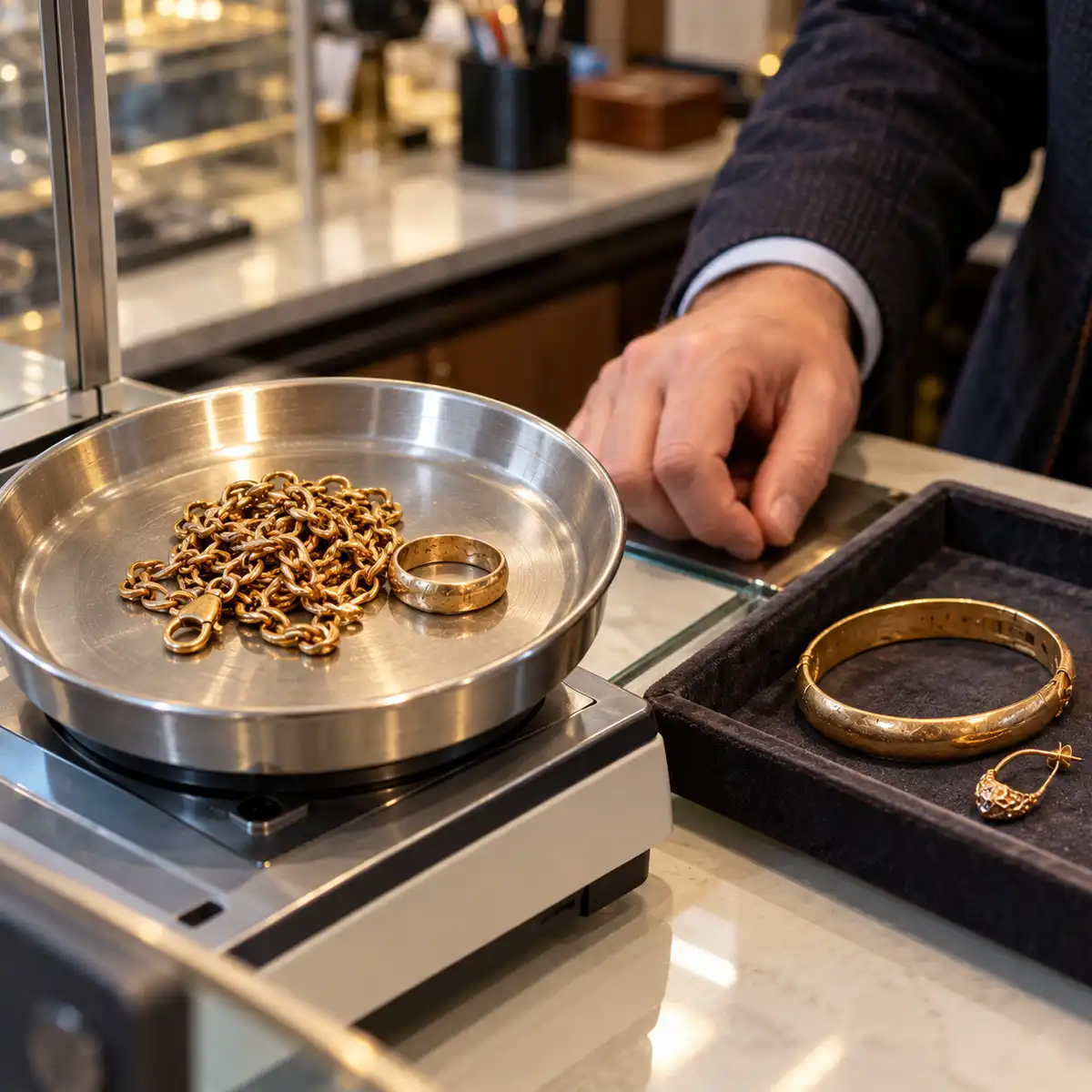
The gap is easier to see on an object. A 20 gram chain in 9 carat gold came to £739.00 on the first list and £640.00 on the second, a difference of £99.00. On 13 October 2026, 2 Hatton Garden price lists quoted the same 9 carat gold £4.95 a gram apart.
The lists are not like for like, and it would be wrong to read one as generous and the other as mean. Landale's is headed as a trade list. Hatton Garden Metals says on its own site that business customers must apply for a trade account to see its business prices, and that a sale made in person may be priced off the live market during the visit.
A disclosure belongs here. Both firms are paying subscribers to this directory, on different plans. They were chosen for this comparison because both publish per-gram prices that anyone can check, and neither was told about it. What the comparison establishes is narrow: on a single day, on a single street, the published scrap gold price for identical metal differed by about 13%. A single quote is not a market price.
Why record buying by gold funds did not lift the price
The claim doing the rounds is simple. Funds bought a record amount of gold, so gold must be worth more.
The World Gold Council's own report, published on 7 October 2026, does not support the second half. Physically backed gold funds took in $10 billion in September and $31 billion across the third quarter, the largest quarterly figure the council has recorded. Holdings rose by 67 tonnes in September to 4,256 tonnes, also a record. Yet the value of everything those funds hold fell 7% in the month, to $574 billion, and the council puts the fall down to a lower gold price.
More metal, worth less. The council gives its reasons: the Federal Reserve raised interest rates by 25 basis points in September, which pushed up Treasury yields and the dollar and raised the cost of holding an asset that pays no interest.
Futures traders went the other way from the funds. Net long positions on the COMEX exchange fell by 100 tonnes over the month, a drop of 13%, and managed money accounted for 84 tonnes of that. Gold had reached its record high in January 2026, and the council describes September as a price pullback.
British buyers were the surprise. Funds listed in the UK added $7.5 billion in the quarter, their strongest on record, with inflows in 12 of the 13 weeks to 25 September. The council reads the run as "sustained investor interest rather than a reaction to a single event" and notes that it coincided with a rising gilt term premium, which may reflect concern about inflation and the public finances.
With $9.5 billion added since January, UK-listed funds have edged past China's as the largest national source of inflows in 2026.
None of that reaches a counter directly. A fund buys bars in a vault, while the scrap gold price is struck from the fix of the day. How that fix is set is covered in our piece on the LBMA and the gold market.
How a scrap sale runs from envelope to payment
A sale has an order to it, and the published terms of these 2 buyers show where along the way the price is fixed.
Landale sets out 4 steps for selling by post. The seller sends the gold, or asks for a pre-paid insured envelope. The package is assessed and settled on the day it arrives by the trade counter staff, with payment based on the daily fix, and any discrepancy is raised with the seller before the gold is bought. Payment follows by same-day bank transfer, cash or cheque, with an invoice sent by email. The firm says its free postal service is insured up to £2,500.
The detail that matters is the date. Under those terms the price is the fix on the day the parcel is opened, not the day it was posted, so the seller carries the market risk while the envelope is in transit. Hatton Garden Metals handles the same risk differently and guarantees its quoted price for 2 working days.
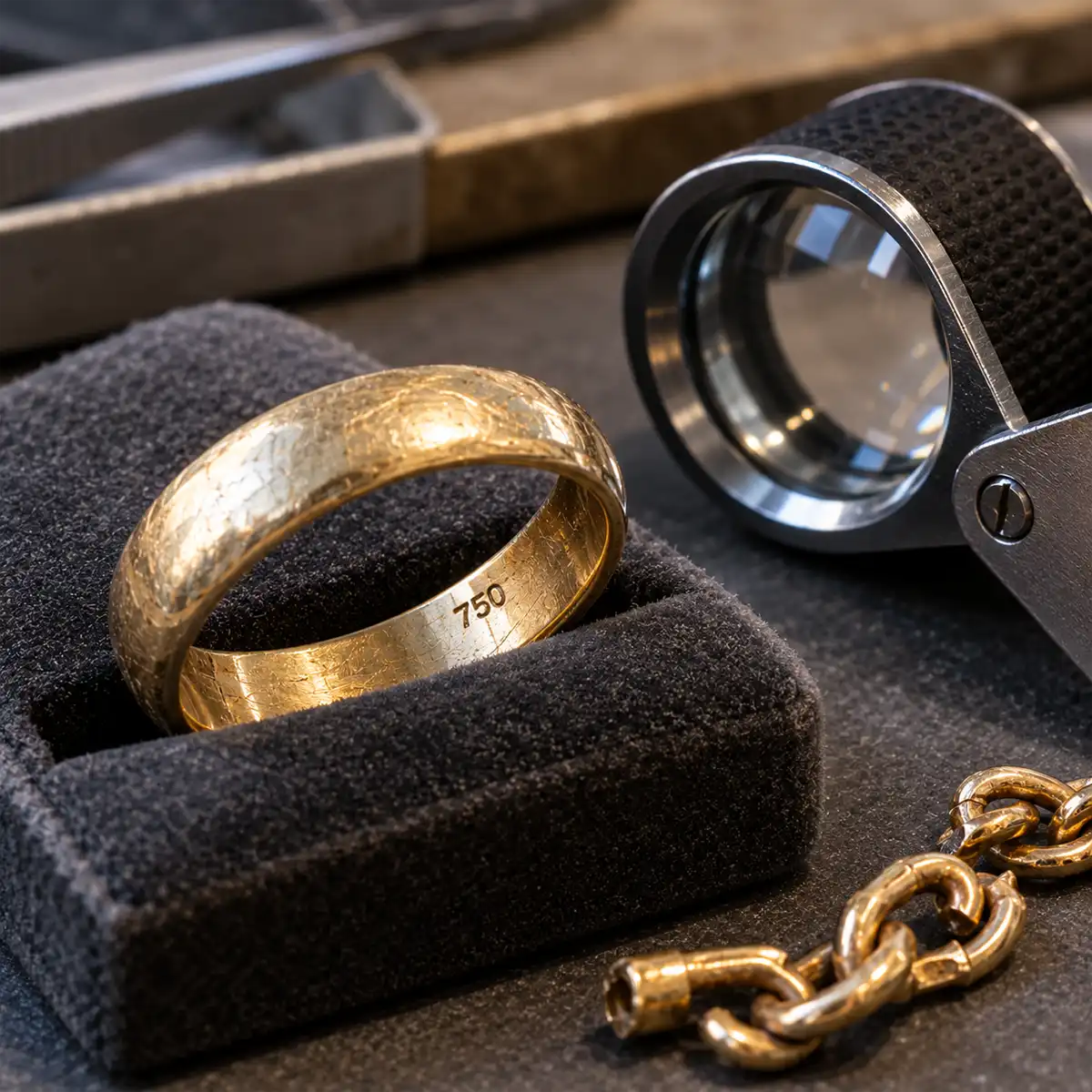
The hallmark earns its keep at the assessment stage. The Goldsmiths' Company Assay Office says a hallmark means an article has been independently tested and guarantees that it meets the legal standard of fineness. Landale's list puts a price on that assurance. On 13 October 2026 it paid £73.91 a gram for hallmarked 18 carat gold against £72.43 for unmarked metal of the same stated carat, a difference of £1.48 a gram, or 2%. On 22 carat the gap was £1.81.
The list does not say why. A reasonable reading is that an unmarked piece has no independent test behind it, so the buyer prices the doubt. How the marks are read is set out in our explanation of gold hallmarking.
Does a lower gold price make jewellery cheaper
A lower gold price reduces the metal cost inside a new piece of jewellery, and nothing else. On 13 October 2026 the gold in a 5 gram 18 carat ring was worth £369 at the London fix. The rest of a retail price is making, stones, overheads and VAT at the standard rate of 20%.
The arithmetic is modest. A 5% move in the fix changes the metal in that ring by about £18. The setter's time stays the same, and so does the diamond.
The same sums explain the gap between what a ring costs and what it fetches. A ring sold as scrap is paid for as metal by weight, and on the 2 lists above that 5 gram ring came to £369.55 or £320.00 on 13 October 2026, whatever it cost new.
Selling the ring as a finished piece is a different market, and the replacement value an insurer uses is a third number again. Retail jewellery is bought to wear. Gold bought for its metal content is sold as bars and coins, a separate trade with its own pricing.
What to check before you sell scrap gold in Hatton Garden
Every check below can be done at home, before any buyer sees the metal, and together they turn a scrap gold price from a mystery into a sum.
Read the hallmark and sort by the fineness number: 375, 585, 750 or 916.
Weigh each group in grams. Stones and steel springs are not gold.
Multiply weight by fineness, divide by 1,000, then multiply by the fine gold price per gram on the day. That is the metal content, and the ceiling.
Compare at least 2 published lists on the same day, and work out each as a percentage of the ceiling.
Ask when the price is fixed: on the quote, on the day the parcel arrives, or live at the counter.
Find out whether unmarked pieces are paid at a lower rate, and what is deducted for testing.
Start with the 2 addresses in this piece, because both publish their figures. Landale Limited is at 57 Hatton Garden, EC1N 8HP. Hatton Garden Metals is at Plouviez House, 19-20 Hatton Place, EC1N 8RU, and gives its phone hours as 9am to 4pm. Chancery Lane and Farringdon are the nearest Underground stations.
Neither list was tested with a real sale for this article, so treat each figure as the published offer on 13 October 2026 and ask for the price in writing on the day. More buyers, and the wider process, are in our guide to how to sell scrap gold in London. A published price is a starting point. The offer that counts is the one made across the counter, for the weight on the scales.
Continue Reading
The Hatton Gazette
Delivered weekly to your inbox
Subscribe for the latest from Hatton.