Most first-time buyers walk into Hatton Garden focused on the stone and treat the setting as a secondary decision. That sequence is backwards. The setting determines how the stone looks on the finger, how the ring wears across 30 years of daily use, how much of the stone's light performance the buyer actually sees, and whether the ring can be resized, rhodium-plated or repaired without dismantling the centre setting. Engagement ring settings in Hatton Garden are built by specialist workshops within a 400-metre radius of each other in the EC1N postcode, between Chancery Lane and the Farringdon Elizabeth line exit, and the quarter handles every mainstream setting type plus several that high street retailers cannot easily source. What follows covers the major setting categories from a bench perspective, with honest trade-offs on security, light performance, resizing implications and suitability for daily wear.
What an engagement ring setting actually does
An engagement ring setting is the metal framework that holds the centre stone and secondary stones in place on the ring. The setting determines stone security, light performance, setting height, compatibility with a wedding band, and the piece's long-term durability. Major setting types include claw (prong), bezel, pavé, channel, gypsy, tension, cathedral and halo, each with distinct construction techniques and daily-wear characteristics.
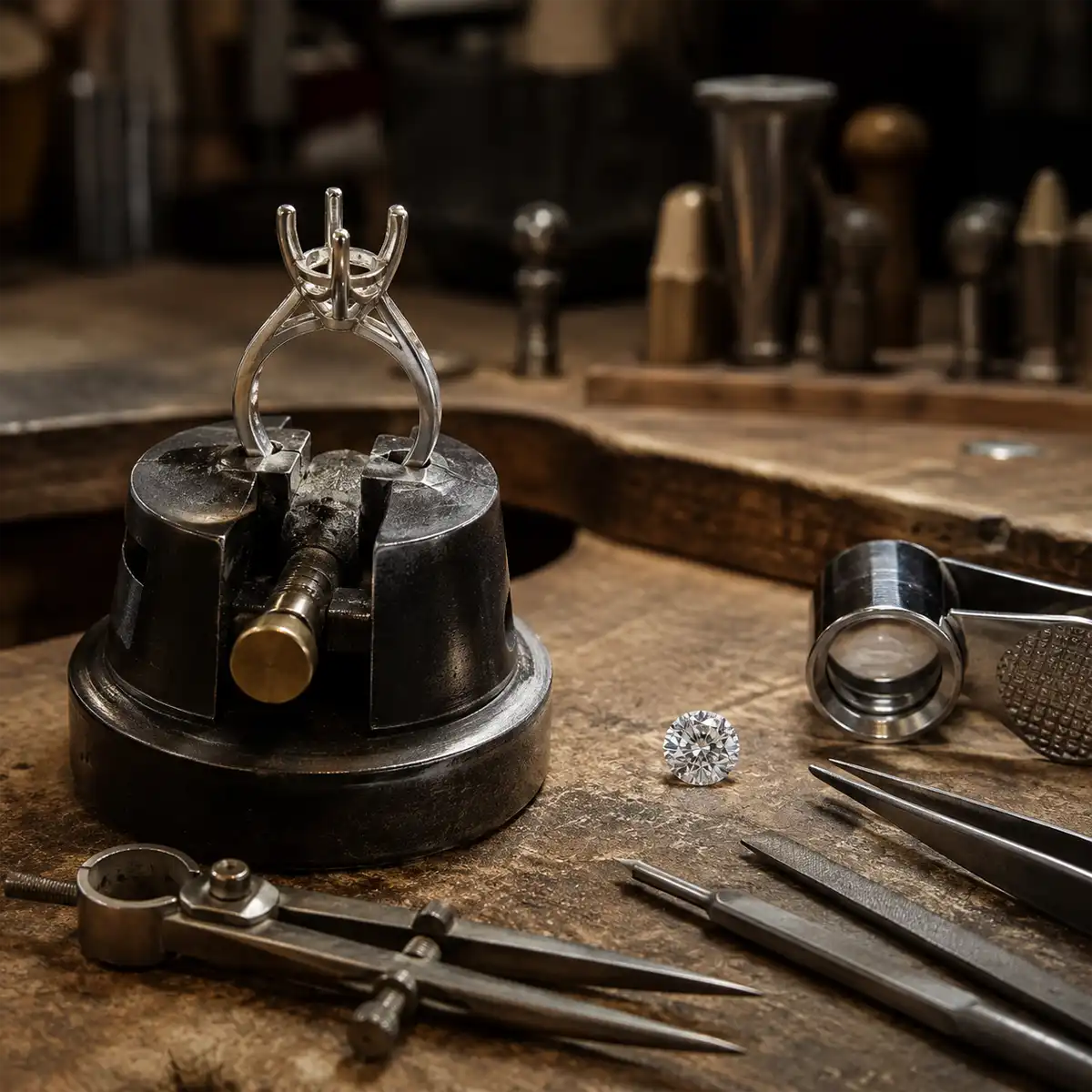
From the bench perspective, a setting is not decoration; it is structural engineering at miniature scale. The claw thickness, the gallery profile, the bearing cut where the stone seats against the metal and the angle at which the metal bends over the girdle all determine whether the stone sits securely for decades or loosens within 5 years. A well-made setting supports the stone across multiple stress points, allows light to enter the pavilion from below, and transfers wear energy through the metal framework rather than into the stone itself. This is the work that separates a good Hatton Garden setting from a mass-produced commercial one.
Setting choice also determines what the ring becomes over its lifetime. A solitaire in a classic claw setting can be resized, rhodium-plated, reset and remounted with relative ease. A pavé band can be resized modestly but not by more than 1 full size without compromising the setting geometry. A tension setting usually cannot be resized at all and may require complete remake if the wearer's finger size changes materially. A bezel setting can be resized and the bezel itself refurbished. These practical considerations matter more for an engagement ring than for almost any other jewellery purchase, because the ring is intended to be worn every day for a lifetime.
how to buy an engagement ring in Hatton Garden
Claw and prong settings at the workshop level
The claw setting, also called a prong setting, is the most common format in Hatton Garden and the most adaptable across stone shapes and sizes. A standard round brilliant solitaire uses either 4 or 6 claws. Four-claw settings show more of the stone's girdle and face-up area but offer slightly less security, and are traditionally associated with the Tiffany setting format that dates from 1886. Six-claw settings provide more stone security and a slightly more distributed wear pattern across the claws, and are often recommended for softer stones or for active wearers. The difference in light performance between 4 and 6 claws is negligible for a well-cut round brilliant.
Claw construction varies by workshop in ways a buyer can feel. A cast claw is produced by lost-wax investment casting and comes out of the flask attached to the shank as a single unit. A fabricated claw is made from wire, formed around the stone by hand and soldered into place. Fabricated claws are typically thinner at the tip, sharper in geometry and more expensive in bench time, and they hold their shape better over decades because the metal is worked rather than cast. Top-tier Hatton Garden workshops use fabrication for claw construction on higher-value pieces, and cast claws for mid-range work. Both are legitimate; the distinction is visible under 10x magnification.
Claw tip shapes also vary. A round-tipped claw sits softly against the crown facets of the stone and reads traditional. A square-tipped claw has a more modern, architectural feel. A V-tipped claw is used to protect the corners of marquise, princess and pear shapes, which are vulnerable to chipping at the points without corner protection. A double claw, where two thin claws sit where one would normally go, adds visual interest without compromising security. The claw tip shape does not affect the stone's light performance but does affect the ring's overall aesthetic.
Bezel, halo, pavé and channel settings
A bezel setting encloses the stone's girdle entirely in a metal rim, producing the most secure format available for daily wear. The bezel protects the girdle against chips and knocks, sits low against the finger, and suits active lifestyles where a raised claw setting would catch. The trade-off is light performance. A bezel setting allows light to enter only through the table, not from the pavilion sides, and the stone reads as less bright under typical lighting than an equivalent claw-set stone. For a first-time buyer choosing between bezel and claw, the decision turns on lifestyle; a bezel is the right answer for surgeons, nurses, chefs and anyone whose daily work involves hand contact with hard surfaces.
A halo setting surrounds the centre stone with a ring of smaller melee diamonds, producing the visual effect of a larger stone at the agreed budget. A 1-carat centre with a well-constructed halo reads visually as a 1.25 to 1.5-carat single stone from a distance of 1 metre, which is why the halo has been the strongest-selling setting style in Hatton Garden since approximately 2015. Halo construction requires precise melee setting and is where bench-level quality differences become visible; a poorly set halo shows uneven melee heights, inconsistent claw work and visible gaps between stones. A Hatton Garden workshop specialising in halo work is worth seeking out for this specific setting category.
A pavé band sets small melee diamonds flush across the shank surface, typically using 4 tiny beads of metal raised around each stone to hold it in place. A channel setting sets small diamonds between two parallel walls of metal, with the stones sitting below the rim and providing a smoother band profile. Pavé is more brilliant and reads as sparkling across the finger; channel is more refined and holds up better against snagging on fabric or hair. A cathedral shank raises the centre stone visually on a pair of metal arches and suits taller hands and more formal aesthetics. Each of these setting types can combine with claw, bezel, halo or solitaire centre mounts to produce compound settings.
sapphire engagement ring settings
Tension, gypsy and specialist settings
A tension setting suspends the centre stone between the two ends of the shank, held purely by the spring pressure of the metal bearing against the stone's girdle. The visual effect is striking and modern. The practical implications are serious. Tension settings require a very hard metal, typically platinum 950 or 18ct white gold worked to the correct tension calibration, and they cannot be resized after manufacture without remaking the shank entirely. A knock to the stone can fracture the girdle because there is no claw or bezel to absorb the impact. Tension settings suit specific buyers with specific aesthetic priorities; they are not the default choice and a reputable Hatton Garden workshop will explain the trade-offs before taking the commission.
A gypsy setting, sometimes called a flush setting, sits the stone level with the metal surface of the ring, with the girdle held in a bearing cut below the surface. Gypsy settings suit smaller stones in men's rings and in signet-style engagement rings where a raised centre would be impractical. The stone is maximally secure against knocks because nothing projects above the metal. Light performance is reduced because only the table face is visible. This setting has grown in popularity for modern minimalist engagement rings since about 2019.
The collet setting is a specialist vintage format where the stone sits in a closed-back metal cup, often with decorative gallery work visible from the side. Georgian and early Victorian pieces commonly use closed-back collet settings, sometimes with foil backing behind the stone to enhance colour reflection. Modern reproductions of vintage-influenced engagement rings often use open-back collet settings, which retain the visual reference to the vintage format while allowing light to enter the pavilion. Specialist Hatton Garden bench workers handle collet settings routinely; it is one of the setting categories where the quarter's workshop depth matters most.
bespoke engagement ring commissions
How to choose the setting for your specific stone and lifestyle
The right setting for a specific engagement ring combines three considerations. The stone's shape and size dictate which settings work structurally; a marquise or princess cut requires V-tip corner protection, while a round brilliant can use almost any setting format. The wearer's lifestyle dictates which settings suit daily wear; active hands benefit from bezel or low-profile settings, while office-based work allows freely for raised claw and halo formats. The intended wedding band configuration matters too; a cathedral shank or a high-profile halo may not sit flush against a plain wedding band, which either requires a contoured wedding band or a lower-profile engagement ring from the start.
Fun fact: The classic Tiffany setting was patented by Charles Lewis Tiffany in 1886 and is the first engagement ring design in history specifically engineered to maximise light return on a round brilliant diamond; the 6-claw configuration raised the stone above the shank for the first time, a principle that remains the default for solitaire settings 140 years later.
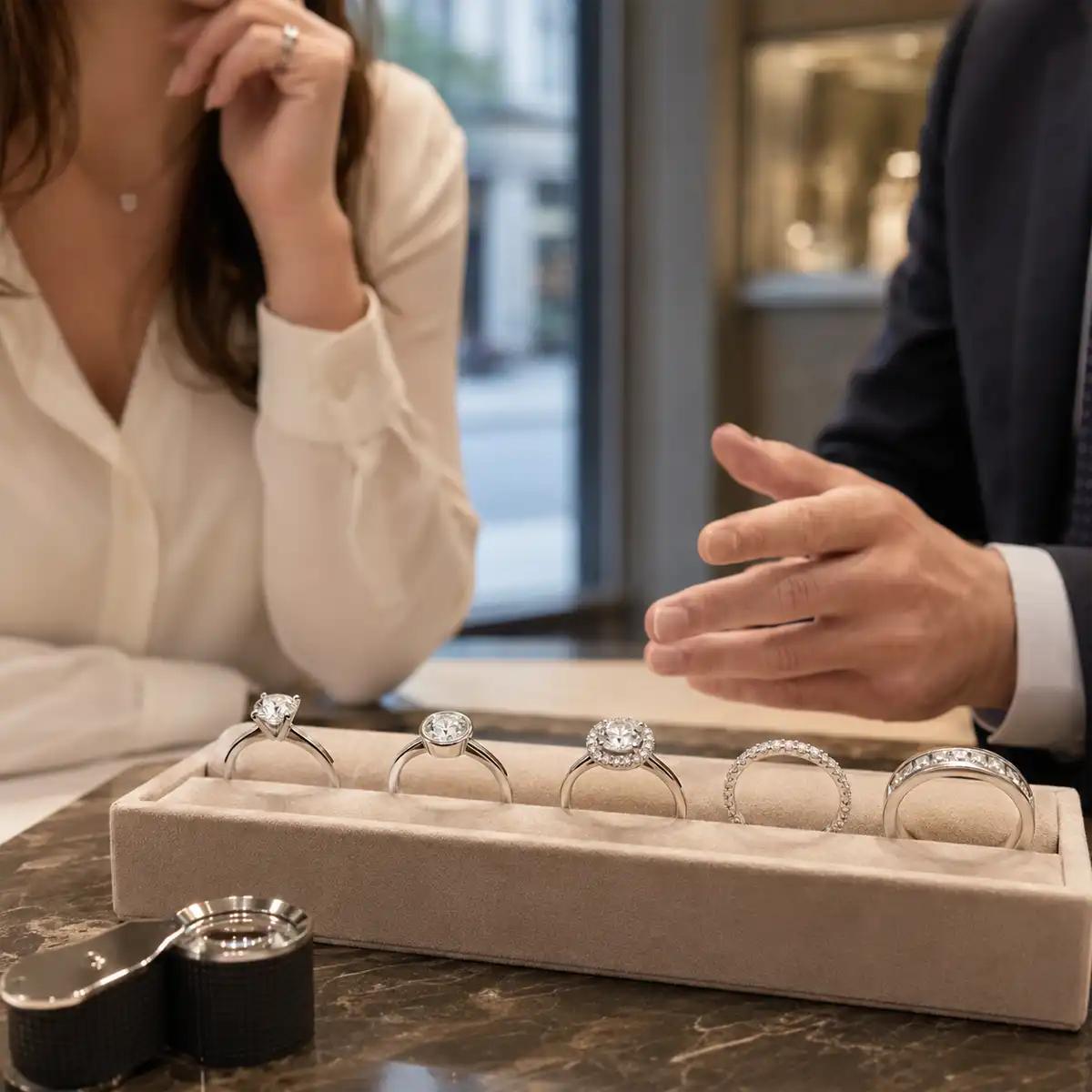
A useful first-consultation exercise is to try on 4 or 5 setting styles in the same metal with a comparable centre stone, under natural light at the showroom window. Most reputable Hatton Garden jewellers will have sample rings in each of the major categories available for handling. The hand-feel of each setting on the specific finger often makes the decision that specifications cannot. A setting that looks beautiful in the case may sit uncomfortably on the finger, catch on clothing, or sit too high for daily comfort. The bench's job is to produce the finished piece to specification; the buyer's job is to understand what specification will work.
Choosing your engagement ring setting in Hatton Garden
For a buyer approaching engagement ring settings in Hatton Garden in 2026, the right sequence is to choose the stone first, then try the stone or a comparable sample in 3 to 5 different setting formats at the same appointment before committing to a direction. Claw settings remain the adaptable default; halo settings maximise visual impact at a given carat weight; bezel settings suit active lifestyles; tension and collet settings suit specific aesthetic briefs and carry specific trade-offs. The workshop that builds the setting matters as much as the setting type itself; fabricated claw construction holds up better over 30 years than cast claw construction, and a specialist halo bench produces noticeably cleaner work than a generalist. Ask the jeweller who will actually build the setting, where the melee setting will be done, and what the resizing implications are before the commission begins.
Continue Reading
The Hatton Gazette
Delivered weekly to your inbox
Subscribe for the latest from Hatton.