The quiet truth about a great deal of jewellery seen on British screens is that the piece itself was made within a 5-minute walk of Chancery Lane station. Hatton Garden has supplied the bench-made and reproduction work for film, television, and theatre productions for as long as the modern British screen industry has existed, and the workshops on Greville Street and the streets running off it have produced commissions for productions filmed at Pinewood, Shepperton, and Leavesden. The story of the Hatton Garden engagement ring on screen is less about which celebrity wore which piece in a tabloid photograph and more about how a small concentration of EC1 workshops became the discreet engine room for jewellery in British and international film. For buyers researching the quarter for the first time, this hidden history is one of its most useful contexts.
Why production designers come to Hatton Garden
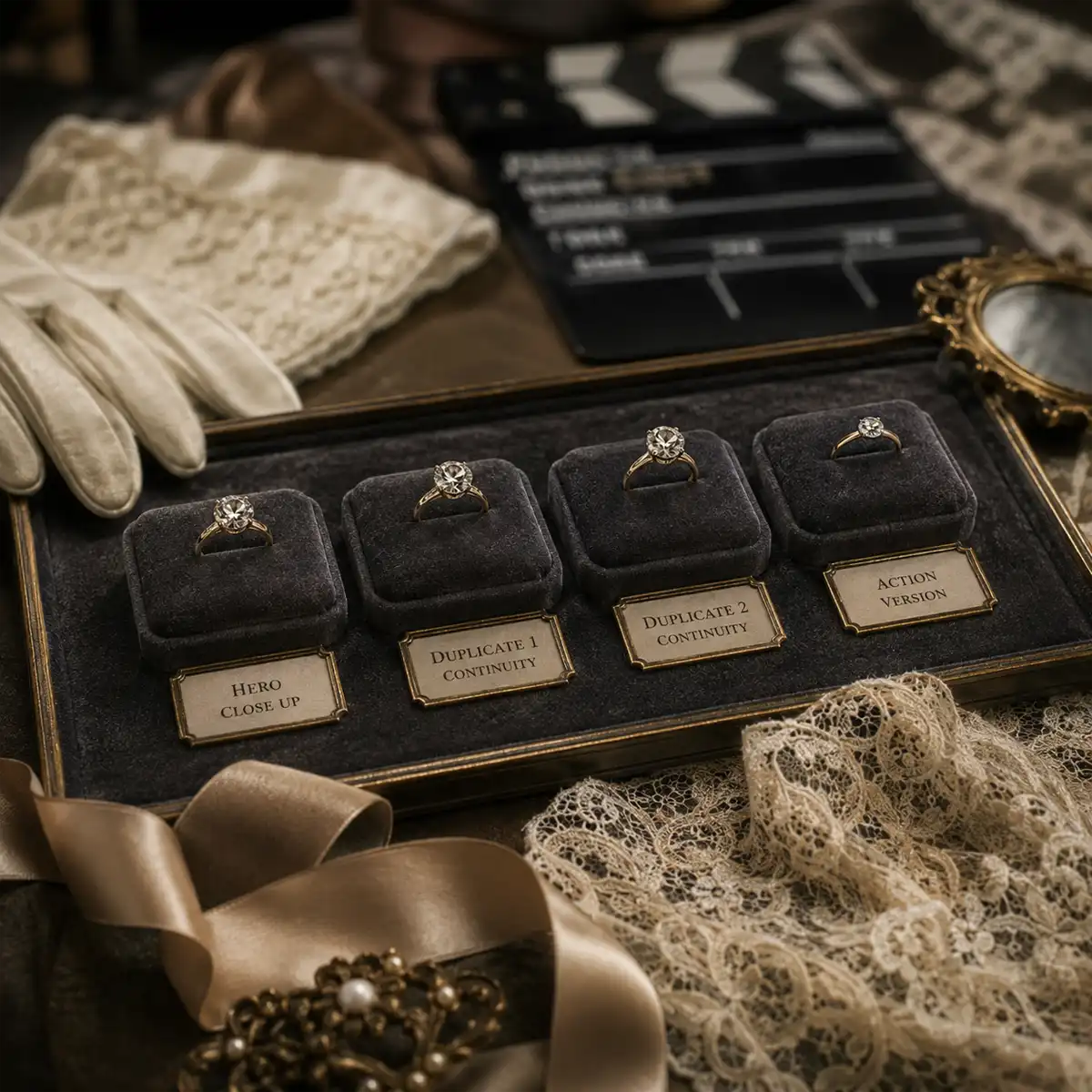
When a costume department needs an engagement ring for a period drama, the request is rarely for a single piece. A typical commission involves a hero ring for close-ups, two or three identical reproductions for stunt and continuity, and sometimes a deliberately downgraded version for scenes involving struggle or damage. Hatton Garden has the workshop concentration to deliver this kind of multi-piece commission on short turnaround, with the discretion that screen work demands and the period-accurate skill base required for Georgian, Victorian, Edwardian, and Art Deco reproductions. The quarter's bench jewellers can replicate setting techniques that have not been used in mainstream manufacture for a century, and that capability is what brings the production designers back.
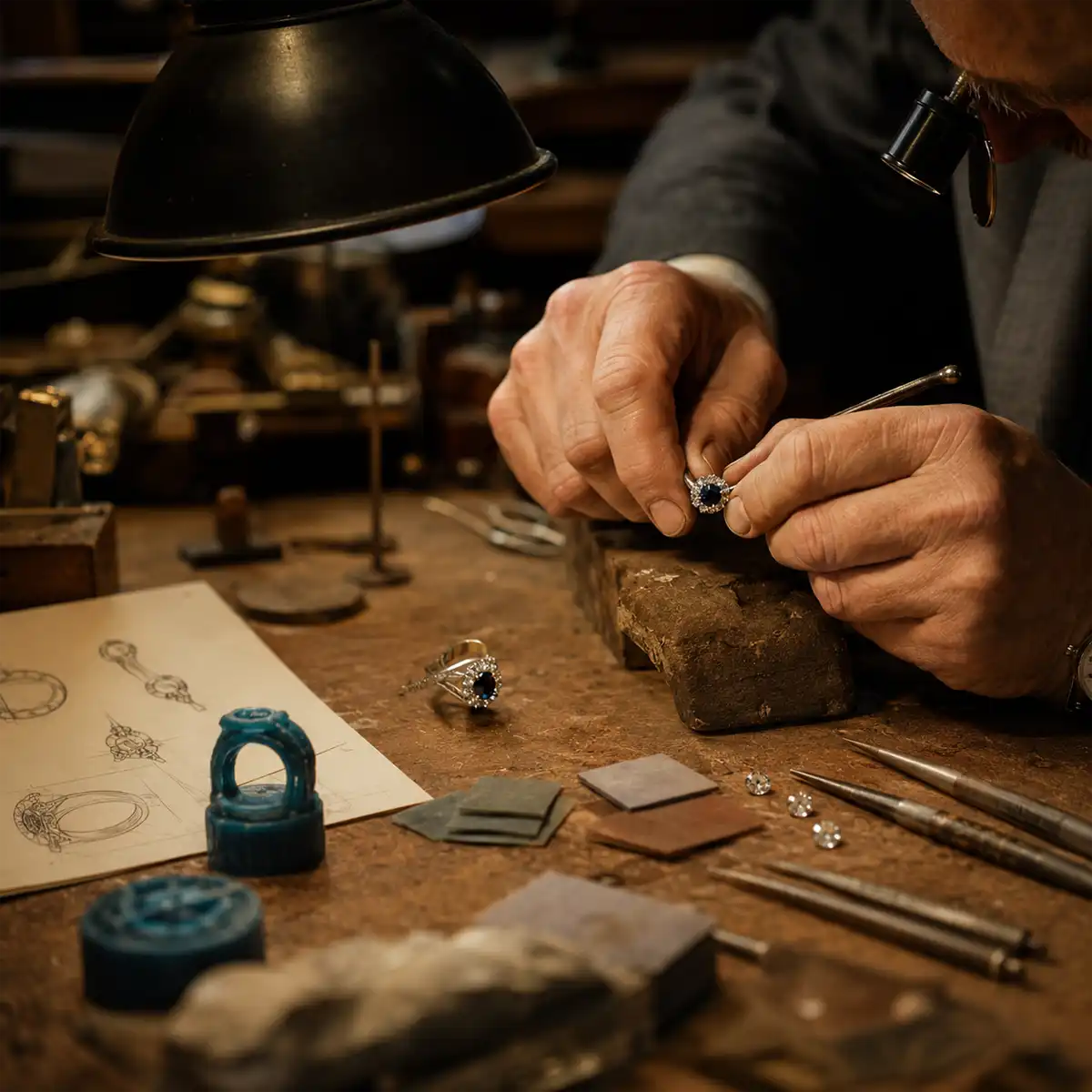
There are practical reasons too. A workshop in Hatton Garden engagement ring production for a film typically works directly with the costume designer rather than through a retailer, allowing the brief to remain confidential through the production. The Assay Office turnaround is rapid enough to meet shooting schedules, the alloys and gemstone sources are available within the same square mile, and the bench specialists can hand-engrave makers' marks and date letters that match a chosen period if the production requires it on a hero piece. Most of this work is never publicly acknowledged by the workshop that made it, because the contract with the production company requires that silence. The discretion is part of the service.
The documented royal engagement ring connection
The single most famous engagement ring in British public life, the Cleves blue sapphire surrounded by 14 round brilliant-cut diamonds set in 18-carat white gold, was designed by Garrard in 1981 for the engagement of Diana, Princess of Wales, to the then Prince of Wales. The ring later passed to Catherine, Duchess of Cambridge, in 2010. Garrard, the company that designed and produced the ring, was the long-standing Crown Jeweller and held that appointment until 2007, with workshops and trade connections that ran deep into Hatton Garden throughout the late 20th century. The piece itself was not made in Hatton Garden, but the wider story of its sapphire-and-diamond format, which has since been one of the most influential engagement ring templates in the world, has been replicated, adapted, and reinterpreted in EC1 workshops for more than four decades.
The point is not to claim the original. The point is to observe that an entire generation of Hatton Garden buyers has walked into the quarter asking for a version of that ring, and the bench jewellers in EC1 have built a quiet expertise in the cluster-and-halo sapphire format as a result. This is the most documented example of how a single royal commission can reshape a quarter's working stock. Anyone who has commissioned a sapphire halo ring in Hatton Garden in the last 15 years has been buying into a lineage that traces directly to that 1981 design.
Bond, period drama, and the discreet workshop chain
The James Bond franchise has used jewellery and precious-metal pieces from David Morris over multiple decades, a connection that is part of David Morris's published company history. David Morris began his career as an apprentice in Hatton Garden in the late 1950s and opened his first showroom in the quarter in 1962, and the company's working relationship with the Bond productions is one of the better-documented Hatton Garden screen connections. The pieces themselves are publicly attributed by the production and by the jeweller, which is the verification standard required for any claim in this article.
Period drama is the other consistent source of Hatton Garden screen work. Productions set in the Regency, Victorian, Edwardian, and Art Deco eras require engagement rings, mourning rings, and parures that are visually correct for their period. A modern reproduction made in EC1 with the appropriate setting style and stone choices will carry conviction on screen where a genuine antique cannot, because antiques are too valuable to risk on set and too fragile for the demands of repeated takes. The bench jewellers who do this work understand setting techniques that match the period brief, and the result is a parallel stock of period-accurate reproductions that occasionally enter the retail market after a production wraps.
How to spot a screen reproduction in the retail market
Buyers occasionally come across pieces in Hatton Garden antique cases that look genuinely period but carry modern hallmarks. The presence of a recent UK date letter on a ring that otherwise reads as 1920s Art Deco is not necessarily a sign of misrepresentation. It can be the legacy of a production commission, where a workshop made a period-accurate piece for a film or television production and the surplus inventory has entered the secondary market after the production. A reputable Hatton Garden dealer will tell you this openly if the piece is offered as a modern reproduction in a period style. The hallmark date letter will not lie.
The reverse situation is more concerning. A piece presented as a 1920s original that carries no hallmark, or carries a hallmark that does not match the claimed period, is a piece that needs further verification. Vivienne's standing advice on antique buying applies: provenance documentation, independent gemmological assessment, and a date letter that corresponds to the period claim are the three checks that protect a buyer. The screen reproduction market has expanded the pool of available period-style stock in Hatton Garden, which is on balance a good thing for buyers who want the aesthetic without the antique premium, provided the piece is honestly described.
Celebrity engagement rings and the Hatton Garden trade press
A 2024 trend across British jewellery trade press has been the increasing willingness of Hatton Garden bench workshops to publish, with client permission, the engagement rings they have produced for clients who appear in the public eye. This is a deliberate marketing shift away from the strict discretion that defined the trade for most of the 20th century, and it reflects a younger generation of jewellery commissioners who treat the design process itself as part of the engagement narrative. Several of the workshops named in coverage from 2024 and 2025 confirmed that the volume of celebrity and public-figure commissions running through Hatton Garden has grown alongside the wider visibility of bespoke engagement ring culture on social platforms.
This is the modern equivalent of the 1981 Cleves sapphire effect at a smaller scale. A documented celebrity engagement ring made in Hatton Garden becomes a reference point for the next 100 buyers who walk into the same workshop asking for something similar. The bench jeweller who produced the original is rarely named publicly in the celebrity coverage, but the workshop will quietly acknowledge it to a serious commissioning client during a consultation. This is one of the small advantages of consulting in Hatton Garden directly rather than buying from a high street retailer or an online specialist.
Fun fact: The 14 diamonds that surround the sapphire on the Cleves engagement ring were selected to be matched in colour and clarity grade, a level of stone matching that requires a working diamond-buying relationship with multiple suppliers and remains one of the most demanding tasks in Hatton Garden engagement ring production today.
Common questions about screen and celebrity jewellery in EC1
A snippet-ready answer for buyers searching for the relationship between Hatton Garden and the film industry reads as follows. Hatton Garden workshops in EC1 have supplied engagement rings, reproduction period jewellery, and bespoke pieces to British and international film productions for decades. Notable documented connections include David Morris and the James Bond franchise, and Garrard, formerly the Crown Jeweller, with trade links throughout the quarter. The work is typically commissioned through costume designers directly, with the workshops bound by confidentiality during production. Modern reproduction pieces made for productions occasionally enter the retail market afterwards and can be identified by their hallmark date letters.
Buyers sometimes ask whether they can commission a copy of a famous engagement ring seen on screen. The answer is yes in most cases, with the obvious caveat that reproducing a specific design too closely can raise design-right and trademark questions. A good Hatton Garden workshop will discuss the inspiration openly with you and offer interpretations that capture the essence of the original without infringing protected design elements. This is the standard practice in EC1 and reflects the quarter's longstanding role as a working interpreter of jewellery history.
Conclusion
The most useful thing a buyer can take from the Hatton Garden screen and celebrity story is not the names of the celebrities but the understanding that the quarter has been an interpretive engine for jewellery history since long before the modern luxury market existed. Walk into a first consultation aware that the bench jeweller you are speaking to has likely produced period reproductions, royal-influenced sapphire halos, and quiet commissions for clients you would recognise. Bring an image of any specific piece you want to reference, ask the workshop directly about their period reproduction capability, and ask which historical commissions or screen pieces they are willing to discuss. Most workshops in Hatton Garden will tell you more than you expect once they understand you are a serious commissioning client. The history is part of the service, and learning to ask for it is a useful part of the buying process.
Art Deco engagement rings in Hatton Garden
how to read a British hallmark on a period piece
first visit to Hatton Garden for engagement rings
Related reading: First visit to Hatton Garden, what every buyer needs to know, How to Buy an Engagement Ring in Hatton Garden EC1.
Continue Reading
The Hatton Gazette
Delivered weekly to your inbox
Subscribe for the latest from Hatton.