Few purchases carry the weight of an engagement ring, and fewer still involve walking into an unfamiliar quarter with a four-figure budget and only a rough idea of what to ask for. The emotional pressure is real, the financial stakes are higher than most people have ever committed to a single object, and the standard advice on how to buy an engagement ring in Hatton Garden is scattered across retailer blogs that all want the same outcome. What follows is the editorial view from the quarter itself, not from any single jeweller's showroom. Hatton Garden sits in the EC1N postcode between Chancery Lane and Farringdon stations, and more than 300 jewellery businesses trade within a few hundred metres of each other along Hatton Garden itself, Greville Street, Leather Lane and Ely Place. The purpose of the walk below is to set out the buying process stage by stage, the questions that matter most at each stage, and the realistic timings a first-time visitor to Hatton Garden should plan around in 2025 and 2026. Treat it as a working reference rather than a sales document, because the quarter genuinely rewards a prepared buyer and is rarely kind to a rushed one.
What is the right way to buy an engagement ring in Hatton Garden
The right way to buy an engagement ring in Hatton Garden is to book 2 or 3 appointments in advance, arrive with a defined budget and a shortlist of setting styles, and treat the first visits as learning sessions rather than purchase decisions. The quarter rewards buyers who compare stones and workshops before committing, and most reputable jewellers expect that process. Final purchase usually follows a second or third meeting.
This is a different buying culture from the high street. Oxford Street or Bond Street retailers are designed for walk-in and walk-out purchasing, with a single display and a single margin structure. Hatton Garden runs on appointments, wholesale-adjacent pricing and independent specialists who compete on craft and stone sourcing rather than on window displays. A first-time buyer who treats the quarter as a one-stop trip loses the core advantage the area offers.
Appointments are the norm for several reasons. The stones that matter for a serious engagement ring purchase are often held in the safe and shown under proper lighting only on request. Many bespoke workshops work by consultation and do not keep street-facing stock. And the jewellers worth returning to are the ones whose diary fills up with serious buyers, not drop-ins. Booking 2 weeks ahead for peak engagement season, which runs November through February, is realistic; 1 week ahead for most other periods.
What stone and setting questions to prepare before your first visit
The strongest position a first-time buyer can arrive in is one of prepared questions rather than fixed conclusions. The 4Cs framework, which covers cut, colour, clarity and carat, is the starting point, but the trade rarely thinks about the 4Cs as a checklist. A Hatton Garden jeweller will typically ask what matters most to the buyer, because the 4Cs are a set of trade-offs that require prioritising, not four boxes to tick.
A useful shorthand for a first conversation is this. Cut drives sparkle more than any other factor and is the one most buyers under-weight. Colour from D to F reads as cold white face-up; G and H read as white in most settings at most budgets; I and J carry warmth that some buyers prefer and others reject. Clarity from VS1 to VS2 is almost always eye-clean and represents the value sweet spot; SI1 and SI2 can be eye-clean but require inspection. Carat weight is the single biggest price driver, which is why Hatton Garden jewellers often recommend optimising the other three Cs to allow the carat weight the buyer actually wants.
On settings, the practical decision is daily wear. A solitaire in a 6-claw setting protects the stone and reads clean from every angle, which is why it remains the most popular setting category in the quarter year after year. A halo setting adds perceived size at a given carat weight and works particularly well with round brilliants and ovals; it has been the strongest-selling setting style across Hatton Garden since about 2020. A bezel setting is the most secure for active lifestyles but shows less of the stone's light performance, which is a trade-off to see in person under a jeweller's lamp rather than decide on from a photograph. A pavé band increases sparkle across the finger at modest cost and pairs well with almost any centre stone shape. Cathedral shanks raise the stone visually and suit taller hands. Three-stone settings carry a different emotional register and typically use side stones of 0.20 to 0.40 carats flanking a larger centre. Bringing a shortlist of 2 or 3 settings to a first consultation narrows the conversation productively, and most jewellers are happy to show adjacent variations they think might suit the same finger better.

What to bring and what to expect from a first consultation
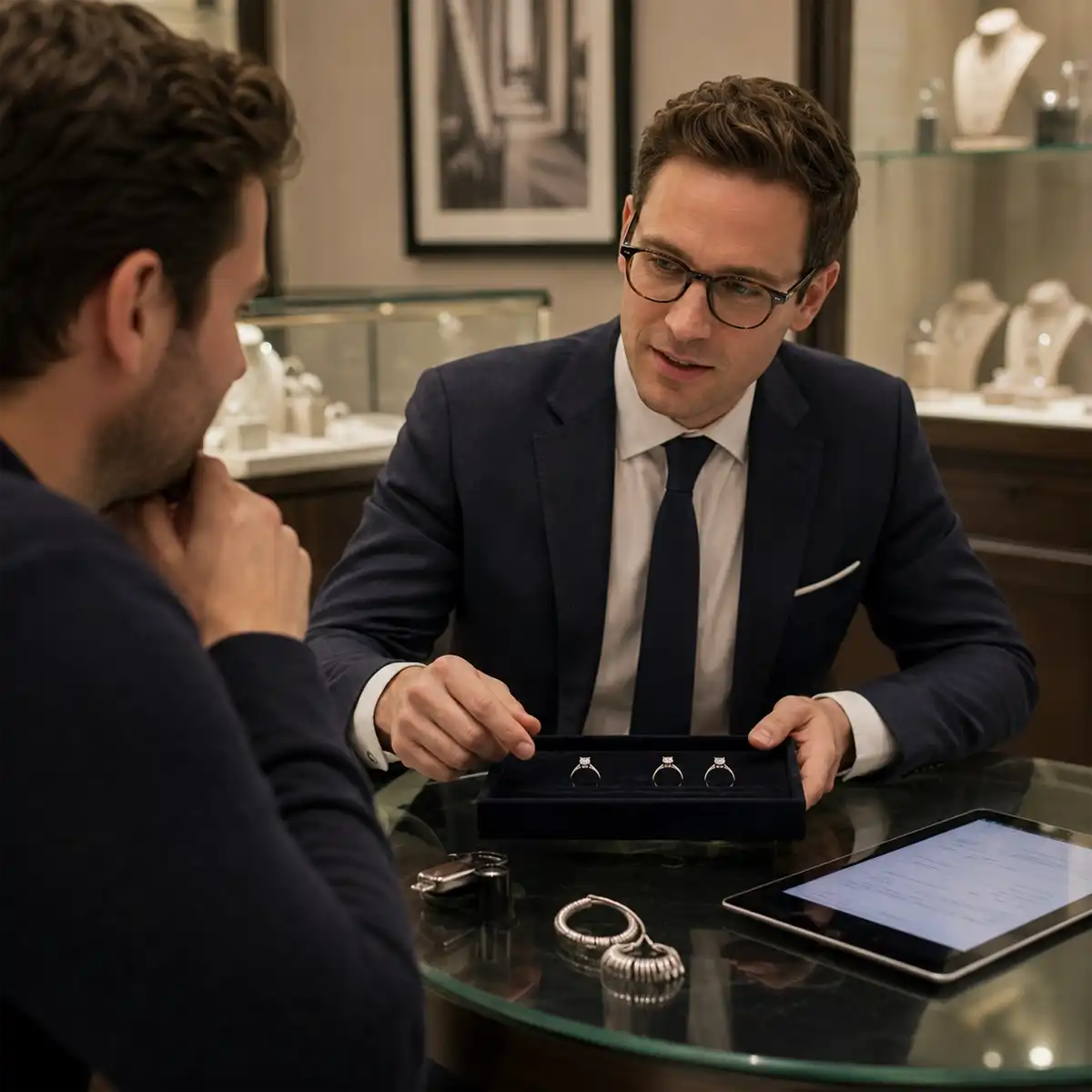
A first consultation in Hatton Garden is more productive when the buyer arrives equipped. Ring size if known, or a ring already worn on the correct finger; images of 3 or 4 settings that resonate; a clear budget expressed as a range rather than a single number; and any existing stones or gold earmarked for resetting or credit toward a new commission. If the purchase is intended as a surprise, a written size estimate and a borrowed ring for sizing are acceptable, though most Hatton Garden jewellers can adjust within 1 full size after collection at modest cost within the first year. A short note on the partner's daily work and lifestyle is also useful. Hands that spend time at a keyboard tolerate a different setting profile from hands that garden, swim or carry young children, and the jeweller will factor that into recommendations on setting height, claw count and metal choice.
Consultations typically run 45 to 60 minutes for a standard engagement ring brief, longer for bespoke commissions. The jeweller will walk through stone options at the agreed budget, show 3 or 4 settings in metal, and explain what certification to expect. Reputable HG jewellers will offer GIA or IGI grading reports for diamonds above 0.30 carat; for stones under that weight, certification is less standard and the jeweller's own verification becomes the primary reference.
Payment structure for a standard stock engagement ring is generally full payment on collection or a deposit with balance on delivery. For bespoke commissions the structure is typically 50% deposit to commence work, with the balance payable on final viewing before collection. Card and bank transfer are standard; for higher-value transactions bank transfer is usually preferred. Anti-money-laundering identification checks apply on purchases above certain thresholds and are a compliance requirement rather than a red flag.
Why the Hatton Garden process works differently from high street retail
The structural reason the quarter's buying process is different comes down to supply chain position. Hatton Garden jewellers operate adjacent to the London Diamond Bourse and trade with the cutting centres in Antwerp, Mumbai and New York directly. A high street retailer in a chain format buys finished rings through a central purchasing function, which adds a brand premium and a retail margin on top of the wholesale stone price. Independent HG jewellers typically compress those steps into one, and the price structure reflects that compression.
The trade-off is comparison shopping. A chain retailer offers a standardised product that is easy to compare across branches and online listings. An independent HG jeweller offers access to a specific pool of stones sourced from a specific set of suppliers, which means two Hatton Garden jewellers may quote materially different prices for stones that read as equivalent on paper. That is why the 2 or 3-appointment rule exists. Three quotes on comparable GIA-graded stones is the realistic way to understand the market for any given brief.
Reputation signals in the quarter are not the same as high street brand signals. Membership of the National Association of Jewellers, Assay Assured retailer status, Responsible Jewellery Council certification, and listing on the London Diamond Bourse are the indicators that carry weight. A long trading history at a single Hatton Garden address, typically 10 years or more, is a stronger signal than polished marketing copy. A buyer who asks about NAJ membership and RJC certification at the first consultation demonstrates literacy that reputable jewellers respect.
What to check on certification and what to plan for after collection
On the certification front, a GIA report for a diamond above 0.30 carat is the benchmark; an IGI report is a widely accepted alternative and is the standard certification for lab-grown diamonds. Either report should show the cut, colour, clarity, carat, proportions, and polish and symmetry grades, and for larger stones a plotted diagram of any inclusions. The laser inscription on the girdle matches the report number and is the verifiable link between paper and stone. Natural diamonds remain the primary stone for an engagement ring purchase in Hatton Garden, with lab-grown diamonds available as a clearly delineated alternative for buyers who prioritise size at a given budget and accept the different secondary-market value pattern.
GIA and IGI diamond certification
Fun fact: Sir Christopher Hatton, the Elizabethan courtier whose name the quarter carries, received his Holborn estate from Queen Elizabeth I in 1576 at a rent of £10 per year and ten loads of hay, not for jewellery trade but for dancing at court.
After collection, the immediate next step is an independent insurance valuation, which is distinct from the purchase receipt. A proper valuation documents replacement cost at current market rates and is the document insurers require. Ring insurance is usually arranged as a rider on a home contents policy or through a specialist jewellery insurer such as TH March or Assetsure. Resizing within 1 full size is generally free or modestly priced within the first year from most Hatton Garden jewellers; beyond that, resizing is chargeable and may require partial setting removal for larger adjustments, which is why getting the initial size right matters. Rhodium-plating on white gold will typically need refreshing every 12 to 18 months of daily wear, depending on skin chemistry and how active the wearer is, and most reputable HG jewellers include the first service within the first year at no extra charge. Platinum does not require rhodium plating and develops a soft patina over time that many owners prize, though polishing to a bright finish is available on request.
bespoke engagement ring process
Your next steps for buying an engagement ring in Hatton Garden
For a first-time buyer approaching Hatton Garden in 2026, the right move is to treat the quarter as a 2 or 3-appointment process rather than a single shopping trip. Book ahead, arrive at each consultation with a defined budget, a shortlist of settings and a few honest questions about the 4Cs trade-offs that matter most at that budget. Ask for GIA or IGI certification on any diamond above 0.30 carat and confirm NAJ membership, Assay Assured status or RJC certification at the first visit. For engagement season, start the process 3 months before the intended proposal date to allow for bespoke lead times of 6 to 10 weeks and a clean fit at the end. The quarter rewards patience and preparation more than it rewards negotiation, and a well-prepared first visit is the single most valuable hour of the purchase.
Explore Engagement Rings by Style and Approach
Hatton Garden covers every style and budget. These guides go deeper on each route:
- Bespoke engagement rings and what the commission process involves
- The most popular engagement ring styles in the UK
- Ring settings explained
- Art Deco engagement rings and antique engagement rings
- Ethical and traceable engagement rings
- Sapphire and emerald engagement rings
- Buying on a budget and buying to a tight deadline
- What to expect on your first visit
- Ring size chart and how to measure
To browse the workshops themselves, see our directory of Hatton Garden engagement ring specialists.
Continue Reading
The Hatton Gazette
Delivered weekly to your inbox
Join 12,000+ Hatton insiders