There is a moment familiar to anyone who has walked Hatton Garden looking for an engagement ring. You ask for a 1.50ct oval, F colour, VS1, and the jeweller says yes, of course, and disappears into the back. What happens next is rarely explained. A growing number of Hatton Garden jewellers between Greville Street and Leather Lane do not hold that stone in the safe at all. It is in a supplier's vault in Antwerp or Mumbai, visible to the jeweller through a wholesale marketplace, and it will be ordered the moment you commit.
This is not a trick and it is not new. What is new is that the same inventory now appears on the jeweller's public website, priced and filterable, before you set foot in the EC1N postcode. Understanding how retailers of diamond rings Hatton Garden wide actually source their stones will make you a considerably better buyer, and it changes which questions are worth asking across the counter.
How Hatton Garden Jewellers Sell Stones They Do Not Own
Most Hatton Garden jewellers hold a modest core stock and source the rest on demand from wholesale marketplaces. When you select a stone, the retailer places an order with the supplier, the stone ships to London, and it is set in your chosen mount. You pay the retailer, and the retailer pays the supplier. Legally and practically, you are buying from the jeweller.
The model exists because diamonds are capital-intensive and individually unique. A 1.50ct F VS1 oval with excellent cut, polish and symmetry is not a commodity that can be restocked from a warehouse. It is a single object. A retailer holding 400 such stones would have several million pounds of dead capital sitting in a safe, most of which would never match a specific customer's brief.
On-demand sourcing solves that. It also explains something buyers often find confusing, which is why two Hatton Garden shops 40 metres apart can quote near-identical stones at meaningfully different prices. They may well be selling the same physical diamond from the same supplier, differing only in markup, setting quality and service.
What Changed When the Inventory Went Online
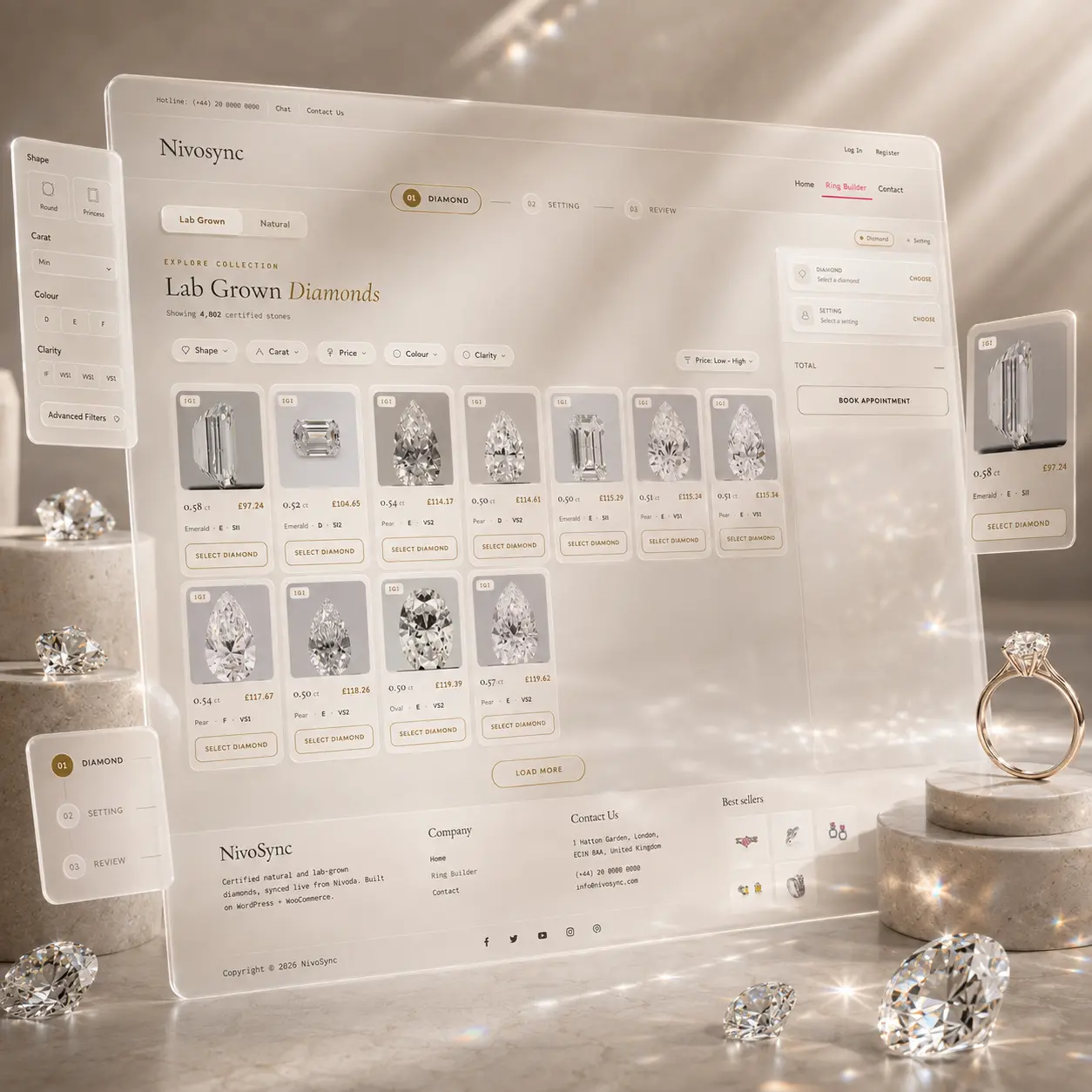
Until recently, that wholesale inventory was invisible to the public. The jeweller searched it on a trade terminal in the back office and read out the results. Now retailers publish it directly, which is the single largest shift in Hatton Garden's shop-window economics since the arrival of laboratory certification.
The obstacle used to be cost. Wiring a wholesale marketplace into a retail website is a software project, and agencies have routinely quoted £15,000 to £40,000 for the integration alone, before design, and before the ongoing maintenance that API changes and pricing edge cases demand. For an independent with 6 staff, that was not a rational spend.
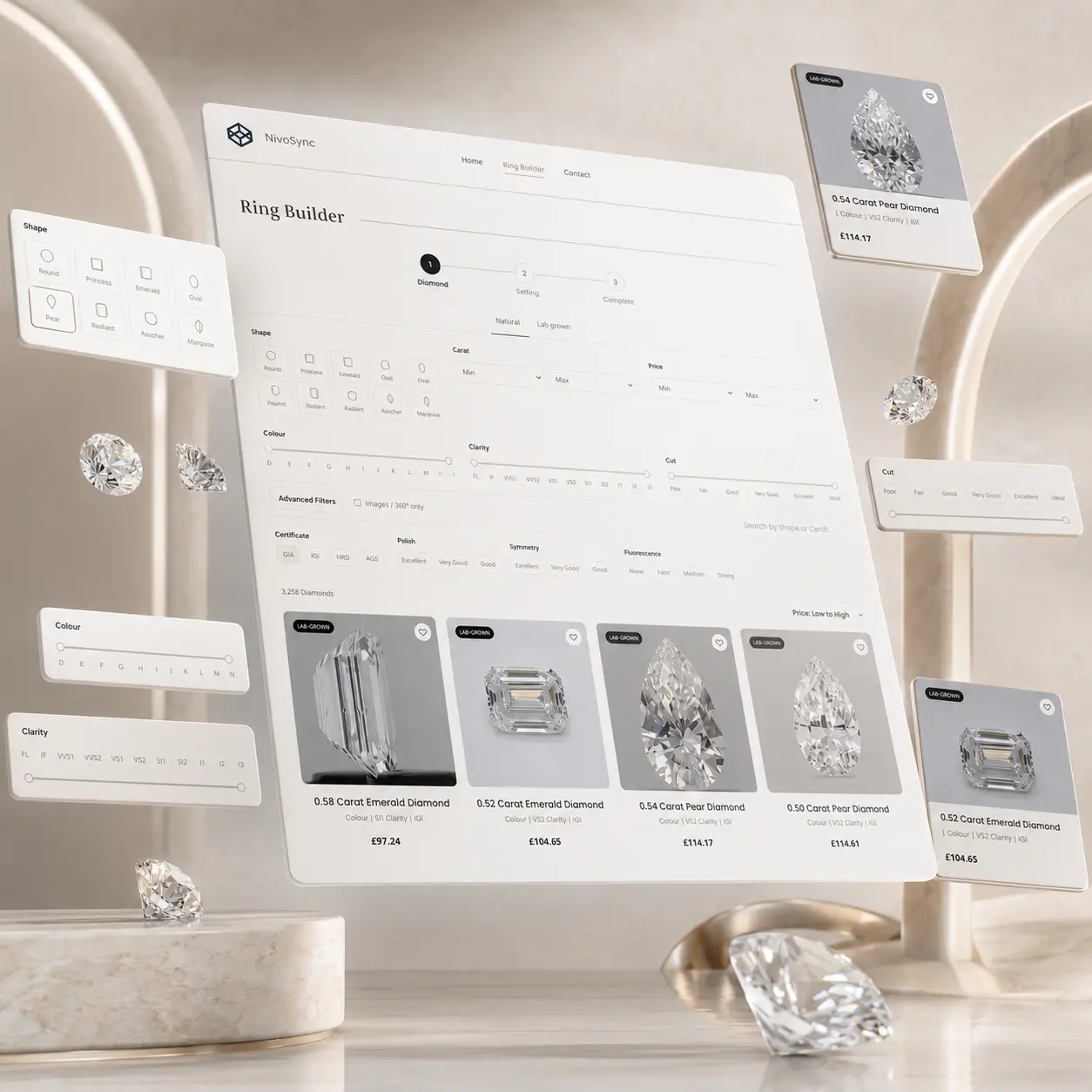
Packaged software changed the arithmetic. A diamond catalogue plugin for WordPress now delivers the sync, the caching, the markup engine and the checkout as a licensed product rather than a bespoke build, which moves the decision from a capital project to an annual line item. That is why the number of Hatton Garden shops with genuinely live online stock has risen sharply rather than gradually.
What a Buyer Gains From a Live Catalogue
A live catalogue gives buyers three things that a showroom visit alone cannot. It gives unhurried comparison, it gives certificate transparency before any sales conversation, and it gives an honest read on price positioning across the district.
Comparison matters most. Diamond pricing is not linear, and the steps between grades are where value is won or lost. A stone one clarity grade lower, at VS2 rather than VS1, is very often indistinguishable to the unaided eye in a mounted ring while costing appreciably less. Seeing 40 stones in a filterable grid teaches that lesson in 10 minutes. Seeing 4 stones on a tray teaches it slowly, if at all.
Certificate transparency is the second gain. Every reputable listing carries the laboratory and the certificate number, and you can verify that number directly on the issuing laboratory's own website. The differences between grading bodies are real and worth understanding before you compare prices, a subject we cover in detail in our comparison of GIA and IGI diamond certification. Broadly, GIA grading is the stricter benchmark and commands a premium, while IGI has become the dominant laboratory for lab-grown stones.
Fun fact: Hatton Garden's association with the jewellery trade dates to the late 18th century, but the street itself is named after Sir Christopher Hatton, a favourite of Elizabeth I who acquired the land from the Bishop of Ely in 1581.
The Question Every Buyer Should Ask About Stock Holds
Ask the jeweller what happens to your stone between the moment you pay and the moment it ships. The answer reveals whether their catalogue is genuinely connected or simply a periodically updated list.
A properly integrated system places an automatic hold on that specific stone with the supplier at checkout and releases it if the order is cancelled or refunded. Without that hold, there is a real window in which the same one-of-a-kind diamond can be sold twice, once by your jeweller and once by a retailer in another country working from the same marketplace. The customer who loses that race receives an apologetic call and a suggestion of an alternative stone.
This is not a hypothetical failure mode. It is the most common operational complaint in on-demand diamond retail, and it is entirely preventable with software that does the job properly. The technical detail behind how these integrations are built is covered in our partner analysis of connecting wholesale diamond data to a WordPress store, and the short version is that the hold logic is the part cheap implementations skip.
Does On-Demand Sourcing Reduce the Value of Visiting Hatton Garden
No, and the reason is instructive. The stone is roughly 60% to 75% of the cost of a typical certificated engagement ring, but it is close to 0% of the craft. Setting, finishing, sizing and the judgement involved in matching a stone to a mount are where a Hatton Garden workshop earns its reputation.
A poorly set excellent diamond looks worse than a well set very good one. Claw thickness, seat depth, the alignment of a halo, the finish on a cathedral shank and the tension in a pavé run are all hand skills, and they are the reason bespoke commissions in the district still quote lead times of roughly 6 to 8 weeks rather than 6 days. The full commissioning sequence, from CAD to hand-finishing, is set out in our overview of the bespoke engagement ring process.
Viewing also matters because certificates describe stones, they do not photograph them. Two diamonds with identical grading reports can differ visibly in brilliance depending on crown angle, pavilion depth, girdle thickness and fluorescence behaviour under different lighting. Ask to see your shortlisted stones under both daylight-balanced and warm light before deciding.
Your Rights and Protections When Buying This Way
Buying a sourced-to-order diamond does not weaken your consumer position, but it does change which rules apply. Your contract is with the retailer, so the Consumer Rights Act 2015 governs faults and misdescription regardless of where the stone originated. If the delivered stone does not match its certificate, that is a misdescription and the retailer is responsible.
Distance selling rules give a 14-day cooling-off period for goods bought online, with an important exception. Rings made to your specification, including a stone set into a mount you selected, are generally treated as bespoke and fall outside automatic return rights. Confirm in writing at deposit stage whether your order is classified as bespoke, because this is the most common source of dispute. Our fuller treatment of UK consumer rights for jewellery buyers covers the exceptions in detail.
Check hallmarking too. UK law requires precious metal articles above the statutory weight thresholds to carry an Assay Office hallmark, and London or Birmingham marks are the ones you will most often see on Hatton Garden work. Membership of the National Association of Jewellers is a further, though voluntary, credibility signal worth asking about.
How to Use the Catalogue and the Street Together
The best approach treats the website as research and the visit as verification. Shortlist online, then go in person, and let the two stages do different jobs.
Before you visit, save 4 or 5 stones spanning a modest range of grades, ideally with at least one option each side of your target on colour and clarity. Record the certificate numbers. Set a budget for the stone and a separate budget for the setting, because conflating the two is how buyers overspend without noticing.
At the appointment, ask to see your shortlist side by side, ask which stone the jeweller would choose personally and why, and ask what the same money buys if you drop one grade. Ask about resizing policy, the aftercare interval for checking settings, and whether an insurance valuation is included. Then ask about lead time honestly, particularly if you are buying between October and February when workshop capacity in the district tightens ahead of Christmas and Valentine's Day.
The advantage Hatton Garden jewellers hold was never that they kept every diamond in a drawer. It was that the expertise sat within a few hundred metres of itself. Live inventory has simply made the district's real strength easier to reach, and the buyer who researches diamond rings online before arriving now walks in better prepared than almost anyone did a decade ago.
Continue Reading
The Hatton Gazette
Delivered weekly to your inbox
Join 12,000+ Hatton insiders