Most buyers who commission a bespoke engagement ring have never watched a stone-setter work. They have seen a finished ring on a cushion, perhaps a CAD render on a screen, and a few photographs of stones under showroom lights. The bespoke engagement ring process in Hatton Garden is more interesting than any of those snapshots suggest, because it runs across 5 to 7 distinct workshop stages, most of them carried out by different specialists, most of them invisible to the buyer, and all of them happening within a 400-metre radius of each other in the EC1N postcode. Hatton Garden is the only quarter in the UK where a commission can move from stone selection at the London Diamond Bourse, to CAD design, to wax carving, to casting, to setting, to hand-finishing, to hallmarking at Goldsmiths' Hall, all without leaving walking distance from Chancery Lane station and the Farringdon Elizabeth line exit. This is why the bespoke engagement ring process in Hatton Garden works on lead times that independent workshops outside the quarter cannot match, and on a cost structure that reflects workshop-to-workshop competition at every stage.
What the bespoke engagement ring process actually involves
The bespoke engagement ring process in Hatton Garden moves through stone selection, brief and CAD design, wax or resin model approval, lost-wax casting, fabrication and assembly, stone setting in sequence, hand-finishing and polishing, and hallmarking at the London Assay Office. Most commissions complete in 6 to 10 weeks from brief to collection. Each stage involves specialist bench workers, which is why workshop density in the quarter matters structurally to the process.
A first-time bespoke client typically walks into a showroom on Hatton Garden itself or Greville Street, describes what they want in rough terms, and is shown examples of comparable work. The first consultation takes 45 to 90 minutes and covers three things. Stone selection, which means either selecting a loose stone from the jeweller's inventory or commissioning one through a bourse dealer. Setting concept, which is translated into a rough sketch or design brief. And budget structure, which separates stone cost from making cost, because the two behave differently through the commission.
The making cost itself is driven by four inputs. Metal choice and weight, because platinum at 950 fineness is denser and costlier than 18ct gold at 750 fineness which is in turn costlier than 14ct gold at 585 fineness. Gemstone setting complexity, because a pavé band with 40 melee diamonds takes more bench hours than a single 6-claw solitaire. Design complexity, which covers filigree, engraving, milgrain edges and pierced galleries. And labour rate, which varies modestly between independent workshops in the quarter but which is fundamentally lower than equivalent bench labour elsewhere in central London because of the volume of trained bench workers in EC1N.
CAD design, wax carving and what each stage adds
After the first consultation the jeweller typically returns within 3 to 5 working days with a CAD render, which is a photorealistic computer-generated 3D model of the ring at accurate proportions. The CAD stage confirms three things. The geometry of the setting, including stone orientation and claw placement. The shank profile and thickness. And the overall proportions as the ring will appear on the finger. CAD cannot simulate two things that matter enormously. The light performance of the actual stone in the actual setting. And the weight of the finished piece in the hand. Both of those require the next stage.
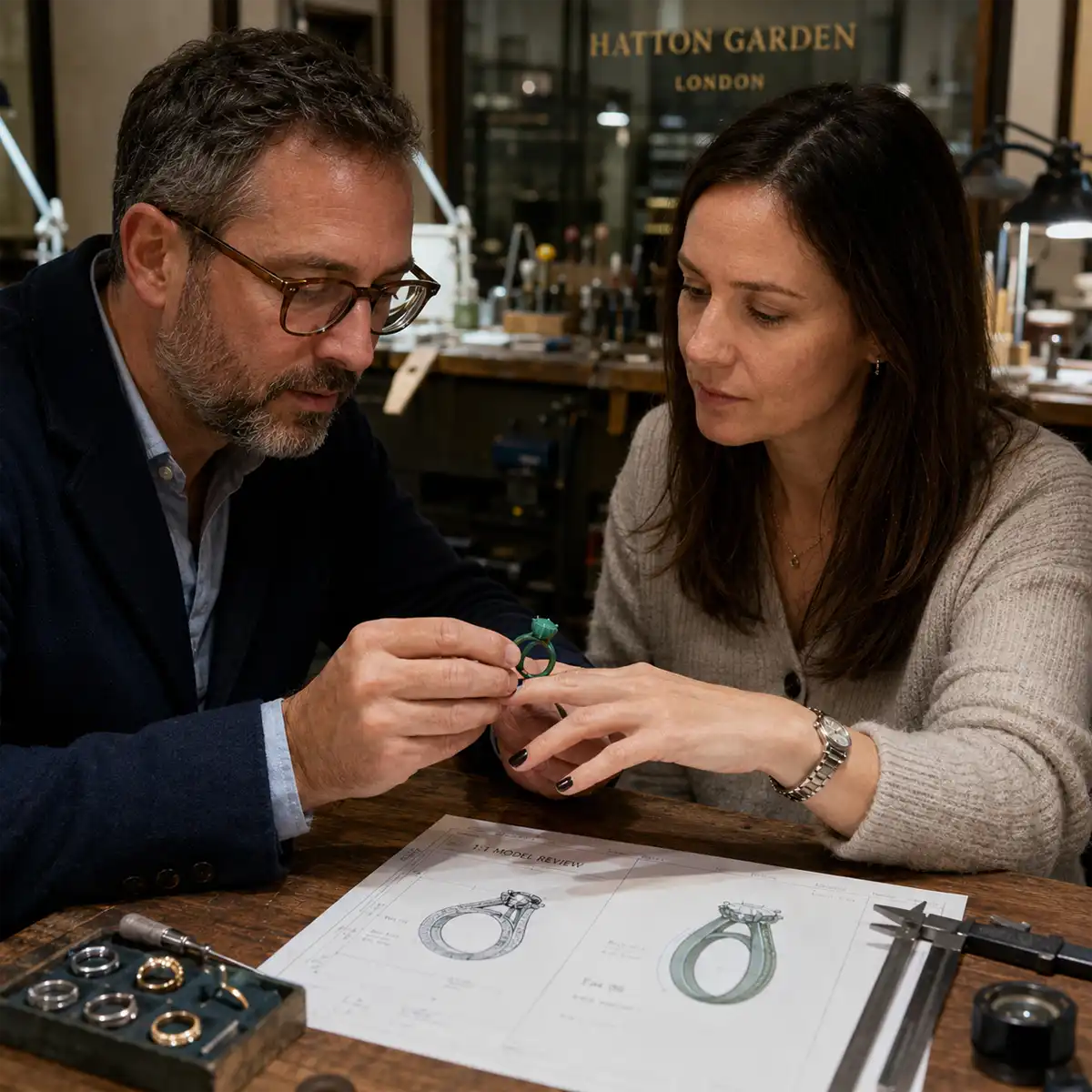
The wax or resin model is either carved by hand from a block of jeweller's wax, or 3D-printed in a castable resin from the approved CAD file. Hand-carved wax takes longer and costs more, and is typically used for heavily sculptural or filigree-heavy designs where the bench worker wants to feel the form as it takes shape. Resin printing is faster and cheaper and is the standard approach for geometric or symmetrical designs that benefit from CAD precision. Either output produces a 1-to-1 scale model of the ring that the client can handle, weigh in the hand and inspect from every angle. This is the stage where minor adjustments are cheap; once the model is approved and casting begins, changes become expensive and time-consuming.
The model review is the most important client-facing stage of the whole commission. An experienced Hatton Garden jeweller will walk the client through the proportions slowly, hold the model against the client's finger, check shank comfort and confirm every detail one element at a time. This is not sales theatre; it is risk management. A design issue caught at model stage costs nothing to fix. The same issue caught at the finished piece stage costs the entire casting and setting labour to remake.
Lost-wax casting and fabrication techniques in Hatton Garden
Casting in Hatton Garden is done almost exclusively by lost-wax investment casting, a technique that has been standard in fine jewellery since the 1960s and refined continuously since. The approved wax or resin model is encased in investment plaster inside a steel flask, the plaster is cured, the wax or resin is burned out in a kiln at approximately 720°C, and molten metal is injected into the resulting cavity under vacuum or centrifugal pressure. The casting runs to several rings per flask in a production workshop and to single pieces in a bespoke-dedicated workshop. Most of the casting for Hatton Garden bespoke commissions is outsourced to specialist casting houses within the quarter, which run daily casting schedules and typically return cast pieces to the commissioning jeweller within 2 to 3 working days.
Fabrication is the alternative construction route for certain design types. Where lost-wax casting produces a single cast body, fabrication builds the ring from sheet, wire and hand-soldered components. Art Deco-influenced designs, pieces with complex millegrain edges, and pieces where a specific structural strength is required at the shank are sometimes fabricated rather than cast. Fabrication costs more bench hours and runs to a higher making price, but produces a piece with denser metal structure and, in the hands of a skilled bench worker, crisper detail than casting alone can produce. Many Hatton Garden commissions use both techniques, with a cast base body and fabricated detail work soldered on.
Metal choice at the casting stage is essentially binding. Platinum at 950 fineness is the standard for diamond engagement rings that are intended to be worn daily for decades, because platinum scratches and burnishes rather than wearing away under abrasion. 18ct white gold at 750 fineness is brighter but requires rhodium plating that needs refreshing every 12 to 18 months. 18ct yellow gold and 18ct rose gold hold colour over time and do not require plating. 14ct gold at 585 fineness is harder and more scratch-resistant but less luxurious in appearance, and is more common in commissions intended for active daily wear. Palladium, 950 fineness, is hypoallergenic and platinum-adjacent in appearance, at a lower weight and a modestly lower price.
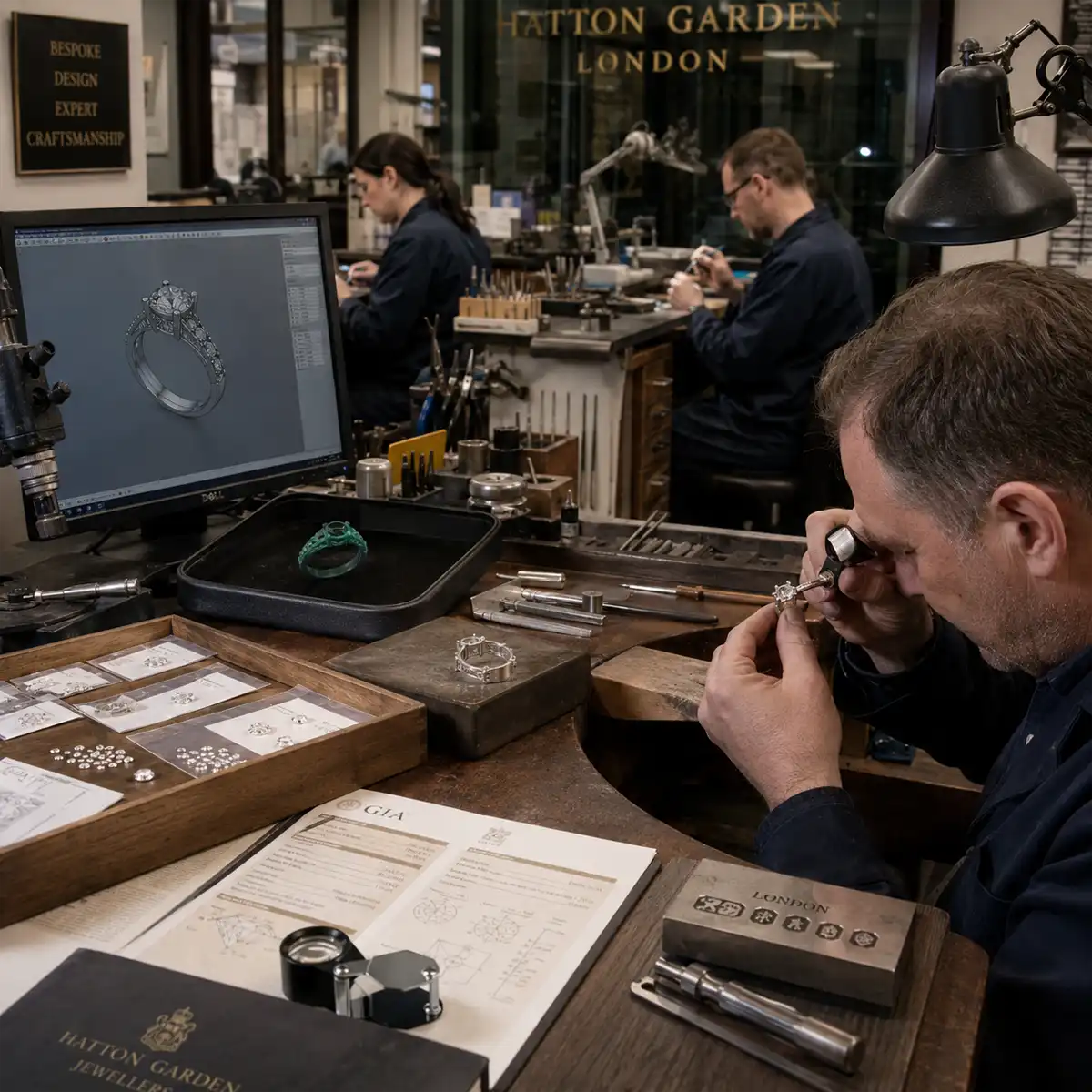
Stone setting sequence and hand-finishing
Setting is where the commission becomes irreversible, and it is the stage where Hatton Garden's workshop density shows most clearly. A single ring may pass through 2 or 3 specialist setters during setting, with a claw-setter working the centre stone, a pavé specialist working the band, and a millegrain specialist finishing the beading edges. Each setter holds decades of bench experience in their specific technique, and the interplay between them is part of what produces a finely finished Hatton Garden piece. The sequence matters. A setter works the centre stone first, confirming claw tips are seated correctly against the crown and pavilion, before any pavé melee is set, because the centre stone placement dictates the rest of the geometry.
After setting, the ring moves to polishing. A skilled polisher works the piece in stages, using progressively finer abrasive compounds on cotton buffing wheels to remove setting marks, tool marks from fabrication and any micro-scratches from casting. Platinum polishes to a bright white finish that develops a soft patina over time. 18ct white gold polishes brighter still but shows the plating edge where it will eventually wear. Hand-finishing at this stage includes checking the inside of the shank for comfort, confirming the ring sits flat on a flat surface, and testing the gallery structure for any play or movement.
Hallmarking is the final stage before collection, and it happens at the London Assay Office in Goldsmiths' Hall on Gutter Lane, a 10-minute walk from Hatton Garden. British law requires hallmarking on precious metal pieces above certain weight thresholds, and the process takes 2 to 5 working days depending on the Office's workload. The ring returns to the jeweller with the sponsor's mark, the fineness mark, the London Assay Office leopard's head and the date letter struck inside the shank. For some pieces the jeweller may add the commemorative additional mark for a specific anniversary year at the buyer's request.
What to ask the workshop before committing to a bespoke commission
A first-time bespoke client can ask a small set of questions that reveal a great deal about the workshop's depth. Ask whether the setting will be done in-house or outsourced. A reputable jeweller will typically have in-house setting for the centre stone and may outsource pavé and millegrain to specialists in the quarter; both approaches are legitimate, and the transparency is what matters. Ask who the caster is, because a jeweller who cannot name the casting house or the casting schedule is not tracking the commission tightly. Ask for the lead time in working weeks rather than calendar weeks, because engagement season delays at the London Assay Office can add 1 to 2 weeks in November and December.
Fun fact: The London Assay Office at Goldsmiths' Hall is the oldest in the UK, with its hallmarking authority traceable to a statute of 1300, and its leopard's head town mark has been struck on silver and gold assayed in London for 726 years, making it one of the longest-running consumer protection marks in continuous use anywhere in the world.
Payment structure for a bespoke commission follows a consistent pattern across the quarter. A 50% deposit to commence stone procurement and CAD work, with the balance payable at final viewing before collection. Some workshops may stage the payments across stone payment, casting deposit, and final balance, which reduces cash flow risk for both parties on higher-value commissions. Anti-money-laundering identification is taken at the deposit stage and is a regulatory requirement rather than a comment on the transaction. On collection the buyer receives the ring, the certification for any certified stones, a hallmarking note where relevant, an independent insurance valuation arranged before or after collection, and the jeweller's own sale receipt.
Planning your bespoke engagement ring commission in Hatton Garden
For a buyer approaching a bespoke engagement ring commission in Hatton Garden in 2026, the right starting position is to understand that bespoke is a collaborative process across multiple workshops, and that the quarter's structural advantage is the density of those workshops within walking distance of each other. Book the first consultation 3 months before the intended proposal date to allow for 6 to 10 working weeks of commission time plus engagement-season delays at the London Assay Office. Prepare the brief with a clear stone specification, a setting concept with 2 or 3 reference images, and a defined budget covering both stone and making cost. Ask the jeweller for references to workshops they use, lead times in working weeks, and a written model approval protocol before deposit. The quarter rewards a prepared client who understands the process; it is harder on a client who expects a bespoke commission to work like a retail purchase.
Continue Reading
The Hatton Gazette
Delivered weekly to your inbox
Join 12,000+ Hatton insiders


