Inside the shank of almost every precious metal ring sold in the UK sits a small cluster of marks that most buyers glance at once and never look at again. Those marks are the UK hallmark, and they are the oldest continuous consumer protection system in the world, operating under statutory authority since 1300. A bespoke engagement ring commissioned in Hatton Garden will be hallmarked at the London Assay Office at Goldsmiths' Hall on Gutter Lane, a 10-minute walk from the quarter, before it returns to the workshop for final polishing and presentation. Hatton Garden itself sits along the EC1N postcode between Chancery Lane and Farringdon stations, 3 minutes from the Farringdon Elizabeth line exit, and the proximity to the Assay Office is one of the structural reasons the quarter's bespoke commission turnaround is faster than independent workshops elsewhere in the UK. Knowing how to read a UK hallmark helps a buyer verify purity, identify age, confirm origin, and spot the rare cases where a hallmark does not say what the seller claims.
What a UK hallmark actually consists of
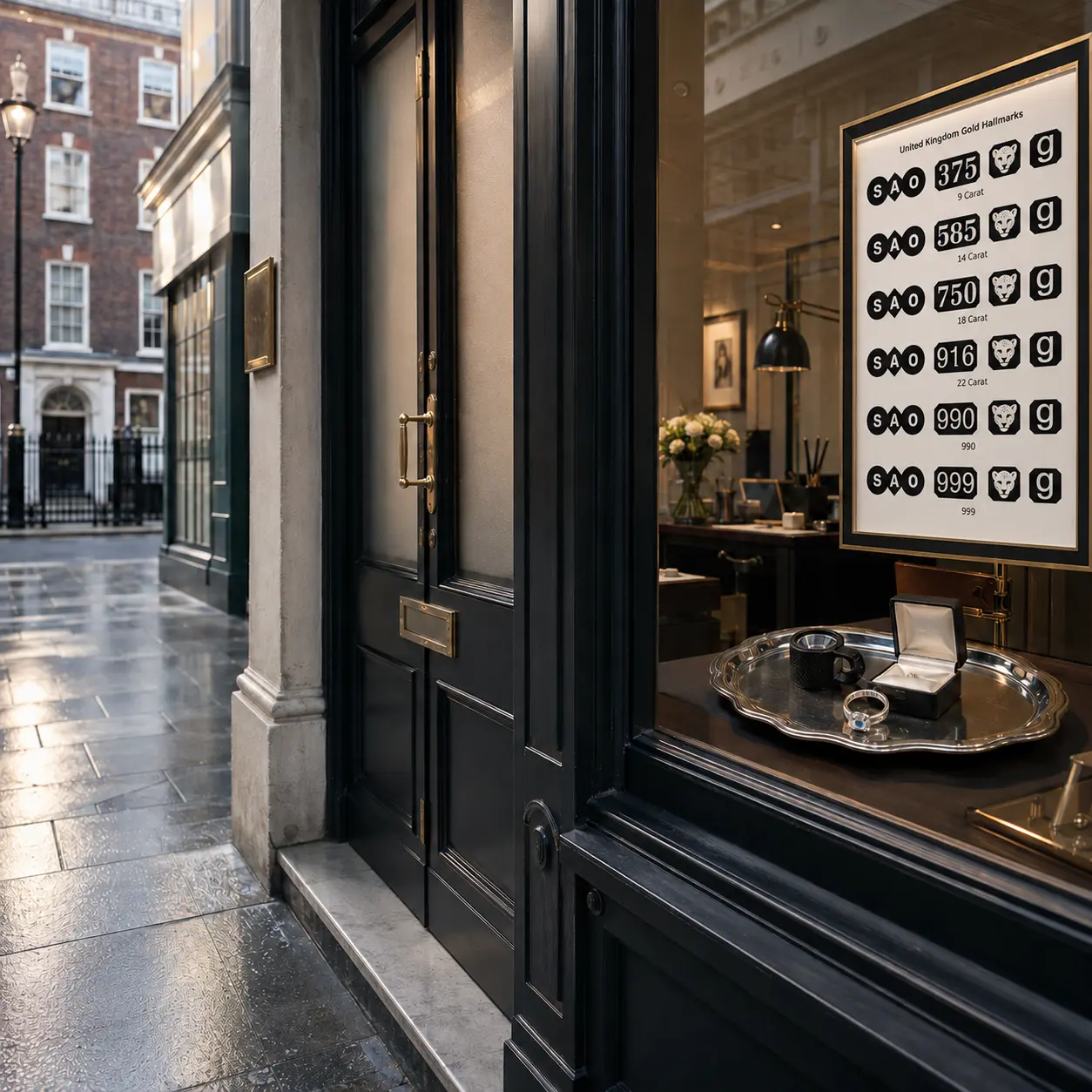
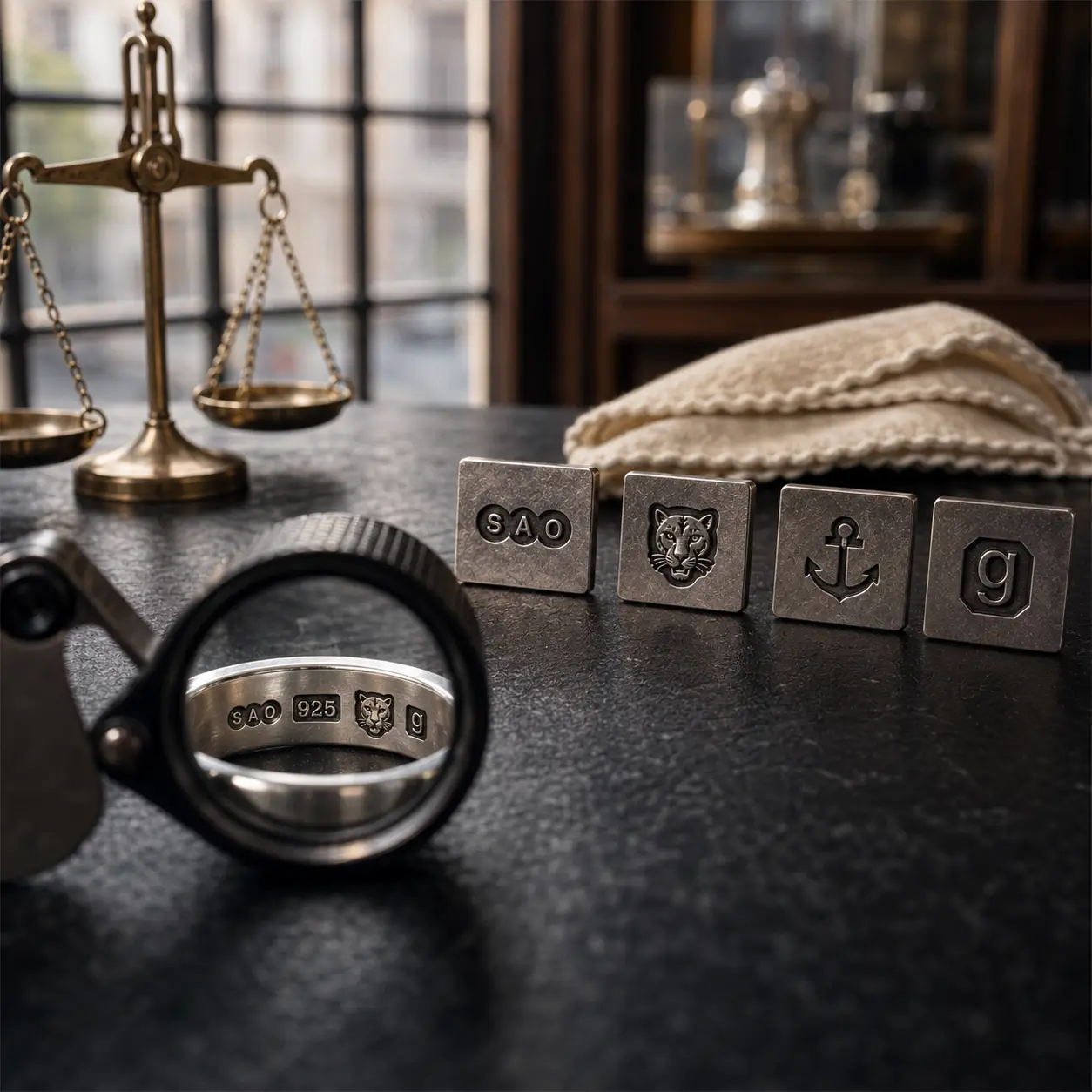
A UK hallmark consists of three compulsory marks: the sponsor's mark identifying the maker or submitting party, the fineness mark stating the precious metal purity in parts per thousand, and the assay office mark identifying which of the four active UK offices tested the piece. A fourth optional mark, the date letter, identifies the year of assay. Together these marks certify that the metal has been independently tested and meets the stated purity standard.
The three compulsory marks have been required on precious metal items sold in the UK under the Hallmarking Act 1973, which consolidated earlier legislation dating to 1238. Pieces above a weight threshold, currently 1 gram for gold, 7.78 grams for silver, 0.5 grams for platinum and 1 gram for palladium, must carry a full hallmark before sale. Below those thresholds hallmarking is not compulsory, which is why very small items such as delicate chain links may carry only partial marks or no marks at all. Every Hatton Garden bespoke engagement ring above the threshold weight carries a full hallmark, and the hallmark is struck before the ring leaves the Assay Office.
The four active UK assay offices are London, based at Goldsmiths' Hall; Birmingham, based in the city's Jewellery Quarter; Edinburgh; and Sheffield. Each office uses a distinct town mark that has remained essentially unchanged for centuries. The London mark is a leopard's head, which has been in continuous use since approximately 1300 and is one of the longest-running consumer protection marks anywhere in the world. Birmingham uses an anchor, Edinburgh uses a three-towered castle, and Sheffield uses a Yorkshire rose. A ring commissioned and hallmarked in Hatton Garden will always carry the London leopard's head, because commissions in the quarter are submitted to Goldsmiths' Hall.
The fineness mark and what the numbers mean
The fineness mark does two jobs at once, and most buyers only ever notice one of them. The number tells you the purity, expressed in parts per thousand. The shape around the number tells you which metal you are holding. That second job is the part nobody explains at the counter, and once you know it you can name the metal of any UK-marked piece across a table without asking anyone. The millesimal number became compulsory on UK hallmarks in 1999, replacing the older carat-only system.
| Metal | Shape around the number | Fineness marks recognised in the UK |
|---|---|---|
| Gold | Octagon | 375, 585, 750, 916, 990, 999 |
| Silver | Oval | 800, 925, 958, 999 |
| Platinum | Pentagon, like a small house | 850, 900, 950, 999 |
| Palladium | Three joined circles | 500, 950, 999 |
Within those, a few numbers carry names worth knowing. On silver, 925 is sterling and 958 is Britannia. On platinum, 950 is the standard for UK engagement rings. On palladium, 950 is the bridal standard. On gold, the number converts straight back to the carat figure most people already half-know, because carat is simply purity counted in twenty-fourths. Eighteen carat means 18 parts gold in 24, which is 75 per cent, and 75 per cent of a thousand is the 750 struck on the ring.
| Gold mark | Carat | Pure gold content | Where you meet it |
|---|---|---|---|
| 375 | 9 carat | 37.5 per cent | The UK's everyday gold, hard-wearing and the most affordable |
| 585 | 14 carat | 58.5 per cent | Common on imported and American pieces, less usual on British work |
| 750 | 18 carat | 75 per cent | The fine jewellery standard, and most Hatton Garden engagement rings |
| 916 | 22 carat | 91.6 per cent | Traditional in Indian and Middle Eastern jewellery, deep yellow and soft |
| 990 | No carat equivalent | 99 per cent | Rare, and too soft to hold a stone securely |
| 999 | No carat equivalent | 99.9 per cent, fine gold | Bullion territory rather than jewellery |
Notice what the official standards do not say. The Assay Office gives 375, 585, 750 and 916 a carat equivalent and gives 990 and 999 none, because carat counts in twenty-fourths and neither number lands on a whole one. A dealer who calls a 999 piece 24 carat is speaking loosely rather than dishonestly, but the hallmark itself never makes that claim. On a ring you would want neither number in any case, because gold that pure is too soft to hold a stone.
Alongside the number, most London-marked pieces carry a picture of the metal as well. The traditional fineness symbol is optional under the Hallmarking Act, but the Goldsmiths' Company Assay Office strikes it as standard, which is why nearly every ring marked in the quarter has one. These are the symbols buyers puzzle over most, because they look ornamental and are in fact the oldest working part of the mark.
| Symbol | The metal it stands for |
|---|---|
| A crown | Gold |
| A walking lion, the lion passant | Sterling silver |
| A seated figure holding a trident and shield, Britannia | Britannia silver |
| An orb topped with a cross | Platinum |
| A helmeted head, Pallas Athene | Palladium |
Put together, a full London gold mark reads as a sentence once you have the vocabulary. The initials say who submitted it. The crown says gold. The octagon around 750 says gold at 75 per cent. The leopard's head says Goldsmiths' Hall tested it. The date letter says the year. Five marks, five separate facts, and not one of them asks you to trust the person selling you the ring.
The number on the hallmark is a precise guarantee. A 750 mark on an 18ct gold ring certifies that the metal contains at least 750 parts of pure gold per 1000 parts of total alloy, with the remaining 250 parts made up of copper, silver, zinc, palladium or other metals that give the gold its specific colour and working properties. A 950 mark on a platinum ring certifies a minimum of 950 parts pure platinum per 1000, with the remaining 50 parts typically ruthenium or iridium for working hardness. The Assay Office tests samples from the piece before striking the mark, which is what distinguishes a hallmark from a maker's stamped declaration of purity.
Colour variations in gold do not change the fineness mark. A rose gold, yellow gold and white gold ring all at 18ct all carry the 750-fineness mark, because the gold content is identical; the colour difference comes from the non-gold alloy composition. White gold specifically is typically rhodium-plated for whiteness, which is a surface coating rather than a metal purity issue; the 750 mark refers to the gold alloy beneath the rhodium. A buyer examining a white gold ring under magnification may see the rhodium wearing thin over time, revealing the slightly warmer-toned underlying 18ct alloy, and this does not indicate any fineness issue.
Reading the sponsor's mark and the date letter
The sponsor's mark is a code of between two and five initials inside a distinctive cartouche that identifies the party who submitted the piece for hallmarking. This is not necessarily the original maker; it may be the jeweller, the workshop, or the retailer depending on who handled the commission. Each sponsor registers a unique mark with the Assay Office and the mark stays assigned to that sponsor as long as the business operates. A buyer who knows the sponsor's mark can confirm which specific workshop or jeweller submitted the piece, and reputable Hatton Garden workshops are happy to confirm their sponsor's mark on request. The Goldsmiths' Company maintains a searchable public register of all active sponsor's marks.
The date letter rotates on a 25-letter cycle, with each cycle using a different font style and cartouche shape to distinguish it from the previous cycle. The London cycle for 1976 to 2000 used one font; the cycle from 2000 onwards uses another. A date letter on a UK hallmark allows a piece to be dated to the year of assay with precision. For a modern bespoke ring, the date letter simply confirms the year of commission. For an antique piece, the date letter is often the most valuable element of the hallmark because it allows precise period dating without reliance on stylistic analysis alone.
Date letters changed in a specific sequence. Until 1999 the date letter was compulsory on all UK hallmarks. From 1999 the date letter became optional, part of a broader harmonisation with European hallmarking practice. Many sponsors continue to request the date letter for its provenance value, but its absence on a post-1999 piece does not indicate any irregularity. A pre-1999 piece without a date letter, in contrast, is unusual and warrants a second look, though certain exempt categories did exist historically.
Continental and imported hallmarks in the Hatton Garden trade
Hatton Garden handles imported jewellery regularly, including French, Swiss, German, Italian and increasingly Asian-manufactured pieces. Under the UK Hallmarking Convention and the Hallmarking Act, pieces imported from convention signatory countries and carrying a Convention Common Control Mark, alongside a recognised national hallmark, are accepted in the UK without re-hallmarking. Pieces from non-convention countries must be submitted to a UK Assay Office for assay and hallmarking before UK sale. This is why the Import mark, typically an identifying letter combination specific to each office, appears on certain imported pieces alongside the standard UK hallmark elements.
French hallmarks use a different system. The eagle's head identifies 18ct gold and the dog's head identifies platinum of 950 fineness. The sponsor's mark, called the poinçon de maître, is struck alongside. A French piece sold in the UK after 1999 may carry the original French hallmark alone if it has been imported under convention arrangements, or it may carry an additional UK import mark if it has passed through a UK Assay Office. A buyer examining a French piece in Hatton Garden should be shown both sets of marks and should be explained the provenance chain.
Swiss and German hallmarks follow their own national conventions with distinctive marks for each fineness and office. Italian hallmarks historically used a different system that has been progressively harmonised with EU standards since 2007. Asian-manufactured pieces, particularly from India, Thailand and Hong Kong, typically enter the UK under importer sponsor's marks and carry full UK hallmarks struck at a UK Assay Office after import testing. The Hatton Garden antique and estate trade handles pieces with hallmark systems spanning 200 years of European history, and a specialist dealer should identify any unfamiliar hallmark on sight.
What to check on the hallmark before leaving the jeweller
A buyer collecting a bespoke engagement ring from a Hatton Garden workshop should ask to see the hallmark under 10x magnification before leaving. The marks should be clearly legible, struck evenly into the metal, and located in a position that does not interfere with stone setting or shank comfort. For a modern ring commissioned in 2026, the London leopard's head, the 950 platinum or 750 gold fineness mark, the workshop's registered sponsor's mark and the current date letter should all be visible. The laser hallmark, which uses a controlled laser to inscribe the same marks rather than striking them with dies, is becoming more common for delicate pieces and is fully valid under the Hallmarking Act.
Fun fact: The leopard's head hallmark of the London Assay Office has been struck continuously since approximately 1300 and is the oldest quality mark still in active use anywhere in the world; the original grant of hallmarking authority to the Goldsmiths' Company predates the founding of most national European assay systems by 300 to 500 years.
For an antique or estate piece examined at a Hatton Garden dealer, the hallmark reading process takes longer and rewards careful attention. The marks should be consistent with the design style and approximate period; an Art Deco ring with crisp 2020s-style marks is a reason to ask questions. Worn hallmarks on a piece that shows extensive 90-year wear are normal and acceptable; crisp hallmarks on a heavily worn piece suggest re-striking or re-hallmarking and should be disclosed by the dealer. Pre-1975 platinum pieces may carry no fineness mark at all because platinum hallmarking became compulsory in the UK only from 1975, and this absence is not a defect. Continental pieces should carry recognised continental marks alongside any UK import marks; a continental piece without either is a significant red flag.
Checking your hallmark before leaving the Hatton Garden workshop
For a buyer approaching UK hallmarking in Hatton Garden in 2026, the practical position is straightforward. On a modern commission, expect a full hallmark from the London Assay Office with the leopard's head town mark, the fineness mark matching the metal choice, the workshop's registered sponsor's mark and the current date letter, all visible inside the shank under 10x magnification. On an imported piece, expect recognised origin marks alongside any required UK import mark. On an antique piece, expect hallmarks that match the piece's stylistic period and wear pattern, with the caveat that pre-1975 platinum may carry no fineness mark. Ask the jeweller to identify each mark specifically at collection; a workshop that cannot walk through its own hallmark is not a workshop worth commissioning from. Hallmarks are small; the protection they provide is substantial.
Continue Reading
The Hatton Gazette
Delivered monthly to your inbox
Subscribe for the latest from Hatton.