Most buyers who walk into Hatton Garden have already done their homework on diamonds. They know the four Cs by heart. They have looked at images of solitaires and halos until the shapes blur. What they have rarely looked at is the inside of the ring itself, where the small set of stamps along the shank decides whether the piece in their hand is what the jeweller says it is. Learning to read a British hallmark is the single most powerful verification a buyer can perform without specialist equipment, and the London Assay Office sits less than 10 minutes from the heart of Hatton Garden for precisely this reason. The marks you are about to examine are not decorative. They are a legal test of metal purity, and once you can read them, you can verify a piece from any UK jeweller in seconds.
What the UK hallmark actually guarantees when you read it
A British hallmark is governed by the Hallmarking Act 1973, and on any precious-metal piece sold in the UK above the statutory weight thresholds the marks are not optional. The hallmark guarantees three things and only three things. It confirms the fineness of the metal, the assay office that tested it, and the year of testing. It does not certify the design, the maker's skill, the stones set into the piece, or the value. A buyer who understands that boundary already has an advantage over most of the people walking through Hatton Garden on a Saturday morning.
The four compulsory marks you should be able to read are the sponsor's mark, the fineness mark, the assay office mark, and the date letter. Optional marks include the traditional fineness symbols such as the lion passant for sterling silver or the crown for gold, and the common control mark used for international convention pieces. On a typical engagement ring made in Hatton Garden and submitted to the London Assay Office, all four compulsory marks will appear inside the shank, usually within a 3-millimetre band that requires a 10x loupe to read comfortably.
The sponsor's mark and what it tells you
The first mark you should locate is the sponsor's mark, sometimes called the maker's mark. This is a unique stamp registered with the assay office by the workshop, dealer, or company submitting the piece for testing. It is not necessarily the bench jeweller who made the ring. In Hatton Garden, sponsor's marks are often registered to the retailing jeweller or the trade workshop they commission from, and the same mark can appear on work from several different bench hands operating inside a single workshop.
The sponsor's mark is typically two or three initials inside a rectangular or shield-shaped outline. The London Assay Office maintains a public register of sponsor's marks, and any buyer can search the register to identify which business stamped a piece for testing. This is the closest thing to a verifiable maker attribution that exists on a modern UK ring. If a jeweller tells you a piece was made in-house in their Hatton Garden workshop, the sponsor's mark should belong to that business or to a workshop they have a documented relationship with. Asking to see the sponsor's mark and matching it to the business is reasonable and customary; no honest jeweller will object.
The fineness mark and what 750 actually means
The fineness mark is the small number stamped inside an oval or rectangle that tells you the precious metal content in parts per thousand. The system is universal across UK hallmarking, and the numbers you will see most often in Hatton Garden are 750 for 18-carat gold, 585 for 14-carat gold, 375 for 9-carat gold, 950 for the most common platinum standard, and 925 for sterling silver. A 750 mark means the metal is 750 parts per thousand pure gold, which is 75% gold by mass, with the remaining 25% made up of alloying metals that give the piece its working strength and its colour.
The shape of the surround tells you what kind of metal it is. Oval surrounds are used for gold, rectangular with cut corners for platinum, and rectangular with rounded corners for silver. A piece with a 750 mark inside an oval is 18-carat gold; the same number inside a rectangular surround would not appear, because platinum has its own fineness range. The fineness number is the single most useful piece of information on the ring for a buyer who wants to verify a quoted specification before paying. If you have been quoted 18-carat gold and the mark reads 585, the metal is 14-carat. There is no ambiguity in this system, and the assay offices that operate it have been doing so to legally enforceable standards for centuries.
The assay office mark and the leopard's head of London
The assay office mark identifies which of the four active UK offices tested and stamped the piece. London uses the leopard's head, Birmingham uses the anchor, Edinburgh uses the three-towered castle, and Sheffield uses the rose. For a piece made in Hatton Garden, the leopard's head is the default expectation, because the London Assay Office is the nearest by a long stretch and the working practice in EC1 is to submit weekly. A piece made elsewhere in the UK can carry any of the four marks legitimately, but a piece sold to you as made in Hatton Garden that carries the anchor of Birmingham deserves a question about the workshop chain.
The leopard's head has been the London mark since the early 14th century, and the current rendering, refined over centuries of die-cutting, is one of the most recognisable hallmarks in world jewellery. On a typical Hatton Garden ring the mark is roughly 1 millimetre across and sits between the sponsor's mark and the date letter. It is the visual signature of the quarter's working relationship with the London Assay Office, a relationship that pre-dates almost every business currently operating in Hatton Garden.

The date letter and reading the year of testing
The fourth compulsory mark is the date letter, which tells you the calendar year the piece was assayed. Each assay office cycles through the alphabet using a different typeface and surround shape each year, restarting at A after roughly 25 years with a new font. The current cycle started in 2025, and a buyer can use the date letter to verify that a piece described as new is in fact recently hallmarked, or to confirm the age of a vintage piece offered as period work.
The London Assay Office publishes the full historical date letter table on its website, and any Hatton Garden jeweller selling antique or estate pieces should be able to walk you through reading the date letter on a piece in their case without hesitation. If the date letter on an Art Deco ring offered for sale corresponds to a 1980s reproduction-era stamp rather than a 1920s original, that is information you can verify yourself in under a minute with the published table. The legal system underpinning UK hallmarks rewards buyers who learn to read them; it was built for exactly this purpose.
What to do at the counter
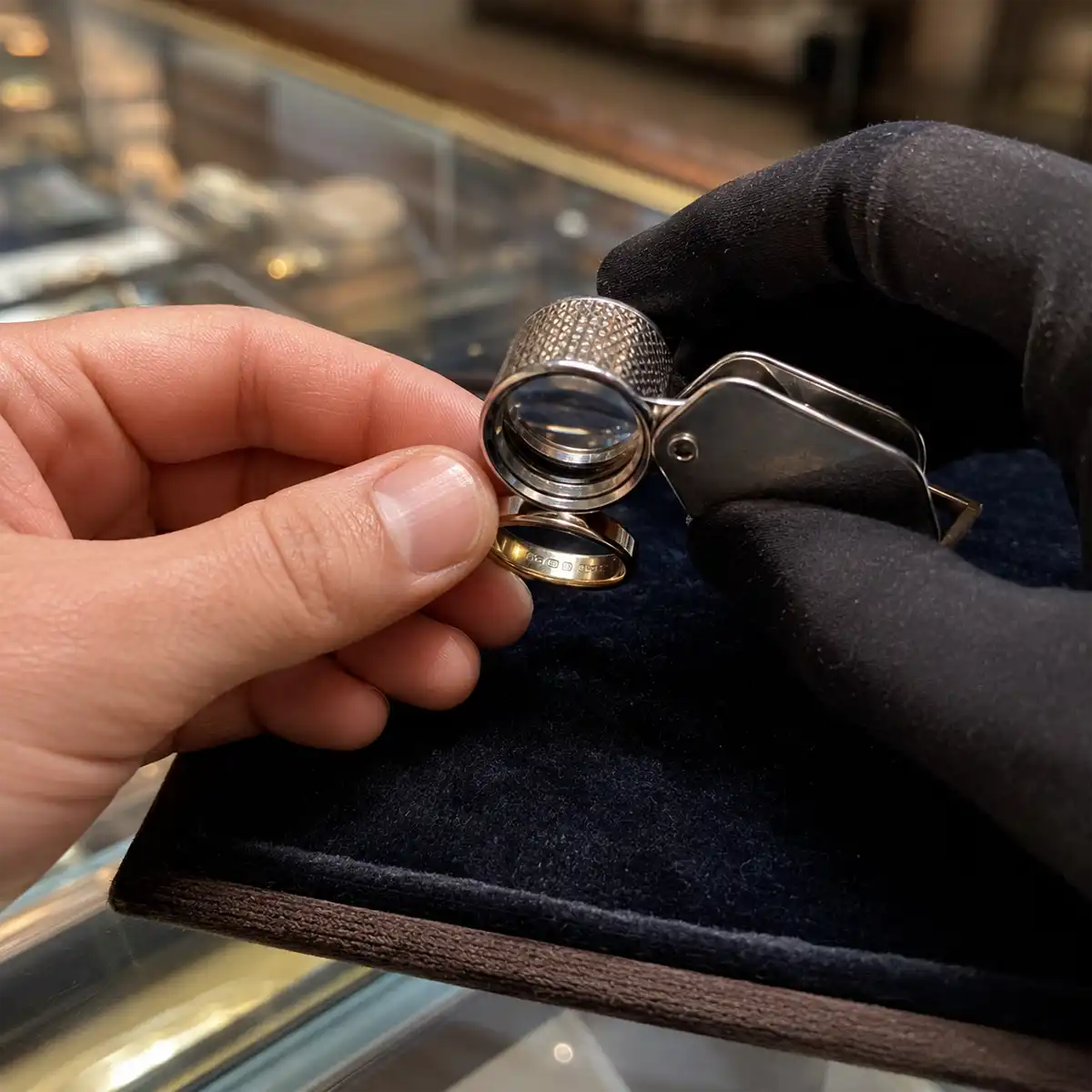
Ask to examine the ring under the jeweller's loupe before paying. This is normal practice in Hatton Garden, and any business in the quarter that hesitates to hand you a 10x loupe and let you read the shank yourself is signalling something about its confidence in the piece. Locate the four marks in order: sponsor's mark, fineness, assay office, date letter. Match the fineness to the quoted specification. Match the assay office to the workshop story the jeweller has told you. Match the date letter to the period claim, if the piece is antique or estate.
Fun fact: The leopard's head hallmark has identified precious metal tested in London since 1300, when Edward I introduced the touch of the leopard's head into English statute, making it the oldest continuously used hallmark in the world.
For new bespoke commissions, the hallmark is applied at the very end of the making process, after stone setting and final polish, which means a finished but unhallmarked piece you are shown at a final fitting is still legitimate. Ask when it is going to the Assay Office and when you should expect to collect it back with the marks struck. A typical turnaround for a London Hatton Garden workshop is 5 to 10 working days for hallmarking, and 2024 reporting from the British Hallmarking Council confirmed that London continues to handle the largest volume of UK hallmark submissions by a clear margin, reflecting the concentration of trade in EC1 and the speed of the workshop-to-Assay Office logistics chain. In 2025 the Council also extended its compulsory testing thresholds review, which means buyers should expect closer scrutiny of mixed-metal and very lightweight pieces in the year ahead.
Common questions buyers ask about UK hallmarks
A snippet-ready answer for the most common search query reads as follows. A British hallmark on jewellery is a legal stamp applied by one of four UK assay offices that guarantees the fineness of the precious metal. Four marks are compulsory: the sponsor's mark identifying the business that submitted the piece, the fineness number giving parts per thousand of the precious metal, the assay office symbol such as the leopard's head for London, and the date letter showing the year of testing. The marks are typically located inside the ring shank and can be read with a 10x loupe.
Some buyers ask whether a piece without a hallmark is automatically suspect. The answer is more nuanced. Pieces below the statutory weight threshold of 1 gram for gold, 7.78 grams for silver, and 0.5 gram for platinum are exempt from compulsory hallmarking, and a very light earring or a thin chain may legitimately carry no marks. Above the thresholds, the absence of a hallmark on a piece sold as gold or platinum is a serious red flag and is a matter the seller should be able to explain immediately.
Conclusion
A buyer who learns to read a British hallmark in 15 minutes of careful practice gives themselves a verification tool that costs nothing and works on any UK-tested piece they ever encounter. Before booking a first consultation in Hatton Garden, spend that time looking at images of the four assay office marks and the current date letter cycle on the London Assay Office website. Bring a loupe to your appointments, or expect the jeweller to provide one. Ask to read the shank on any piece you are considering, match the marks to the specification you have been quoted, and confirm the sponsor's mark with the public register if anything feels off. For a bespoke commission, agree the hallmarking timeline in writing at the design approval stage so that collection is not delayed by Assay Office turnaround. The hallmark is a legal guarantee written into the metal of the ring you will wear for the rest of your life. Learning to read a British hallmark is the most useful 15 minutes a Hatton Garden buyer can spend.
commission a bespoke piece in the quarter
Art Deco engagement rings in Hatton Garden
remodelling inherited diamonds in Hatton Garden
Related reading: How to Buy an Engagement Ring in Hatton Garden EC1.
For our fullest reference on this, read how to read a UK hallmark in Hatton Garden.
Continue Reading
The Hatton Gazette
Delivered weekly to your inbox
Subscribe for the latest from Hatton.