The period running from roughly 1920 to 1939 produced engagement rings of such specific confidence that a century on they still read as distinct on the finger. Geometric settings, calibré-cut coloured stone shoulders, platinum millegrain edges and diamonds cut by hand before the modern round brilliant was standardised give Art Deco pieces a visual register that modern reproductions rarely match. For a buyer considering an Art Deco engagement ring in Hatton Garden in 2026, the appeal is genuine and the market is real, but the due diligence required is substantially greater than for a modern commission. Hatton Garden in the EC1N postcode, a short walk from Chancery Lane station and under 5 minutes from the Farringdon Elizabeth line exit, remains the natural centre of the UK's antique jewellery trade, with specialist dealers along Greville Street, around Ely Place and across the quarter who handle period pieces at every price point. What follows sets out how to identify a genuine Art Deco piece, which red flags separate period from reproduction, and how the buying process differs from a modern ring purchase.
What defines an Art Deco engagement ring?
An Art Deco engagement ring is a piece dating from roughly 1920 to 1939, characterised by geometric symmetry, platinum or white gold construction, calibré-cut coloured side stones, millegrain edges and hand-cut diamonds predating the modern round brilliant standardisation of 1919. Genuine period pieces show consistent wear patterns, hallmarks appropriate to the era and hand-finishing details that distinguish them from later reproductions.
The Art Deco movement replaced the soft organic lines of Art Nouveau with strict geometry: rectangles, triangles, octagons, stepped shoulders and symmetrical compositions. Engagement rings from the period reflect that discipline. A genuine piece will typically carry an Old European cut diamond or a transitional cut at its centre, both predecessors of the modern round brilliant that have a smaller table, a higher crown and a distinctive pattern of light return that reads as a slow fire rather than the sharp scintillation of contemporary stones.
Platinum was the structural material of choice. Before the 1920s platinum working had been difficult and expensive, but improvements in oxy-acetylene technique allowed jewellers to produce platinum mounts with the fine detail Art Deco design required. The metal holds millegrain beading, pierced galleries and fine filigree work in a way that 18ct white gold, which became common only later, cannot match as cleanly. A genuine Art Deco platinum piece will often show the maker's mark, a platinum fineness mark such as 950 and an assay office symbol corresponding to its country of origin. British-made pieces carry the London Assay Office leopard's head, the lion passant was not used on platinum, and a date letter appropriate to the decade.
How to tell a genuine period piece from a later reproduction
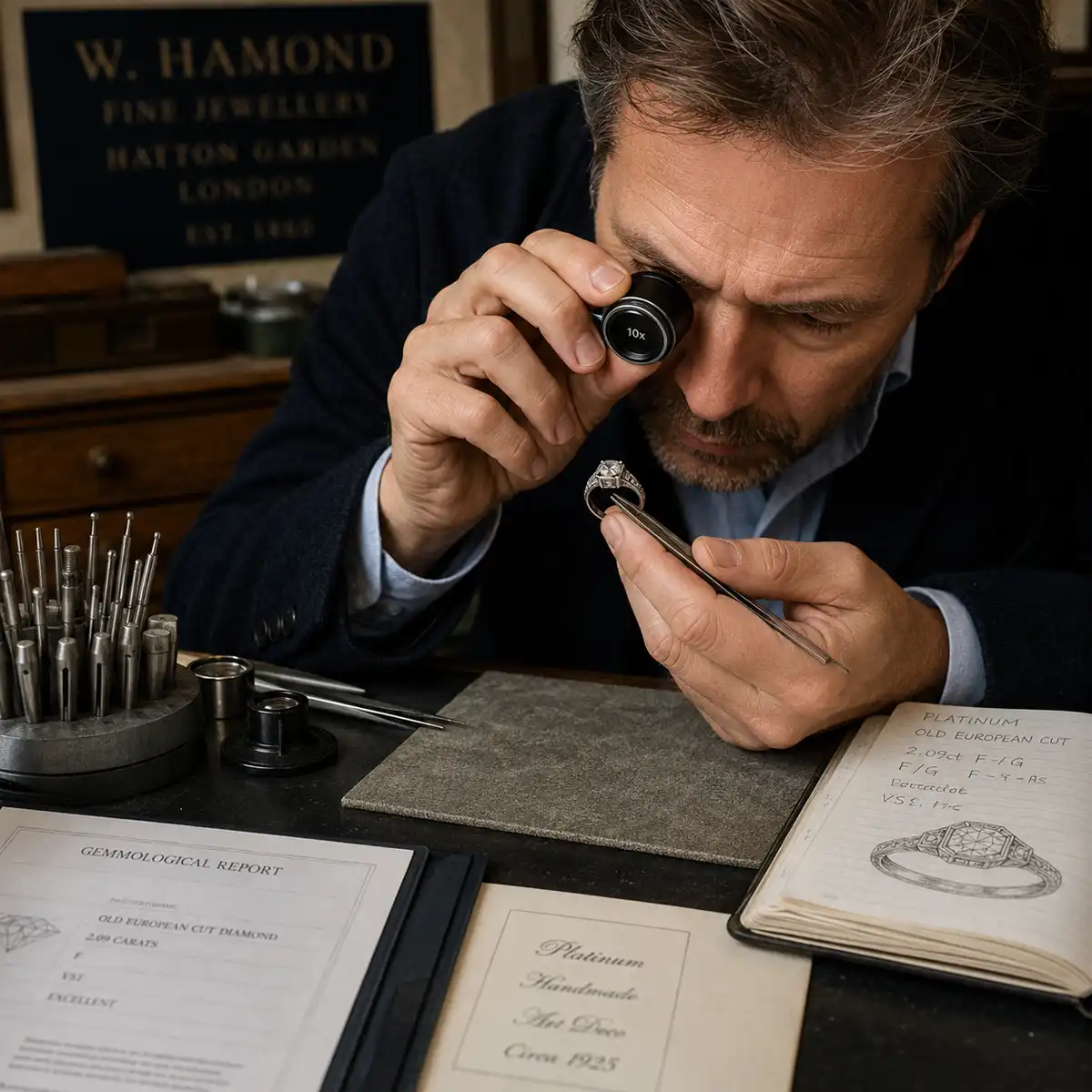
Reproduction Art Deco jewellery is produced in serious volume, and the quality of modern reproductions has risen sharply since about 2015. A piece made last year can look remarkably convincing at 30 centimetres. The examination that matters takes place under 10x magnification with the piece in hand. Several specific markers separate genuine from reproduction, and a Hatton Garden antique specialist will walk through each as a matter of course.
Setting technique is the strongest single tell. Genuine Art Deco pieces were constructed before modern lost-wax casting became standard, which means the mount was fabricated from sheet and wire by hand. Under magnification, a period piece will show asymmetric solder lines, slightly variable wire thickness in the gallery and individual hand-finishing on claw tips. A cast reproduction shows cleaner, more uniform surfaces, visible sprue marks where casting runners were removed and a characteristic softness to internal corners that hand-fabrication does not produce. Millegrain beading on a period piece is cut bead by bead; reproduction millegrain produced on a CAD-generated model carries a mechanical regularity that a trained eye spot quickly.
The stones are the second tell. An Old European cut diamond has a cushion-like outline, a small table, a high crown and an open culet visible through the table as a small dark spot. A transitional cut shows a rounder outline but retains the open culet and the smaller table. A modern round brilliant cut set into a supposedly period mount is a near-certain sign of either a later reset or a reproduction. Calibré-cut coloured side stones, typically sapphire, emerald, onyx and occasionally ruby, should fit the channels they sit in with the precision of pieces cut individually for that specific mount. Modern reproductions often use calibrated-size stock stones that do not quite follow the channel line and leave small inconsistent gaps.
Reading the hallmark on an Art Deco piece
UK hallmarking was compulsory for precious metal sales throughout the Art Deco period, and a genuine British-made piece will carry a set of marks that confirm the metal, the assay office and the date. The four elements present on most pieces are the sponsor's mark, the fineness mark, the assay office symbol and the date letter. On Art Deco platinum, the fineness mark typically reads 950 and the assay office mark for London is the leopard's head, though platinum hallmarking became compulsory in the UK only from 1975, which means genuine British pre-war platinum pieces may carry no fineness mark at all. This is a source of confusion for buyers and a common point of discussion with antique dealers in the quarter.
The date letter rotates on a 25-letter cycle with each cycle using a different font style and cartouche shape. The London Assay Office cycles for 1916 to 1935 and 1936 to 1955 cover most of the Art Deco period, and a London-hallmarked 18ct gold piece from 1928 will carry a specific date letter and cartouche combination that a competent antique dealer can identify on sight. A hallmark that looks fresh, uncharacteristically sharp on the edges or inconsistent with the period design is a reason to pause. Over-polished hallmarks, where the marks are soft and partially worn, are normal for a piece that has been worn for 90 years; crisp marks on a piece with an otherwise aged appearance suggest a later re-hallmarking or a reproduction.
Continental pieces are common in Hatton Garden's antique trade and carry their own mark systems. French pieces use the eagle's head for 18ct gold and the dog's head for platinum; the numeric fineness mark appears alongside. German pieces use the crescent moon and crown; Austrian pieces use a set of heraldic marks that vary by period and assay office. A specialist dealer in the quarter will identify continental marks routinely and should explain provenance without prompting.
How the Hatton Garden antique market works
The antique and estate trade in Hatton Garden runs in parallel to the modern engagement ring trade and operates on a different commercial model. Dealers typically source from auction, private estates, probate sales and deceased estates rather than from contemporary suppliers. Stock turns over more slowly because genuine period pieces are finite and buyers wait for the right piece rather than specifying one. Pricing reflects rarity, signature, condition, and the specific desirability of the design rather than pure stone value. An unsigned Art Deco ring with a 1-carat Old European cut diamond will often price at a significant premium to an equivalent modern stone in a modern setting, precisely because the aesthetic, the craft and the history are not replicable.
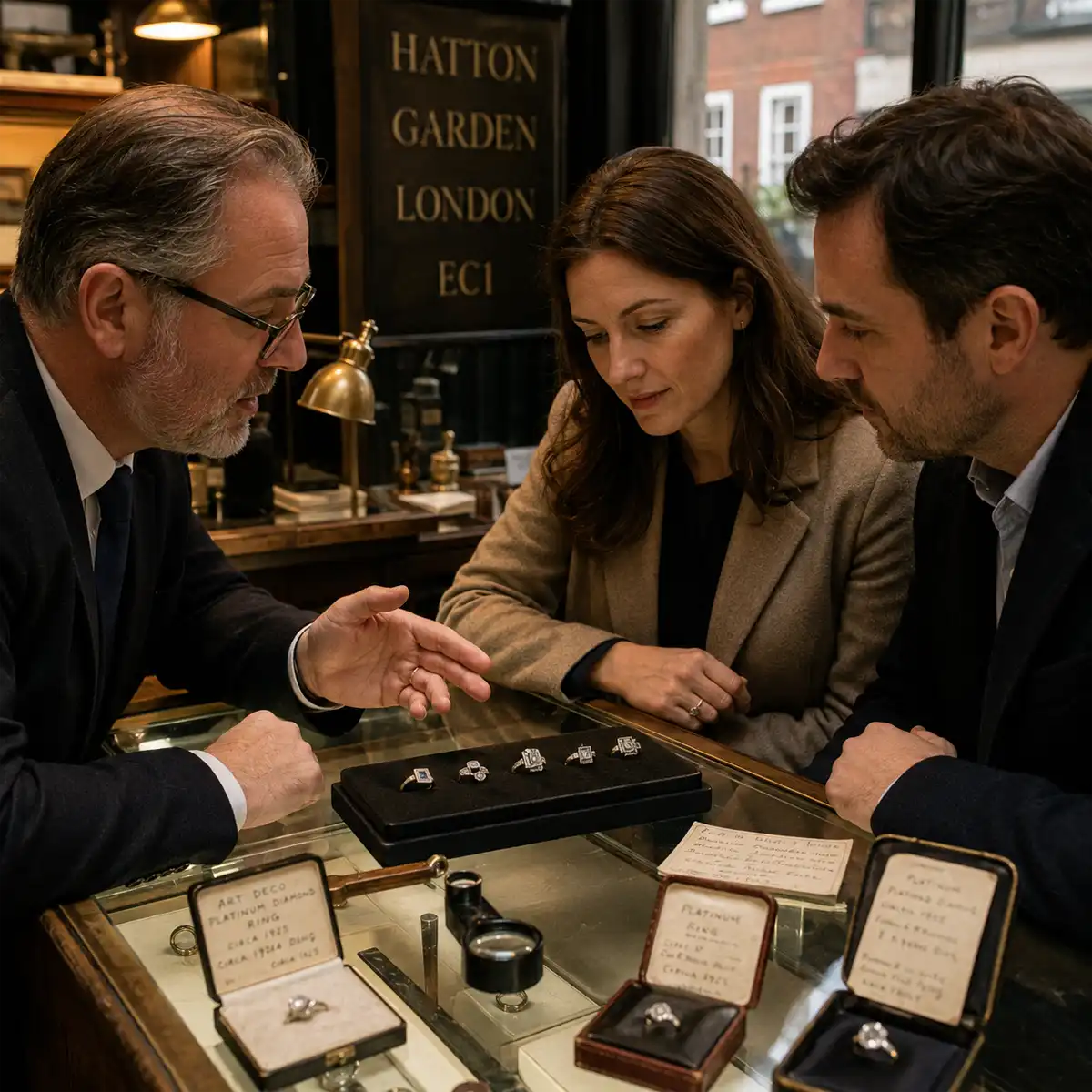
Several named dealers in Hatton Garden specialise in period pieces and are listed in the quarter's antique jewellery category. Berganza, located at 88-90 Hatton Garden, holds one of the largest antiques and vintage collections in the UK and issues its own detailed period attributions with each piece. Farringdons Antique Jewellery covers Georgian through Art Deco across the full stock and offers research support on provenance. Ishy Antiques operates on an appointment-only basis from within the quarter and handles handpicked pieces across eras. Hirschfelds has long-standing roots in the HG antique trade. Each dealer has a distinct specialism and a different approach to provenance documentation, and a serious buyer will typically visit 2 or 3 before committing.
Signed pieces from named makers such as Cartier, Van Cleef & Arpels, Boucheron, Lacloche, Chaumet, Mauboussin on the French side, and Asprey, Garrard, Boodles on the British side, trade at a substantial premium to unsigned work of equivalent period quality. The signature adds authentication confidence and documented auction history, but also adds a brand premium that may not suit every buyer. For a buyer whose priority is the aesthetic rather than the signature, an unsigned high-quality Art Deco piece by a skilled workshop maker represents stronger value, provided the due diligence on authenticity has been done.
What to ask before buying and what to plan for after
A first viewing of an Art Deco engagement ring in Hatton Garden should cover specific questions. Ask where the piece was sourced and whether the dealer has documentation from the acquisition. Ask for a written period attribution stating the estimated decade and the reasoning behind it. Ask whether the centre stone is original to the mount or has been replaced at some point, because a reset stone in a period mount is acceptable but changes the valuation. Request an independent gemmological assessment of any diamond above 0.50 carat, with modern grading terms stated alongside the period identification. For coloured side stones, ask whether any heat treatment or oiling has been disclosed on provenance documentation.
Fun fact: The 1925 Exposition Internationale des Arts Décoratifs et Industriels Modernes in Paris, which gave Art Deco its name, ran for 6 months from April to October and showcased work from 28 countries, but Britain's contribution focused on craft rather than the geometric jewellery styles that came to define the period.
Condition matters differently for antique pieces than for modern ones. Some wear is expected and is part of the evidence of authenticity; the complete absence of wear on a supposedly 90-year-old piece is itself a question. What to check for is structural integrity. Claw tips should be present and securely holding the stone; fine platinum pierced work should be free of hairline cracks; shanks should show no signs of resizing that has compromised the gallery structure. Mild polishing and millegrain refreshing are acceptable, full re-plating of a platinum piece is not usually necessary, and heavy restoration should be disclosed on the written attribution. Insurance valuation for an antique piece requires a valuer with specific period expertise; a generic jewellery valuer will often default to a replacement-cost figure that misses the premium the piece actually carries.
Your next steps for an Art Deco engagement ring in Hatton Garden
Art Deco engagement rings remain one of the most rewarding categories of antique jewellery to pursue in Hatton Garden, but the market rewards preparation and patience rather than speed. The right first step is to visit 2 or 3 named specialist dealers in the quarter, handle several pieces across the price range and develop an eye for the setting technique, stone cut and hallmark patterns that mark a genuine period piece. Ask for written period attribution on every serious candidate. Request independent gemmological assessment on the centre stone. Budget for an insurance valuation from a period-literate valuer and factor in the possibility of minor structural work at the point of purchase. A good Art Deco ring bought well in 2026 will hold its character, its aesthetic and, in most cases, its value for the next 90 years at least.
This guide is part of our complete guide to buying an engagement ring in Hatton Garden.
Continue Reading
The Hatton Gazette
Delivered weekly to your inbox
Subscribe for the latest from Hatton.