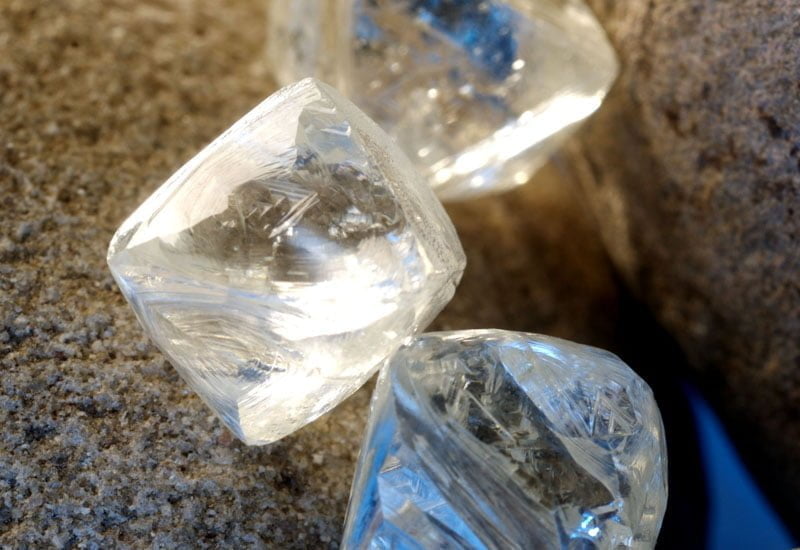
Have you ever wondered what a diamond looks like the moment it leaves the mine. Those who handle rough stones describe them as dull, greasy and unremarkable, closer to dirty pieces of glass than the brilliant gems on a showroom tray. The journey of processing diamonds, from raw crystal to faceted stone, is a feat of geology, planning and craftsmanship that most buyers never see. Yet understanding it explains why a finished diamond costs what it does, and why the cutter's skill matters as much as the rough itself. The most extensive selection of these finished stones reaches buyers through the dealers of Hatton Garden in London's EC1N quarter.
What a Rough Diamond Looks Like Before Cutting
A rough diamond is an uncut crystal straight from the earth, often coated in a dull skin that hides the stone beneath. To an untrained eye many look worthless, and someone judging on appearance alone might be tempted to throw them away. The beauty is locked inside, waiting to be released.
Rough comes in many forms, from well-shaped octahedral crystals to irregular fragments. The shape of the rough strongly influences which finished cut a stone can become, so a cutter studies each piece carefully before a single facet is planned.
This is the first lesson of the trade. A diamond is not simply found and sold. It is read, planned and worked, and the value added between mine and ring is considerable.
Gem Near Gem and Industrial Diamonds Explained
Less than half of the diamonds mined worldwide each year are gem quality. The rest fall into two broad categories, near-gem quality and industrial quality, and only the finest reach the jewellery counter. Industrial stones, by contrast, are prized for hardness rather than beauty and end up in cutting tools and abrasives.
What you see set in diamond rings are gem quality stones, selected for their clarity and potential brilliance. Even within this group, clarity ranges from flawless to stones with visible inclusions, which is one reason prices vary so widely.
This scarcity sits at the heart of a diamond's value. Of everything pulled from the ground, only a small fraction has the clarity, colour and size to become fine jewellery, and rarer still are the largest clean stones.
How Diamonds Are Mined From Pipe to Alluvial Deposits
Diamonds are recovered mainly through pipe mining and alluvial mining. Pipe mining extracts stones from volcanic kimberlite pipes, the deep vertical formations that carried diamonds towards the surface long ago, and it typically requires excavating very large volumes of rock.
Alluvial mining works differently, recovering diamonds that water has carried from their source and deposited in riverbeds, along coastlines and on ocean beaches. Marine mining extends this offshore, retrieving stones from the seabed. Each method reflects where geology and erosion happen to have concentrated the stones.
Whatever the source, yields are tiny relative to the material moved, which is part of why rough diamonds are valuable before any cutting begins. The effort of extraction is the first cost built into every finished gem.
Planning the Cut With Modern Scanning Technology
Before any cutting starts, the rough is mapped and planned, and this planning stage decides how much value the finished stone will hold. Modern processing relies on 3D scanning systems that model the rough and its internal inclusions, allowing planners to test thousands of possible outcomes on screen.
The aim is to balance weight retention against quality. A cutter might choose a slightly smaller, cleaner stone over a larger one that traps an inclusion, because cut and clarity often add more value than raw carats. These decisions, made before the first cut, shape the diamond you eventually buy.
Planning also determines the shape. The crystal's natural form nudges it towards a round brilliant, an emerald cut or a fancy shape, and the planner works with that geometry rather than against it to waste as little of the precious rough as possible.
Cleaving Sawing and Laser Cutting the Rough
Once planned, large rough is divided into workable pieces by cleaving or sawing. Cleaving splits a stone along its natural grain with a single decisive strike, while sawing cuts across the grain, traditionally with a phosphor-bronze blade and increasingly with precision lasers.
Laser cutting has transformed this stage. Lasers separate rough with great accuracy and minimal loss, handling shapes and inclusions that older methods struggled with. The technology gives cutters more freedom to follow the optimal plan rather than the easiest split.
This is precise, high-stakes work. The cutting of diamonds is an exacting art, and the smallest error can sharply reduce the value of a stone, which is why these steps are entrusted only to highly skilled hands.
Bruting Polishing and the Birth of Brilliance
After the rough is divided, bruting rounds the stone into its basic outline, traditionally by grinding two diamonds against each other since only a diamond is hard enough to shape another. This establishes the girdle, the outer edge that defines the finished silhouette.
Polishing then creates and refines the facets, the precisely angled flat surfaces that allow light to enter, reflect internally and return to the eye as brilliance and fire. A round brilliant carries 57 or 58 facets, each placed to exacting angles, and it is this faceting that finally releases the sparkle hidden in the rough.
The result can be startling. A stone that began as a dull pebble emerges so bright it seems to catch and throw light from every angle, the transformation that gives gems and gemstones their enduring appeal.
Why Certification Completes the Journey
The final step before a stone reaches a ring is independent grading. A laboratory such as the GIA, IGI or HRD assesses the polished diamond against the 4Cs of cut, colour, clarity and carat weight and issues a certificate, the objective record that follows the stone to the buyer.
That certificate matters because it lets you compare stones fairly and supports an insurance valuation later. When you view finished diamonds with the dealers of Hatton Garden, asking to see the grading report is the simplest way to confirm exactly what you are buying.
From a dull crystal deep underground to a certificated gem in a London showroom, the work of processing diamonds spans continents and skilled trades. Knowing that journey makes the finished stone, and the expertise behind it, far easier to appreciate when you finally choose your perfect diamond ring.
Continue Reading
The Hatton Gazette
Delivered weekly to your inbox
Join 12,000+ Hatton insiders