Most engagement ring conversations in Hatton Garden eventually arrive at the wedding band, and the band is the piece the wearer will see every day for the rest of their life. The engagement ring carries the proposal and the diamond. The wedding band carries the marriage and the daily reality of wearing fine jewellery while doing everything from washing dishes to typing at a keyboard to lifting a child. Hatton Garden has the workshop concentration to design a wedding band that fits perfectly against an existing engagement ring, the bench expertise to hand-engrave the inside of the band, and the wholesale metal access to price the piece sensibly. Knowing how the wedding band commission process actually works in the quarter, and what the meaningful choices are between plain bands, diamond-set bands, and eternity rings, is what this overview is for.
What a matching set actually means in EC1
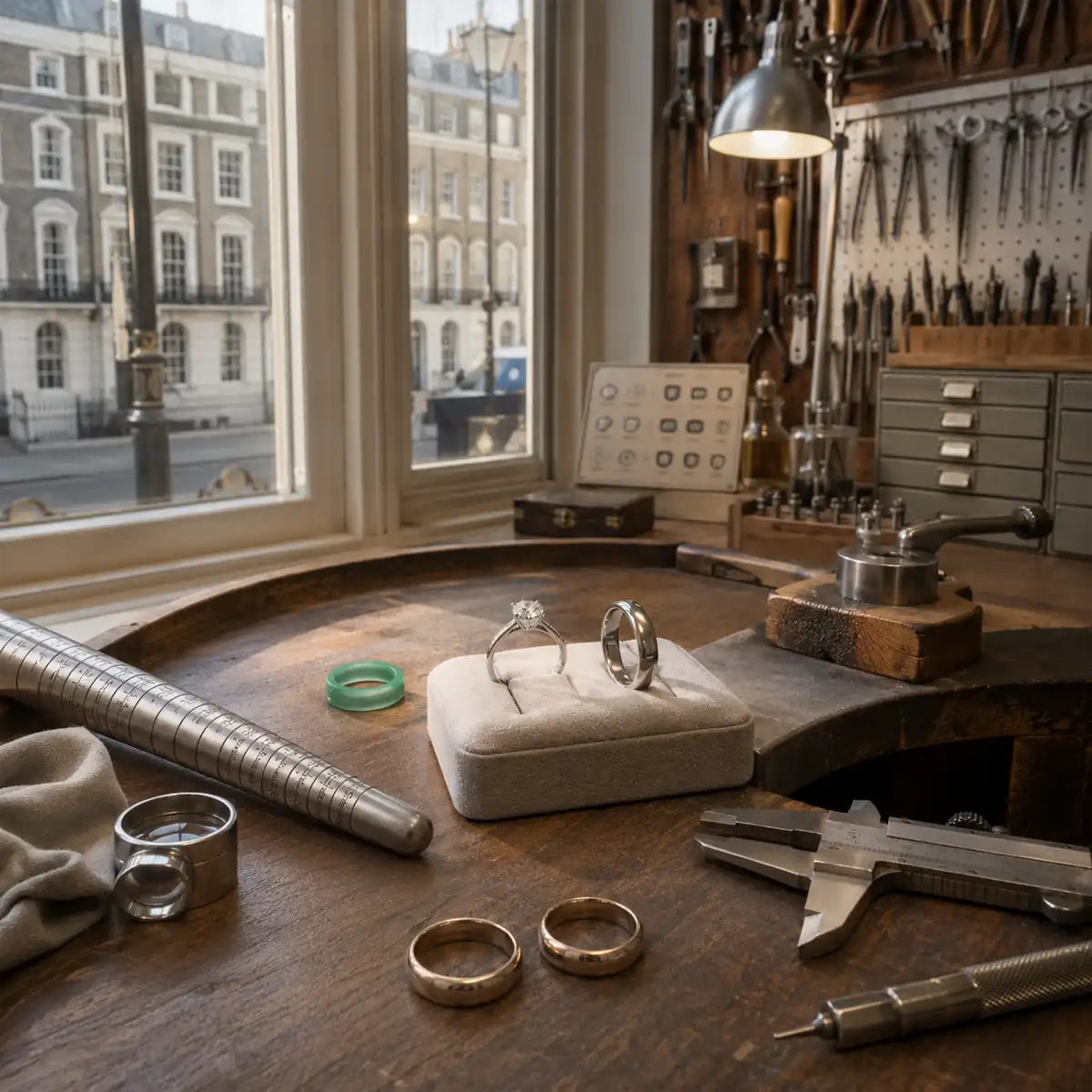
The single most important decision in commissioning a wedding band is whether to design it as part of a matched set with the engagement ring or as an independent piece. A matched-set commission means the band is designed to sit flush against the engagement ring without a gap, with the contour of the band tracing the shape of the engagement ring's setting from underneath, and with the metal alloy and finish chosen to coordinate visually with the engagement ring. The technical term for this in EC1 workshops is a shaped or fitted wedding band, and it requires the engagement ring to be physically present in the workshop during the band design and making process.
The alternative is a wedding band designed independently and worn either alongside the engagement ring with a small visible gap or worn on a separate finger. There is nothing wrong with either approach, and many buyers consciously choose the independent band as a distinct piece with its own character. But the matched-set commission, when done properly in a Hatton Garden workshop, produces a result that high street manufacture cannot replicate, because the band has been physically tested against the specific engagement ring during the making process rather than being designed to standard dimensions. For buyers commissioning both rings in Hatton Garden, asking the workshop to design the band against the engagement ring is the standard approach and is included in the cost of bespoke commission.
Plain bands and the substance of simplicity
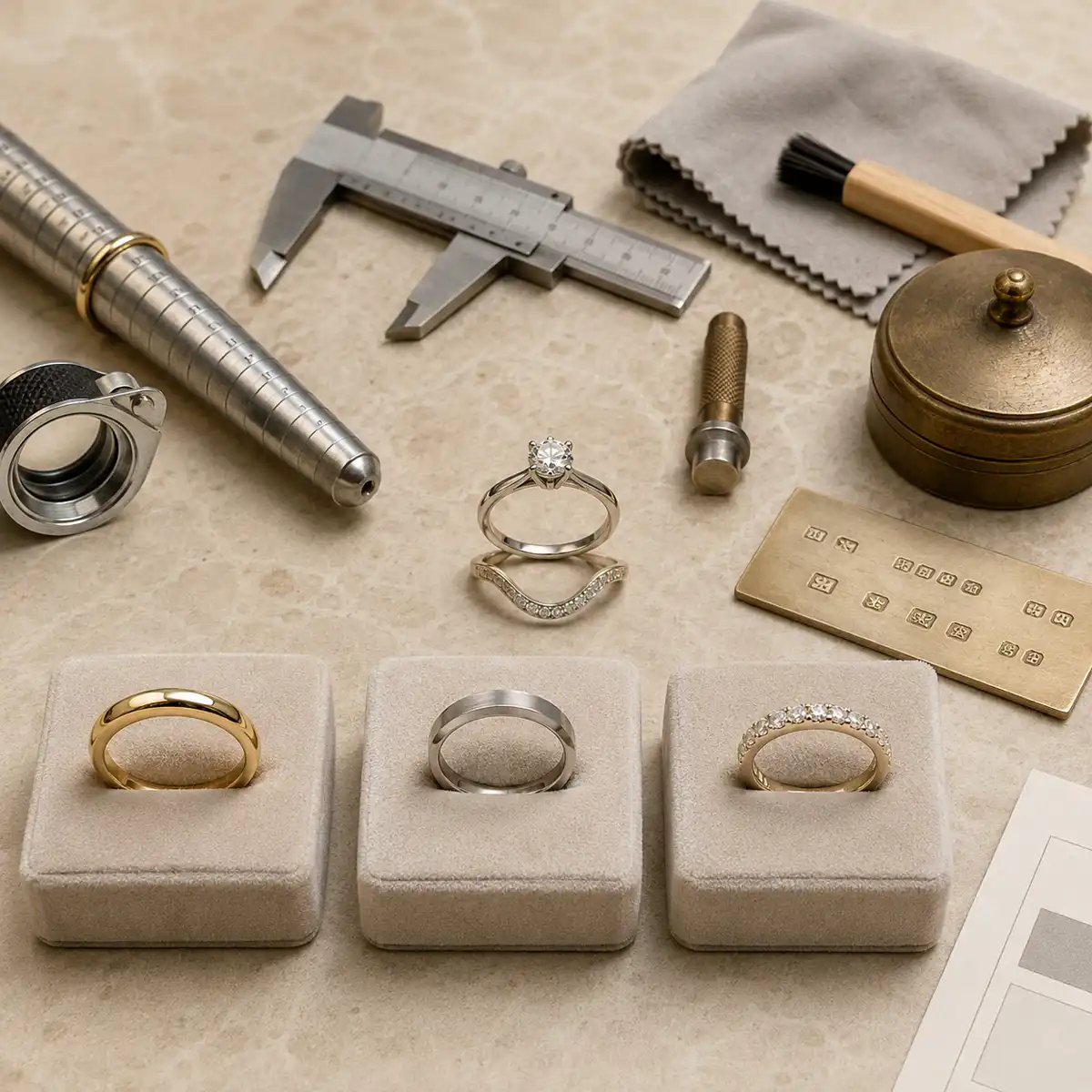
A plain wedding band is the most demanding piece a workshop can be asked to make, paradoxically. There is no detail to hide imperfections, no setting to disguise a slightly off proportion, no stones to draw the eye away from the finish. The metal itself, its weight, its profile, the way it catches light along the curve of the band, becomes the entire visual content of the piece. Hatton Garden workshops that specialise in plain bands typically produce them in 18-carat gold or 950 platinum, with profile choices including court, D-shape, flat-court, and the increasingly popular flat-band profile that sits low against the finger.
Profile matters more than buyers usually expect. A court profile, with rounded inside and outside curves, is the most comfortable for daily wear because the curves slide against the adjacent finger and against the engagement ring without snagging. A D-shape profile has a rounded outside and a flat inside, which suits buyers who like the rounded look but want a flatter contact against the finger. A flat-band profile sits low and modern, but can show wear marks more visibly than a curved profile because the flat surface catches scratches differently. The weight of the band is the other variable, with heavier bands feeling more substantial but adding cost in metal and showing slightly different scratch and wear patterns over time.
Diamond-set wedding bands and the proportional question
A diamond-set wedding band carries small accent diamonds along part or all of the band, set into the metal using one of several techniques. A pavé-set band has small diamonds held by tiny beaded claws cut directly from the metal, packed closely together to create a continuous diamond surface. A channel-set band has the diamonds held between two parallel walls of metal with no claws visible, giving a flush smoother surface. A bezel-set band has each diamond surrounded by its own metal rim. A grain-set band uses fine grains of metal raised from the surface to hold the stones, similar to pavé but with more visible metalwork between stones.
The proportional question for a diamond-set wedding band is how much of the band carries diamonds and how that relates to the engagement ring. A half-set band, where the diamonds cover the top half of the band visible from above, is the most common choice and balances the engagement ring's diamond visually without competing. A three-quarter set extends the diamonds further around but leaves a plain section at the back for resizing later. A full eternity ring carries diamonds all the way around, with the practical implication that the ring cannot be resized later without recutting and remaking the eternity setting itself. This is a meaningful decision for a piece intended to be worn for decades, and a Hatton Garden workshop should walk you through the trade-off clearly during the consultation.
Eternity rings and the third-ring tradition
The eternity ring, traditionally given to mark a significant anniversary or the birth of a child rather than at the wedding itself, sits in a slightly different category from the engagement and wedding band combination. It is typically a full or three-quarter diamond band intended to be worn alongside the existing pair, creating a stacked three-ring set on the same finger. The proportional weight of the eternity ring against the existing pair is the design question, and a Hatton Garden workshop will typically size the eternity ring's stones to coordinate with the engagement ring's accent diamonds rather than competing with the centre stone.
The buyer commissioning an eternity ring should bring the existing engagement and wedding band to the consultation. The workshop will work out the proportions against the existing pieces, will check the colour matching of the metal across all three rings, and will advise on whether the stack will sit comfortably on the finger over decades of wear. Sizing matters: a three-ring stack changes how the finger sits inside the rings, and a band sized perfectly for solo wear may feel slightly different when worn under two additional rings. The workshop will check this during the final fitting.
Hand-engraving inside the band
The Hatton Garden tradition of hand-engraving the inside of a wedding band is one of the small details that distinguishes a bench-made commission from a mass-produced ring. The engraving can be a date, initials, a short phrase, a song lyric, or any other text the buyers want to carry inside the piece. A hand-engraved band uses the technique of cutting the letters with a graver tool by hand, producing a script with character and slight variations that machine engraving cannot replicate. A machine-engraved band uses a CNC tool to cut the text uniformly, which produces a clean modern result but lacks the hand character.
Both are legitimate, and most Hatton Garden workshops offer both options at different price points. A few engravers in the quarter specialise in hand-engraving exclusively and can produce highly detailed work including decorative borders, foliate motifs, or family crests on larger pieces. For most wedding band buyers, simple text engraving inside the band is the standard choice, and the cost is modest. The conversation with the workshop should cover the engraving content, the choice of script, the technique, and any space considerations on a narrow band where text length matters.
What to ask at a Hatton Garden wedding band consultation
A useful checklist for a wedding band consultation covers the following. What metal and fineness do you recommend to coordinate with the engagement ring. What profile do you recommend for daily wear and why? If this is a matched set commission, when can I bring the engagement ring in for the band to be designed against it. What is the bench timeline and the Assay Office turnaround for hallmarking? What are the engraving options and the cost. What is the resizing policy for the band over time, and how does that change if I choose a full eternity ring. What aftercare service do you provide, and is there a charge for cleaning and polishing in years to come.
A Hatton Garden workshop that answers all seven questions confidently is operating at the standard the buyer should expect. Lead times for matched-set wedding bands in EC1 typically run from 6 to 10 weeks for a bespoke commission, including design, making, stone setting if applicable, hallmarking, and final finishing. Booking early matters, particularly during the busy spring and summer wedding season.
Fun fact: The tradition of wearing the wedding band on the fourth finger of the left-hand dates to the Roman belief in the vena amoris, the so-called vein of love that was thought to run directly from that finger to the heart, a belief that has shaped wedding band placement across Western cultures for nearly two millennia.
Common questions about wedding bands in Hatton Garden
A snippet-ready answer for buyers researching the commission process reads as follows. A bespoke wedding band in Hatton Garden typically takes 6 to 10 weeks from design approval to collection, with the band designed in coordination with an existing engagement ring if a matched set is being commissioned. Bands are typically made in 18-carat gold or 950 platinum, with profile choices including court, D-shape, and flat-band. Diamond-set bands range from half-set through three-quarter to full eternity, with the eternity ring choice affecting future resizing options. Hand-engraving inside the band is a Hatton Garden tradition and is offered by most workshops as a low-cost addition.
Buyers sometimes ask whether they should match the metal of the wedding band exactly to the engagement ring. The answer is yes for visual coherence, particularly for a matched set commission, but buyers who want a contrast can choose deliberately different metals, with white-and-yellow gold combinations and platinum-and-rose-gold pairings both having modern precedent.
Conclusion
A wedding band consultation in Hatton Garden should be approached with the engagement ring physically present, a clear sense of which profile suits daily wear, and an idea of whether the buyer wants a plain band, a diamond-set band, or to defer the eternity ring choice for a future anniversary. Book the consultation 10 to 14 weeks before the wedding date to allow comfortable bench time and Assay Office turnaround. Confirm the matched-set design will be tested against the engagement ring during the making process rather than being a generic shaped band. Decide on engraving content and technique before the band goes into final stages. The wedding band is the piece you will see every day, and a Hatton Garden workshop that designs it properly against your engagement ring will produce a piece that sits as if it belongs there because it does.
commission a bespoke matching set
ethical engagement rings in Hatton Garden
how to read a British hallmark
Related reading: How to Buy an Engagement Ring in Hatton Garden EC1.
Continue Reading
The Hatton Gazette
Delivered monthly to your inbox
Subscribe for the latest from Hatton.