A genuine Art Deco engagement ring is one of the most distinctive objects a buyer can put on the finger of someone they love. The period ran roughly from 1920 to 1939, and the engagement rings produced during those two decades share a design language that has never been successfully replicated in mainstream manufacture since. Geometric symmetry, calibre-cut coloured stones set flush into platinum, milgrain edging worked by hand, and a confidence in linear composition that came from the architectural and decorative movements of the same years. Buyers come to Hatton Garden for Art Deco engagement rings because the quarter has the concentration of period specialists, the workshop expertise to authenticate and restore, and the trade depth to source new pieces into the secondary market when collections come up for sale. This is what to look for and what to verify before committing.
What defines a genuine Art Deco engagement ring
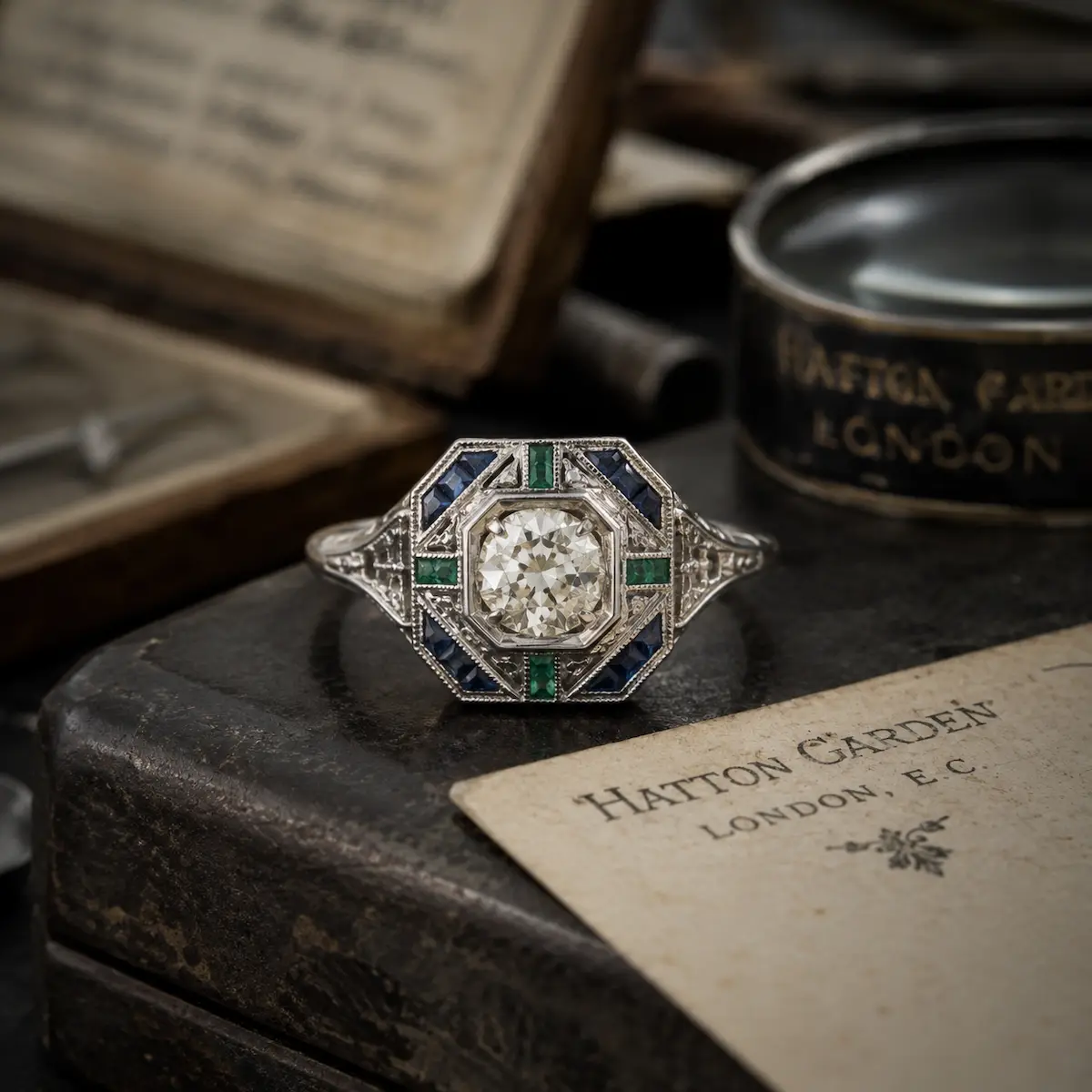
The visual markers of an authentic 1920s or 1930s engagement ring are specific and verifiable. The setting metal is almost always platinum, with white gold appearing later in the period as platinum became scarce in the lead-up to the war. The centre stone is most often a transitional cut diamond, an Old European cut, or an early Asscher or step cut, all of which predate the modern round brilliant pattern standardised after 1950. Coloured stone centres are common, with sapphire, emerald, and ruby all heavily used, and the cuts are typically calibre-cut to fit the geometric setting precisely rather than being standard mass-produced shapes.
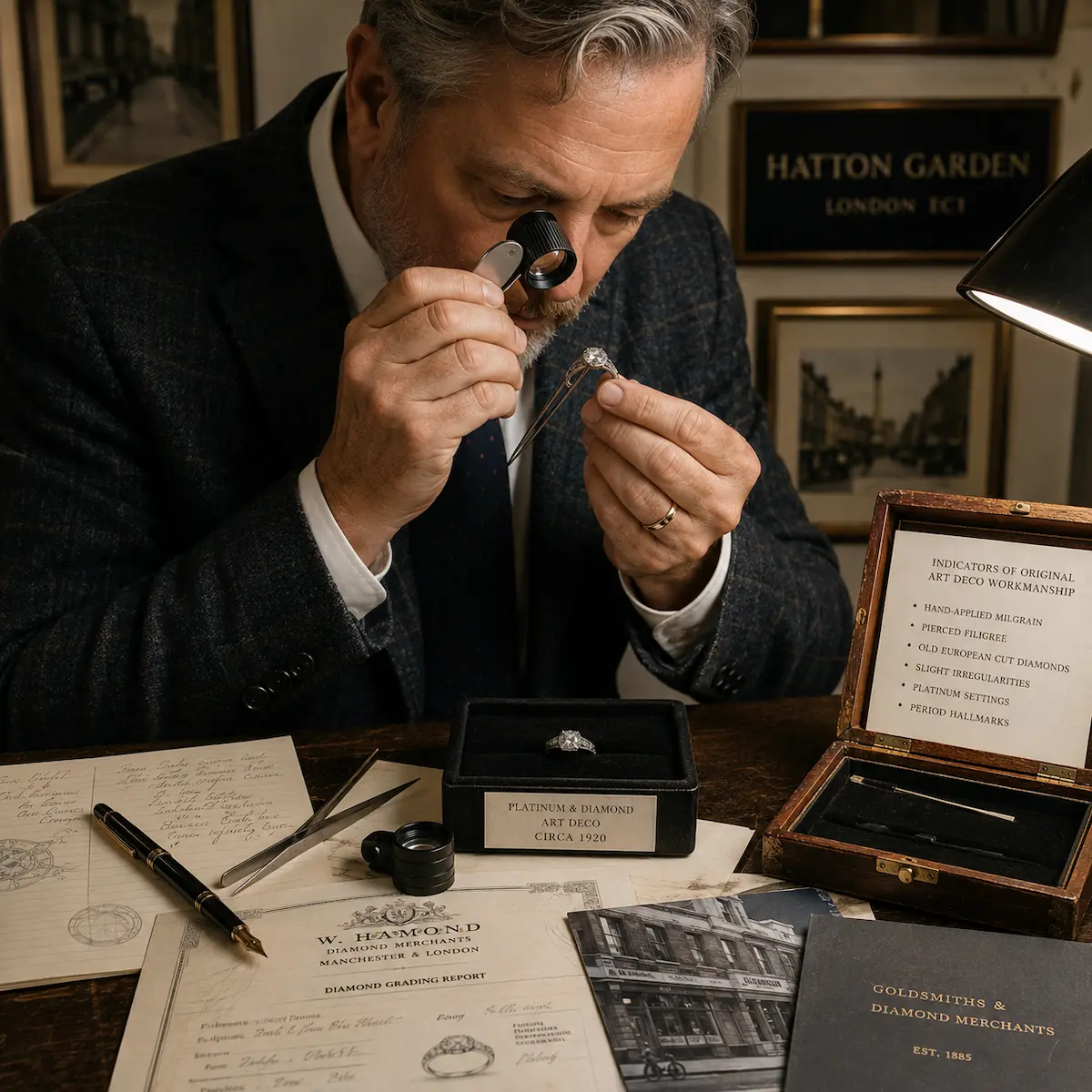
The setting itself shows the period's preference for geometric form. Hexagons, octagons, lozenges, and target patterns are all characteristic. Filigree work, the openwork pattern that allows light to pass through the side of the setting, is one of the signature techniques. Milgrain, the tiny beaded edging worked by hand along the margins of the setting, is another. Both filigree and milgrain require hand work that is uneconomic in modern manufacture, which is why a genuine period piece feels different in the hand from even the best modern reproduction. The weight, the warmth of the platinum, and the slight asymmetries that come from a piece handmade a century ago are markers a trained eye can pick up within seconds.
How to verify the period before you buy
The first verification is the hallmark. A genuine 1920s or 1930s British piece will carry the platinum mark of the period, which became compulsory in the UK from 1975 onwards but appeared voluntarily on better-quality work earlier. Continental pieces of the period will carry the appropriate continental marks, with French Art Deco platinum typically carrying the dog's head mark for platinum and stamped with the maker's poinçon. The absence of any hallmark on a piece claimed as period work is a serious flag, although it can occasionally be legitimate if the piece predates compulsory hallmarking in its country of origin.
The second verification is the setting technique. A genuine period piece will show evidence of hand work that machine production cannot replicate. The milgrain beading will be slightly irregular under magnification. The filigree work will show small variations in the openings. The setting of small calibre-cut stones will sit flush in a way that requires the setting to be cut to the stones rather than the stones to a standard size. A modern reproduction made to a high standard can approach this, but the working time required is so substantial that it is rarely commercially viable for anything other than a deliberate art-quality reproduction. The third verification is the cut of the centre stone. A round brilliant cut diamond in an Art Deco setting is almost certainly a later resetting, not a period original.
Where the Hatton Garden Art Deco engagement rings come from
The supply of genuine period engagement rings in Hatton Garden comes from three main sources. Family disposals, where a piece passes through the trade after probate or a private sale, account for a substantial portion of the available stock. Auction houses, including the major London houses that operate near Hatton Garden, are the second source, with dealers in the quarter bidding for pieces and bringing them back into the retail market with provenance documentation attached. The third source is European trade, with French, Italian, and central European Art Deco pieces entering the UK market through established trade relationships.
The dealers in the quarter who specialise in period work are concentrated on Hatton Garden itself, around Greville Street, and on the upper floors that overlook Leather Lane market. Several of the longest-established antique jewellery businesses in EC1 have been trading in period work for three generations, with stock books and provenance records that extend back into the early 20th century. A buyer who wants serious period work should expect to make an appointment rather than walking in, and should expect to be shown a small number of authenticated pieces with documentation rather than a large display case.
Reproduction pieces and how to tell them apart
A meaningful proportion of what is described as Art Deco style in the wider London jewellery market is reproduction work made in the second half of the 20th century or in the last 20 years. There is nothing inherently wrong with reproduction. A well-made modern Deco-style ring made in Hatton Garden today can be a beautiful piece, and it carries the advantage of modern stone-cutting precision and a recent hallmark that confirms the metal. The problem arises only when reproduction is sold as period, which is a misrepresentation that an honest Hatton Garden dealer will not permit on their own stock.
The marker of a modern reproduction is in the metalwork as much as in the stone. Modern platinum alloys handle slightly differently from the platinum-iridium alloys typical of the 1920s. Modern milgrain is often machine-applied and shows the regularity of mechanical production. Modern filigree is frequently cast rather than fabricated, and the cast version shows the slight rounding of details that hand-fabrication does not produce. The hallmark date letter is the final confirmation. A piece sold as 1925 that carries a 2010 date letter is a modern reproduction, regardless of how convincingly the design references the period.
What to ask the dealer before committing
A serious Art Deco purchase in Hatton Garden should involve a documented provenance, an independent gemmological assessment of the centre stone, and a written confirmation of period and authenticity from the selling dealer. Ask for the hallmark to be read in front of you. Ask whether the piece has been restored, and if so, what work has been done. Resizing, retipping of worn claws, and replacement of small accent stones are all normal restoration that does not undermine period status, but a piece that has had its centre stone replaced or its setting substantially rebuilt is no longer a fully period piece and should be priced accordingly.
Ask about the chain of custody. A dealer who acquired the piece from a known auction or from a documented estate can show you that documentation. A dealer who is vague about how a piece came to be in their case is a dealer to approach more cautiously. The legitimate period market in Hatton Garden runs on paper trails, and any dealer who has been in EC1 for any length of time will understand that paperwork protects both sides of the transaction.
Fun fact: The Art Deco style takes its name from the 1925 Exposition Internationale des Arts Décoratifs et Industriels Modernes held in Paris, an event that defined the visual language of jewellery, architecture, and the decorative arts for the following two decades and produced engagement ring designs that are still being commissioned in Hatton Garden a century later.
Common questions about Art Deco engagement rings
A snippet-ready answer for buyers researching the period reads as follows. A genuine Art Deco engagement ring was made between roughly 1920 and 1939 and shows specific design markers: platinum setting, geometric form often hexagonal or lozenge-shaped, hand-applied milgrain edging and filigree work, calibre-cut coloured stones, and a centre stone in a transitional, Old European, or step cut rather than a modern round brilliant. Period provenance is confirmed through hallmark date letters, setting technique under magnification, and dealer documentation. Buyers in Hatton Garden should expect to view authenticated pieces by appointment with established antique specialists in the quarter.
Buyers sometimes ask whether an Art Deco ring is a practical engagement ring for daily wear. The answer depends on the specific piece. Platinum settings from the period are robust, but original claws and bezels often need retipping after a century of wear, and filigree work is more delicate than modern equivalents. A reputable Hatton Garden dealer will assess wear before sale and recommend any restoration needed for daily wear use.
Conclusion
A genuine Art Deco engagement ring is a piece of social and design history that you can put on a finger and wear into the next century. Approach the purchase with appropriate care. Make appointments with two or three of the established period specialists in Hatton Garden, look at authenticated pieces under their loupe, learn to read the hallmark for date letter confirmation, and ask for documentation on chain of custody and any restoration work. Expect a longer purchase process than a modern ring, because verifying a period piece responsibly takes time. The most important question to ask the dealer before committing is whether they will provide a written confirmation of period and authenticity that you can place with an independent valuer for insurance. Any Hatton Garden dealer who hesitates on that question is one to walk away from politely. Any dealer who provides it without flinching is one worth building a long relationship with.
Continue Reading
The Hatton Gazette
Delivered weekly to your inbox
Join 12,000+ Hatton insiders


