Diamond fluorescence is the single most misunderstood factor on a grading report. Consumers read the words Strong Blue on a GIA certificate and reach for a price search that tells them fluorescence is a defect to be avoided. Dealers in Hatton Garden see a Strong Blue fluorescence stone under proper lighting 4 or 5 times a week, price it into inventory without drama, and often recommend it to the right buyer at the right colour grade. The gap between the consumer story and the trade reality is large enough to cost a first-time buyer thousands of pounds in either direction. The explanation of what diamond fluorescence actually is, when it helps, when it genuinely hurts and how the Hatton Garden trade prices it in 2026 requires something the online diamond market rarely provides, which is observed floor experience. Hatton Garden, the quarter along the EC1N postcode between Chancery Lane and the Farringdon Elizabeth line exit, is the right place to start.
What diamond fluorescence actually is
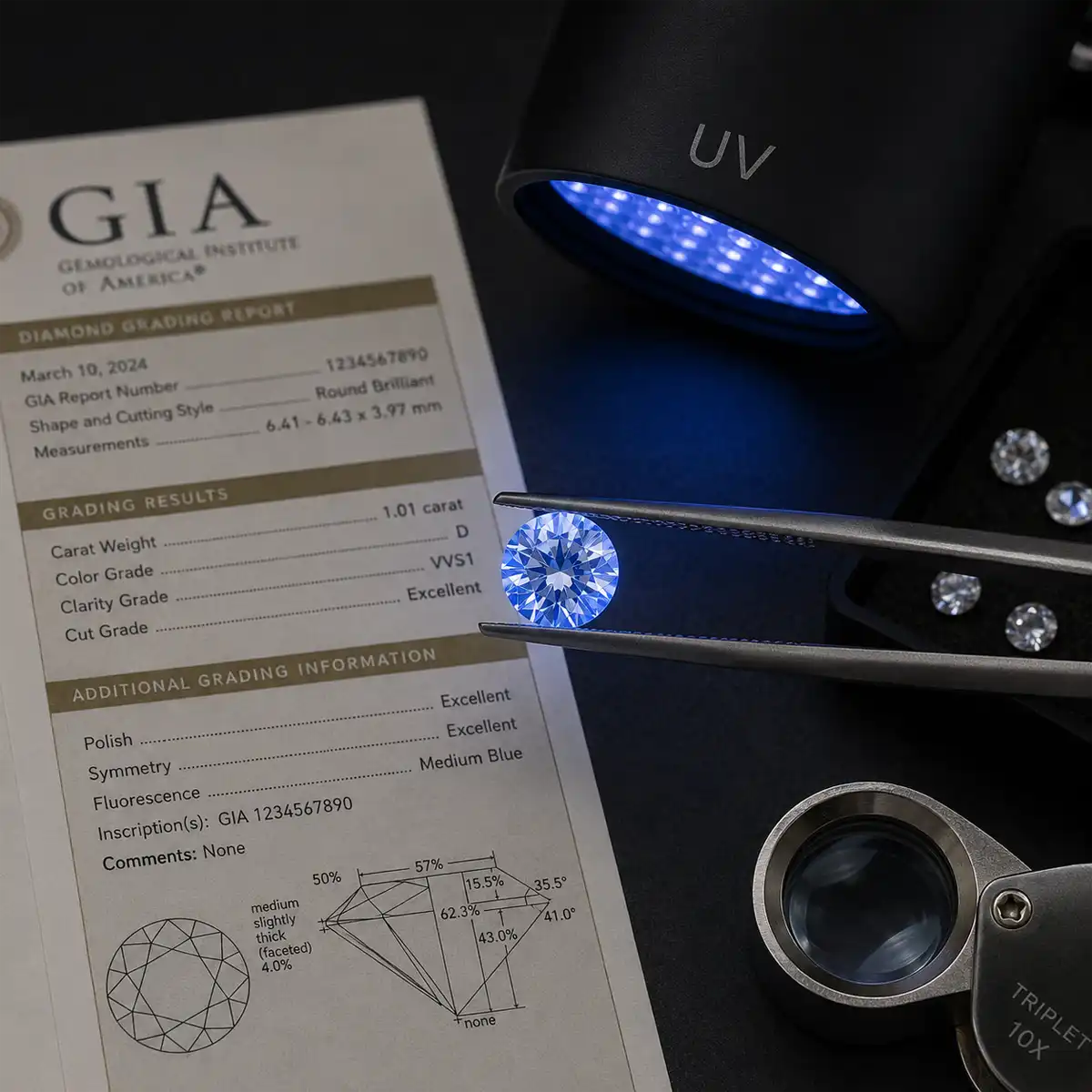
Diamond fluorescence is the visible light emitted by some diamonds when exposed to ultraviolet light. Approximately 30% of all-natural diamonds exhibit some degree of fluorescence, most commonly blue, caused by trace nitrogen atoms in the diamond's crystal lattice reacting to UV wavelengths. Grading laboratories record fluorescence intensity as None, Faint, Medium, Strong or Very Strong, and the colour is stated separately. Fluorescence is a natural property, not a defect.
The chemistry behind it is well understood. A natural diamond's crystal lattice contains occasional nitrogen atoms substituted for carbon. When nitrogen sits in certain configurations within the lattice, it can absorb ultraviolet radiation and re-emit it as visible light, most commonly in the blue part of the spectrum. Other fluorescence colours occur, including yellow, orange, white and green, but blue accounts for roughly 95% of cases the trade encounters. The grade on the report records intensity under controlled long-wave UV conditions, not daylight.
This matter because daylight contains only a small amount of ultraviolet radiation relative to the fluorescent bulbs and certified UV lamps that grading laboratories use. A diamond that reads Strong Blue under a laboratory UV lamp will typically show a much milder effect under normal daylight, and no visible effect at all under typical incandescent or LED indoor lighting. The grade on the report is a laboratory measurement, not a prediction of how the stone will look on a finger.
When fluorescence helps and when it hurts
The trade-floor observation is that fluorescence is genuinely helpful on warmer-coloured diamonds and genuinely problematic only on the very highest colour grades. A J or K colour diamond with Medium or Strong Blue fluorescence often faces up whiter than its nominal colour grade suggests, because the blue emission partially offsets the stone's yellow body colour under daylight conditions. The face-up improvement can be the equivalent of half a colour grade to a full colour grade, which at the mid-range of the scale represents meaningful value. Dealers in Hatton Garden will often quote a Strong Blue J colour as visually comparable to a Faint H under daylight, and price accordingly.
At the top of the colour scale the situation reverses. A D, E or F colour diamond is defined by the absence of body colour, and any blue emission from fluorescence can tip a very high colour grade into a faintly hazy or milky appearance under UV-rich lighting conditions. This is the situation the online consumer literature focuses on, and it is a legitimate concern for buyers of D to F stones above 1 carat, particularly those with Very Strong Blue fluorescence. For D to F stones the Hatton Garden trade typically pays a premium for None or Faint fluorescence, and applies a discount for Strong or Very Strong, reflecting the real visible effect at the top of the colour scale.
In the middle of the colour scale, from G through I, the effect is essentially neutral at Faint and Medium, marginally positive at Strong on the warmer end, and marginally negative at Very Strong on the cooler end. This is the band where most Hatton Garden engagement ring purchases sit, and it is the band where the price discount for fluorescence in the broader market is often larger than the visible effect justifies. A G colour VS2 with Medium Blue fluorescence is not meaningfully different face-up from the same stone with None, but the fluorescence version will typically price 5% to 10% lower because of the consumer-side discount. A prepared buyer in the quarter can convert that discount into genuine value.
The Hatton Garden trade pricing pattern on fluorescence
Trade pricing on fluorescence in Hatton Garden is remarkably consistent across reputable dealers because the pattern has been observed for decades. At D to F colour, the premium for None over Very Strong is typically 10% to 15% at comparable clarity, reflecting the genuine visible effect at the top of the colour scale. At G to J colour, the discount for Strong or Very Strong versus None is typically 5% to 8%, reflecting market demand rather than visible effect. At K and below, fluorescence is often neutral or even commands a modest premium because of the face-up whitening effect.
The 2014 GIA study remains the trade reference on face-up fluorescence effects. The study used a panel of professional observers comparing stones under controlled and natural lighting conditions, and found that the majority of Strong Blue and Very Strong Blue stones above I colour showed no visible difference from non-fluorescent comparables under normal viewing conditions. A minority of stones, typically 10% to 15% of the tested sample at Very Strong Blue intensity, showed a faintly hazy or oily appearance that the panel could identify under direct sunlight. The study did not find the blanket negative effect that the consumer market prices in.
What the study means for a buyer in 2026 is that the price discount on Strong Blue fluorescence in the G through J colour range is substantially larger than the observed visual effect justifies. A prepared buyer who is willing to examine stones under the jeweller's certified lighting can purchase a Strong Blue stone at meaningful savings and accept essentially no visible penalty. The one caveat is the oily or hazy appearance in approximately 10% to 15% of Very Strong Blue stones; those stones are identifiable on sight and should be rejected by a good bench worker before the stone is offered.

How Hatton Garden dealers actually advise on fluorescence
The consultation flow on fluorescence at a reputable Hatton Garden jeweller follows a predictable sequence. The dealer shows the stone first under the showroom lighting, then under direct sunlight at the window, then briefly under a UV lamp. The UV viewing confirms the grade on the report. The daylight viewing confirms the stone's actual appearance on a finger. For most stones the daylight viewing is unremarkable, and the buyer sees no visible effect from the fluorescence regardless of intensity. For the minority of stones where an oily or hazy effect is genuinely visible in daylight, the dealer typically identifies this unprompted and factors it into the price or withdraws the stone.
The 20-year experience the quarter carries on this specific issue is substantial. A dealer who has examined thousands of fluorescent stones under genuine daylight conditions, over many years, develops an eye for the specific intensity and distribution of fluorescence that produces the visible haze. The factor is not the fluorescence grade on its own; it is the combination of the fluorescence grade, the colour grade, the stone's crystal structure, and certain specific inclusion patterns. This combination does not appear on the grading report and cannot be assessed from a PDF scan, which is why buying a fluorescent stone sight-unseen from an online retailer carries more risk than buying in person in the quarter.
Bench and setting considerations also apply. Strong or Very Strong Blue fluorescence does not affect stone hardness, stone durability or the setter's work at the bench. A fluorescent stone sets the same as a non-fluorescent stone, holds its polish the same way, and behaves identically to abrasion over decades of daily wear. The fluorescence is purely an optical property under specific lighting conditions, not a structural or durability factor.
What to ask and what to check on a fluorescent stone
A first-time buyer considering a fluorescent stone in Hatton Garden can work through a simple checklist. Ask the dealer to show the stone under showroom lighting, direct daylight at the window, and UV lamp in sequence. Ask the dealer to describe, before prompting, whether the fluorescence shows any visible haze or oily appearance in daylight. Compare the fluorescent stone against a non-fluorescent comparable of the same colour and clarity grade under the same lighting, side by side. Ask what the price differential is between the two stones, and whether the discount is a standard trade discount for the fluorescence grade or a specific discount reflecting an observed visible issue.
Fun fact: The Hope Diamond, one of the most famous natural diamonds in the world, exhibits a rare red phosphorescence that continues to glow for several seconds after the UV light is switched off, a phenomenon unrelated to standard blue fluorescence and found in perhaps 1 in 10 million diamonds.
Certification and documentation on a fluorescent stone is straightforward. The GIA or IGI report records the intensity and the colour of the fluorescence on the front of the report, and a fresh report is available if the existing one is more than 15 years old. The laser inscription on the girdle matches the report number and allows verification under 10x magnification as with any other certified stone. An independent insurance valuation will typically record the fluorescence grade alongside the other grading parameters; it does not meaningfully affect the replacement cost valuation for insurance purposes, which is based on colour, clarity, cut and carat.
How to decide on a fluorescent diamond in Hatton Garden
For a buyer in Hatton Garden in 2026 evaluating a diamond with Medium, Strong or Very Strong Blue fluorescence, the single most useful question to ask the jeweller is how the specific stone looks under daylight compared with a non-fluorescent comparable of the same colour and clarity grade. A dealer who answers by showing the two stones side by side at the showroom window demonstrates trade literacy; one who declines or deflects is worth a second opinion. For G through J colour stones, fluorescence typically represents a genuine value opportunity at the market's standard discount rates. For D to F colour stones, particularly above 1 carat, the premium for None or Faint is usually worth paying. For K and below, fluorescence can actively improve the stone's daylight appearance. The right choice is stone-specific and observed in person; generalised online advice will often produce exactly the wrong outcome.
Continue Reading
The Hatton Gazette
Delivered monthly to your inbox
Subscribe for the latest from Hatton.