The decision to choose a sapphire over a white diamond is rarely a rejection of the diamond. It is a decision about the person the ring is for, and about the quiet conviction that a colourless stone, however fine, says less about them than a deep cornflower blue would. Buyers arrive in Hatton Garden with that instinct half formed, and the quarter is unusually well equipped to finish the thought. A sapphire engagement ring in Hatton Garden is built around the stone first; loose sapphires are viewed, compared and negotiated here in a way no high street counter can match.
The practical difference is visible within minutes of arriving. Walk the length of Hatton Garden itself, turn off Greville Street, and the combined window stock covers more certified sapphires than most buyers would otherwise see in a decade. That abundance only helps the buyer who understands what separates one blue stone from another. Origin, treatment and certification decide the price, and all 3 can be checked before any money changes hands. What follows explains how to check each one, so your first consultation starts on an equal footing.
Why Hatton Garden Suits a Sapphire Engagement Ring Purchase
Hatton Garden suits sapphire buyers because the quarter trades in loose coloured stones as well as finished rings. A buyer can compare certified sapphires side by side, commission a setting around the chosen stone, and deal with businesses whose supply chains reach the cutting centres directly. No high street retailer offers that combination.
The geography helps. The quarter sits in EC1N, a 2-minute walk from Chancery Lane station on the Central line and a short cut through from the Farringdon Elizabeth line exit. Workshops, dealers and retail counters operate within the same few streets, which means a stone chosen at one address can be set, sized and hallmarked without leaving the area.
For coloured stones specifically, that concentration matters more than it does for diamonds. Sapphire quality cannot be reduced to a grading scale in the way the 4Cs attempt for diamonds. Colour is judged by eye, in person, under changing light. A quarter where dozens of stones can be viewed in an afternoon rewards the patient buyer disproportionately.
There is also a quieter reason buyer choose this route. An engagement ring built around a hand-picked stone carries a story the wearer can retell, and the pressure of the decision eases once the buyer has seen the alternatives with their own eyes rather than trusting a photograph. The quarter’s format, unhurried appointments with stones on the table, suits exactly the person for whom this purchase feels enormous.
How Origin Drives the Price of a Sapphire
Three origins carry a premium that has held for over a century. Kashmir sapphires, mined in a brief window in the late 1800s and early 1900s, show a soft, velvety blue and now trade almost exclusively at auction. Burmese stones from the Mogok region follow, prized for rich, saturated colour. Ceylon sapphires from Sri Lanka complete the classic trio, typically brighter and lighter, and they remain the most realistic of the 3 for an engagement ring budget.
Modern supply tells a different story. Madagascar has become a major source since the 1990s, producing stones that regularly match Ceylon material on appearance at a lower price. Australia and Montana in the United States supply darker and steelier blues respectively. None of this makes any single origin better; it makes disclosure essential, because 2 stones of identical appearance can differ in price several times over on origin alone.
Colour vocabulary is worth learning before the first appointment. Cornflower describes the bright, slightly violet-touched blue associated with Ceylon material. Royal blue sits deeper and more saturated, the register Burmese stones are known for. Teal sapphires, balanced between blue and green, sit outside the classic palette and have become a familiar request in bespoke briefs, while padparadscha, the rare pink-orange variety, occupies a category of its own. Naming the colour you want shortcuts an entire meeting.
One caution an experienced dealer will volunteer and a weaker one will not. Origin is a laboratory opinion, not a birth certificate. Labs reach their conclusion from inclusions and trace element chemistry, and respected labs occasionally disagree on the same stone. Treat an origin report as strong evidence, and be wary of any seller who presents it as absolute fact.
Fun fact: The sapphire in the engagement ring worn today by the Princess of Wales is a 12 carat oval Ceylon stone, originally chosen by Diana, Princess of Wales, in 1981.
What Heat Treatment Means for Value and Disclosure
The majority of sapphires sold worldwide have been heated. The treatment is centuries old, permanent and stable; it improves colour and clarity and requires no special care afterwards. A heated sapphire is not a lesser purchase, and in most Hatton Garden windows it is the standard offer at accessible prices.
The premium sits with untreated material. A stone whose report states no indication of heating commands a substantially higher price than a comparable heated stone, because it left the ground already showing its colour. If a sapphire is priced in a way that implies unheated status, the claim must be supported by a report from a recognised laboratory, not by the seller’s assurance.
The question to ask is direct, and any reputable dealer in the quarter will expect it. Has this stone been heated, and which laboratory says so. UK consumer law requires accurate description of goods, and treatment status is a material fact. A seller who becomes vague at this point has answered the question.
As for numbers, sapphire pricing in the quarter moves on too many variables for a published figure to mean much; carat weight, origin, treatment and cut interact stone by stone. Dealers provide pricing on consultation, and comparing like-for-like quotes across 2 or 3 businesses remains the most reliable measure of fair value the quarter offers.
Which Lab Report to Ask For on a Coloured Stone
Diamond buyers learn the names GIA and IGI. Coloured stone buyers need a different list. Gübelin and SSEF, both Swiss, are the most respected names for origin and treatment analysis on high-value sapphires. GRS is widely used across the trade, and AGL holds a comparable position in the United States. Each test for treatment and offers an origin opinion where the evidence supports one.
Proportion matters. A modest sapphire does not need a Swiss origin report that costs a meaningful fraction of the stone’s value; a dealer’s invoice describing the stone accurately, plus a written treatment disclosure, can be adequate at entry level. As value rises, independent paperwork becomes non-negotiable. For a significant stone, a report from one of the 4 labs above should be in hand before purchase, with the report number matching the accompanying documents.
One distinction saves confusion later. The UK hallmark on the finished ring certifies the precious metal, tested at an assay office such as the London Assay Office in EC1. It says nothing about the stone. Metal and stone carry separate paperwork, and a careful buyer checks both.
Choosing a Setting That Protects the Stone
Sapphire is corundum, which measures 9 on the Mohs scale. Among stones commonly set in engagement rings, only diamond is harder. That makes sapphire an excellent daily-wear choice, though hardness measures scratch resistance rather than immunity to chipping; a hard knock on an exposed girdle can still damage any gem.
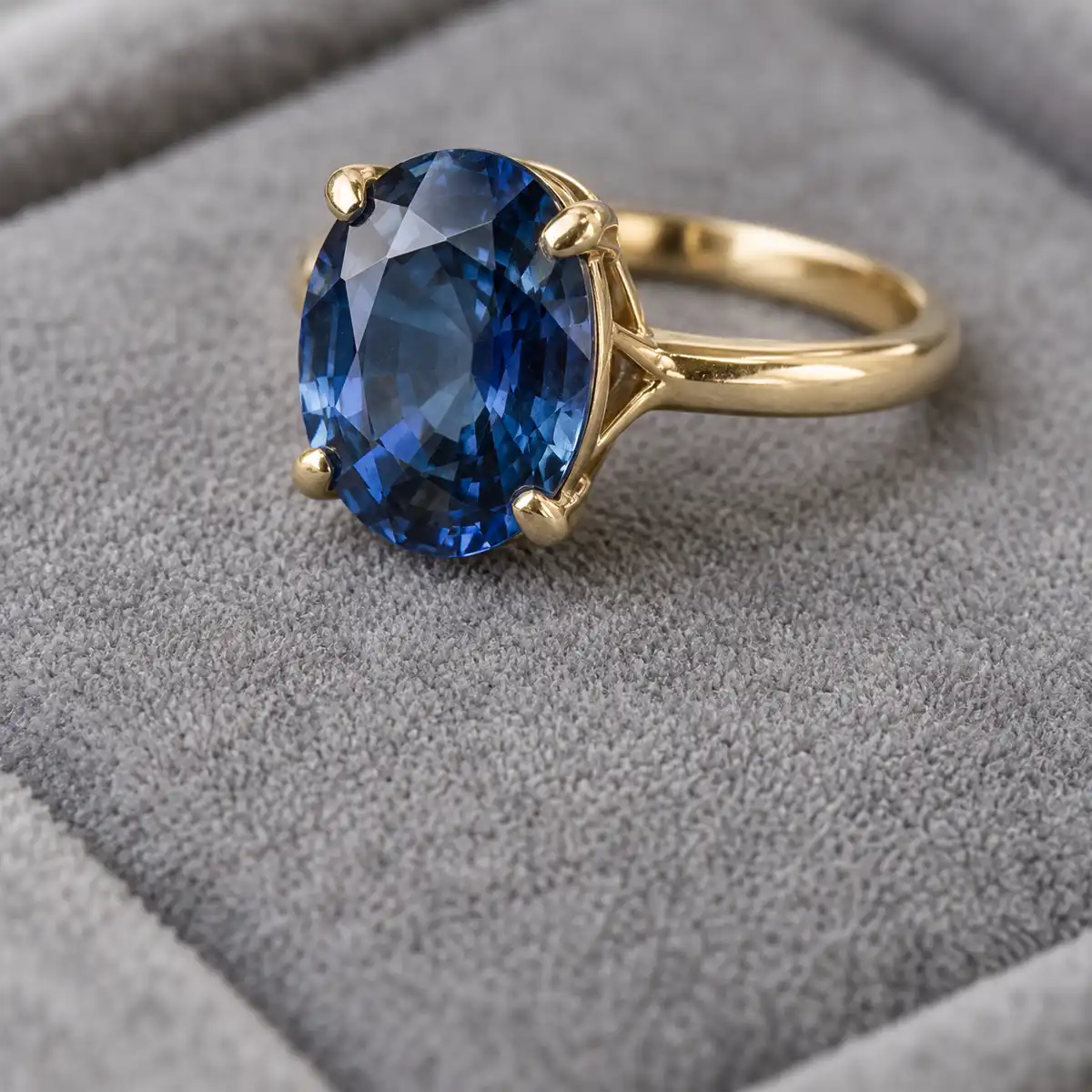
Setting choice follows from that. A claw setting, usually 4 or 6 prongs, shows the most stone and suits buyers who want maximum light return from the pavilion. A bezel, where a rim of metal encircles the stone, gives the strongest protection for active hands. Halo settings, where small diamonds frame the sapphire, do double work here, since the contrast between white diamond and blue corundum flatters both.
Metal choice interacts with the stone more than buyers expect. Platinum’s cool white sharpens a blue sapphire and holds claws securely for decades, while 18ct yellow gold warms the stone and suits antique-leaning designs. White gold needs periodic rhodium re-plating to keep its colour, a small maintenance fact worth knowing at the start. Most workshops in the quarter set sapphires in 950 platinum or 18ct gold as standard.
There is a bench-level detail worth knowing before you compare stones. Sapphire is pleochroic, showing slightly different colour along different crystal directions, and rough often carries uneven colour zoning. A skilled cutter orients the table so the best blue faces up and any zoning hides in the pavilion. Tilt a loose stone under the dealer’s lamp and watch the colour hold or shift; a stone that stays even through movement was cut by someone who knew the material.
What to Expect From a First Consultation in the Quarter
Most sapphire purchases in Hatton Garden begin with an appointment rather than a walk-in, particularly where loose stones are to be brought out. Booking is typically by phone or through the jeweller’s enquiry form, and a first consultation runs 30 to 60 minutes. Bring a clear budget, images of rings that appeal, the ring size if known, and any inherited stones you are considering resetting.
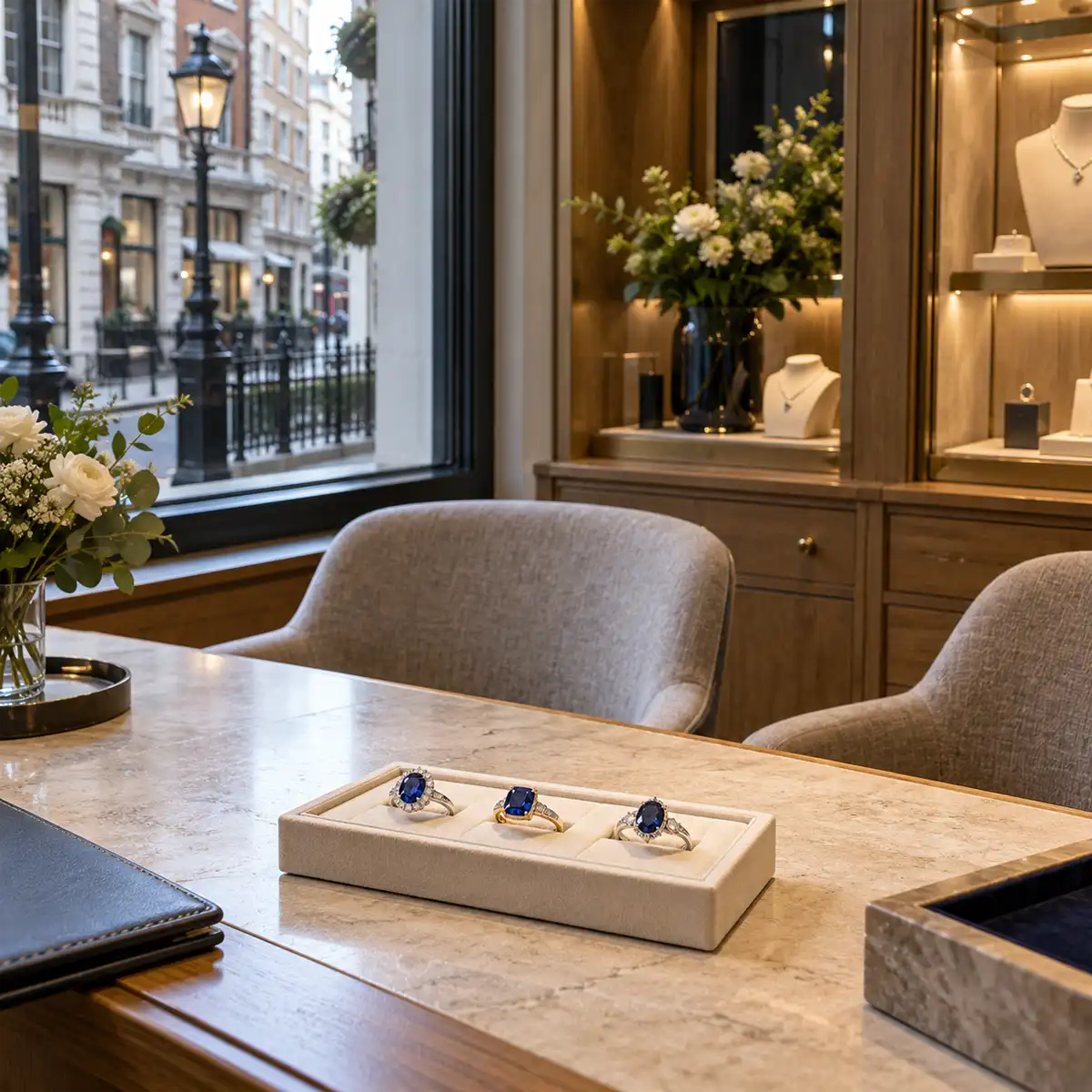
Ask to view stones away from the display lighting. Daylight through the window, or a daylight-equivalent lamp, shows a sapphire’s true behaviour far better than the warm spotlights designed to flatter. Comparing 3 stones side by side teaches more in 10 minutes than hours of online research, which is the quarter’s structural advantage over any website.
Buyers who care about sourcing should raise it in the first meeting. Sri Lankan sapphire mining is dominated by small-scale pits with comparatively strong traceability, one reason Ceylon stones appeal to ethically minded couples. Ask the dealer where the stone entered their supply chain and how far back they can trace it; the quality of the answer tells you a great deal.
Timing matters for bespoke work. A commission built around a loose sapphire typically takes 6 to 10 weeks from design approval to collection, covering sourcing, CAD approval, casting, setting and hallmarking. For a Christmas 2026 proposal, that means confirming the design by early October 2026, and the busiest workshops book out weeks ahead of every engagement season peak.
Making the Purchase With Confidence
A buyer 2 to 3 months from a proposal, drawn to colour and willing to view stones in person, is exactly who the quarter serves best. Book 2 or 3 consultations rather than 1, and take the same questions to each. Ask whether the stone is heated, which laboratory issued the report, and whether you can view it under daylight. Check that the report covers treatment and origin, and that its number matches the stone’s paperwork. Confirm the making timeline in writing, with 6 to 10 weeks as the realistic window for bespoke work. Approached this way, a sapphire engagement ring in Hatton Garden becomes a considered purchase rather than a hopeful one, and the ring that results carries a stone chosen with open eyes.
Continue Reading
The Hatton Gazette
Delivered monthly to your inbox
Subscribe for the latest from Hatton.