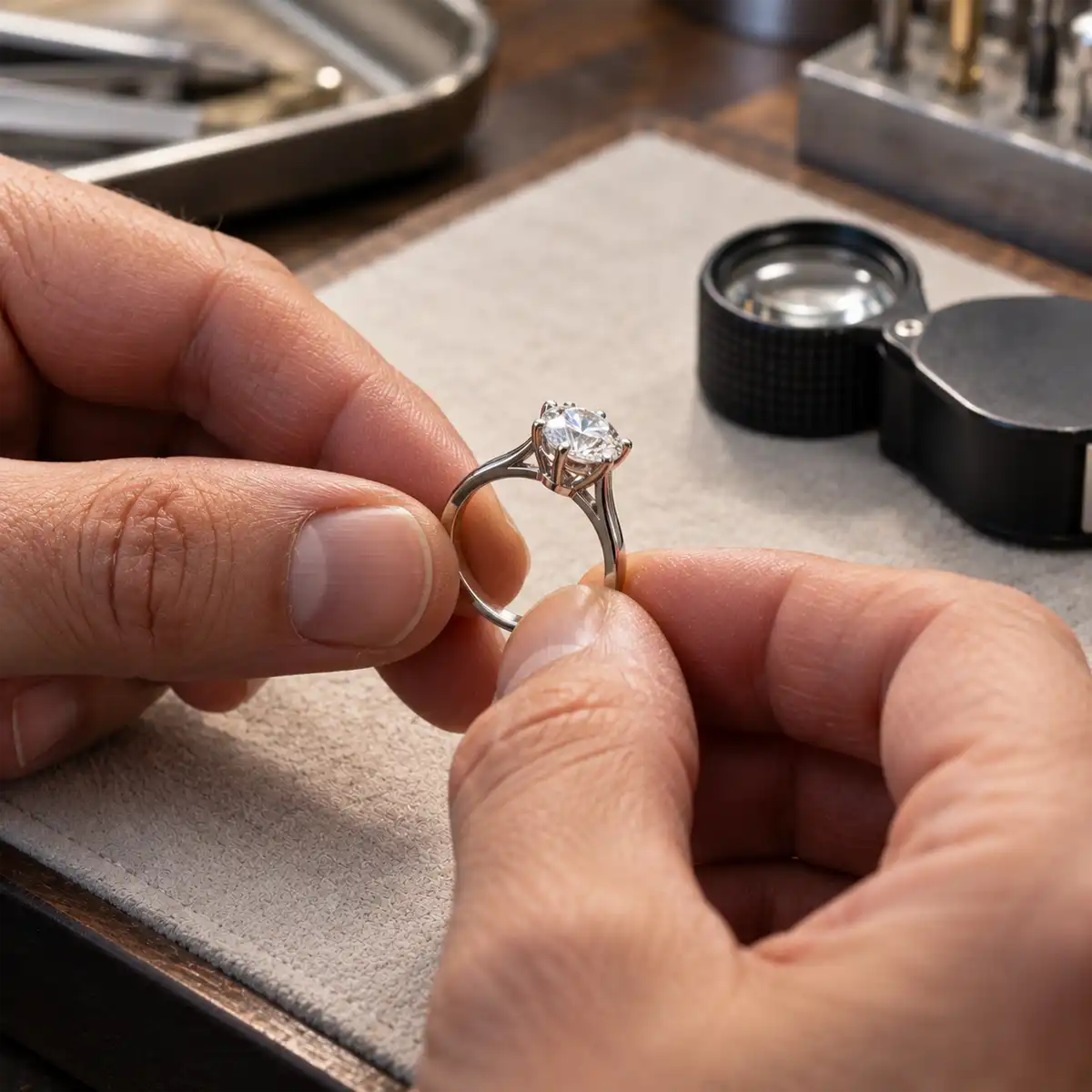
The last thing done to a ring before handover is a setter running a needle point around every claw under magnification, checking that each tip still grips after final polishing. Most buyers never see it, which is a pity, because that check is also the first thing daily life starts undoing. Sensible ring aftercare is simply that bench discipline continued on a calendar, and a ring made in Hatton Garden has the advantage of living a short journey from the people best placed to continue it.
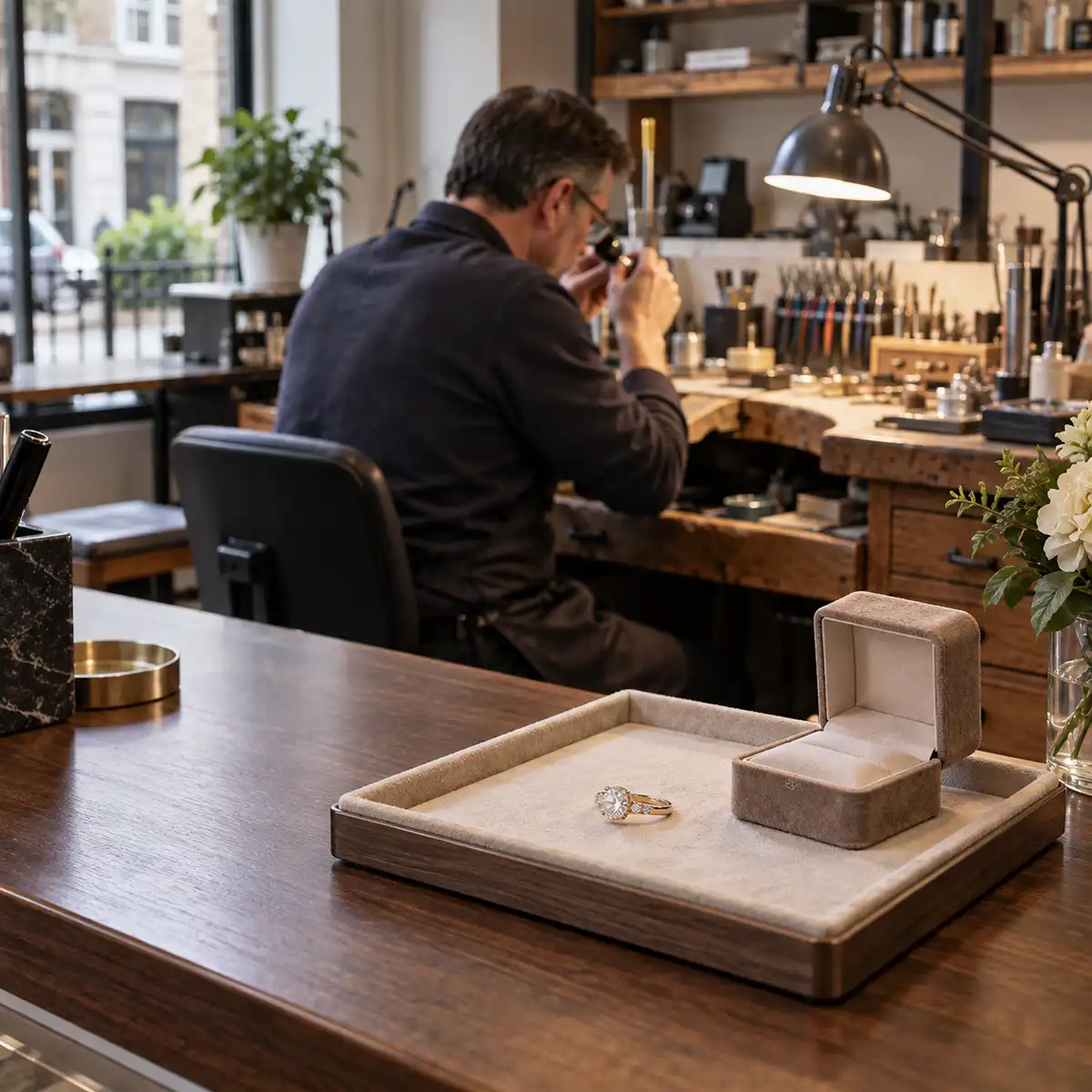
The quarter services what it makes. The workshops along Greville Street and Hatton Garden itself hold the making records of their own pieces, which turns every later adjustment from guesswork into reference work. What follows covers what actually wears, how the metals age differently, what to do at home, and the small list of jobs that should only ever happen at a proper bench.
What Ring Aftercare Actually Involves Year by Year
Ring aftercare runs on a simple calendar. A professional check once a year covers claw tips, setting integrity and shank wear. Gentle cleaning at home once a month keeps stones bright between visits. White gold needs periodic rhodium re-plating, and resizing happens as fingers change. The workshop that made the ring does all of it best.
None of this is fuss for its own sake. A ring is a machine with one moving part, the hand it lives on, and every surface it touches removes a little metal. The annual check exists because the failure mode that matters, a stone leaving a worn claw, is entirely preventable and always cheaper to prevent than to fix.
What the Goldsmith Looks For at the Annual Check
The bench inspection reads wear the way a dentist reads teeth. Claw tips go first, because they stand proud of everything else; a worn tip shows as a bright, flattened facet where a rounded dome should be, and re-tipping it is routine work when caught early. The goldsmith will also test each stone for movement, since a stone that rocks under a needle point is announcing its departure date.
The shank tells the longer story. Decades of wear thin the band at the palm side first, and a shank caught before it goes paper-thin can be re-shanked cleanly while one that splits takes the design history with it. Solder joints, channel walls and the settings of small side stones round out the inspection. Ten minutes under the loupe, once a year, is the entire cost of never losing a stone.
Between annual visits, 1 symptom overrides the calendar. A claw that catches on fabric, a stone that clicks against the loupe of a fingernail, or a visible gap under any tip means the ring comes off that day and goes to the bench that week. Stones almost never fall from settings without warning; they fall from settings whose warnings were worn for another month.
How the Metals Age Differently
Platinum ages by rearranging itself. When a platinum surface is scratched, the metal is displaced rather than removed, which is why platinum claws stay structurally sound for decades and why the soft grey patina it develops is a sign of density rather than decline. Owners can keep the patina, which many prefer, or have the workshop restore the bright finish; the metal underneath is essentially all still there.
Fun fact: When platinum is scratched the metal is displaced rather than removed, so a decades-old platinum ring can still contain virtually all of its original metal.
Gold behaves differently at the bench and on the hand. An 18ct alloy wears by gradual loss, slowly softening crisp edges and engraving over many years. White gold adds a maintenance rhythm of its own; its bright white surface is rhodium plating over a warmer alloy, the plating wears through with daily wear, and the warm tone showing at the back of the band is the signal to book a re-plate. It is cosmetic, routine and quick, but it is workshop work, not a home job.
Cleaning at Home Without Causing the Next Repair
The safe home method has not changed in a century. Warm water, a drop of mild washing-up liquid, a soft brush worked gently behind the stone where skin oils collect, then a rinse with the plug in and a soft cloth. Diamonds shed their dullness instantly with this treatment, and nothing about it can hurt any ring.
The cautions matter more than the method. Chlorine attacks gold alloys, so rings come off for swimming pools and household bleach without exception. Ultrasonic cleaners are excellent for plain diamond and sapphire pieces but must never receive emeralds, tanzanite or any fracture-filled stone. And the gym, the garden and anything involving grit remain the 3-great claw-killers; taking the ring off for them is worth more than every cleaning product combined.
Storage does quiet damage or quiet protection, nothing in between. Diamond is the hardest thing in the jewellery box, and it will scratch gold, sapphires and other diamonds if pieces tumble together, so rings live in separate compartments or soft pouches, never loose in a shared dish. It is the cheapest habit in this entire subject and the one most often skipped.
Resizing and Re-Plating Done Properly
Fingers change and rings should follow. Most rings can be adjusted a few sizes in either direction after a bench assessment, and modern laser work lets a goldsmith join and rebuild with heat kept tightly away from vulnerable stones. The honest exceptions are set by design; a full eternity ring, with stones the whole way round, has no plain metal to work with and generally must be remade or exchanged rather than resized, which is worth knowing before choosing one.
Two habits close the loop. First, take the ring back to the bench that made it where possible, since the original workshop holds the design record, knows the alloy and the setting sequence, and can match the finish invisibly; the quarter’s geography, a 2-minute walk from Chancery Lane station, makes that unusually easy. Second, tell your insurer’s paperwork what happened; any resize, re-shank or replaced stone changes what the ring is, and the valuation should change with it. [INTERNAL LINK: insuring and valuing your ring | ring insurance and valuation in Hatton Garden]
One boundary keeps this subject honest. Maintenance keeps the ring you commissioned in the condition you collected it; the day the conversation turns to changing the design, resetting the stone into something new or rebuilding an inherited piece, you have left aftercare and entered remodelling, which is its own discipline with its own timeline. [INTERNAL LINK: commissioning timelines | when to commission a bespoke ring in Hatton Garden]
The Questions That Keep a Ring for a Lifetime
A ring collected in 2026 should have its first bench check booked before the end of 2026, and every owner should know 2 answers about anywhere that services it; who will actually do the work, and whether it stays on the premises or is sent out. A workshop proud of its bench answers both without blinking. From there the routine is modest, monthly washing-up-liquid cleans, an annual 10 minutes under the loupe, a re-plate when white gold asks for it, and shoes-off respect for chlorine and gym bags. Treat ring aftercare as the continuation of the craft that made the piece and the quarter’s work will outlast its warranty by a generation, which is, quietly, what everyone involved intended.
Continue Reading
The Hatton Gazette
Delivered monthly to your inbox
Subscribe for the latest from Hatton.