A diamond report is only as useful as your ability to check it, and most buyers never check it at all. They are handed a folded certificate, they glance at the grades, and they take the rest on trust. After 20 years around the Hatton Garden trade, I can tell you the certificate is where a careful buyer either confirms what they are buying or discovers that the stone and the paper do not quite match. Learning to verify a diamond certificate is the single most practical skill you can bring to the point of decision.
Hatton Garden, the quarter of dealers and benches between Holborn and Farringdon, is the right place to learn it, because a short walk from Chancery Lane station you can stand at a counter, hold the loose stone, and check it against its report while the jeweller watches. That is a request a good house in the quarter will welcome, not resist.
What a diamond certificate actually is
A diamond certificate, more properly a grading report, is an independent laboratory's assessment of a single loose stone. It records the carat weight, the cut, colour and clarity grades, the measurements in millimetres, and usually a plotted diagram of the stone's internal characteristics. It is not a valuation and it does not state a price. It describes the diamond, so that the same stone can be identified later.
The key word is independent. A report from a recognised laboratory is the opinion of a body with no stake in the sale, which is exactly why it carries weight that a seller's own description cannot.
Which laboratory issued the report
The first thing to check is whose report you are holding. The most widely trusted laboratory for natural diamonds is the GIA. The IGI is very common for lab-grown stones. Both are credible, but they are not interchangeable, and the laboratory shapes how the grades should be read. A report from an unfamiliar or in-house laboratory deserves more questions, because grading standards vary and an in-house certificate is not independent at all.
The distinction between the major laboratories is a subject in its own right, and it is worth understanding properly before you rely on a grade.
How to match the report to the stone in front of you
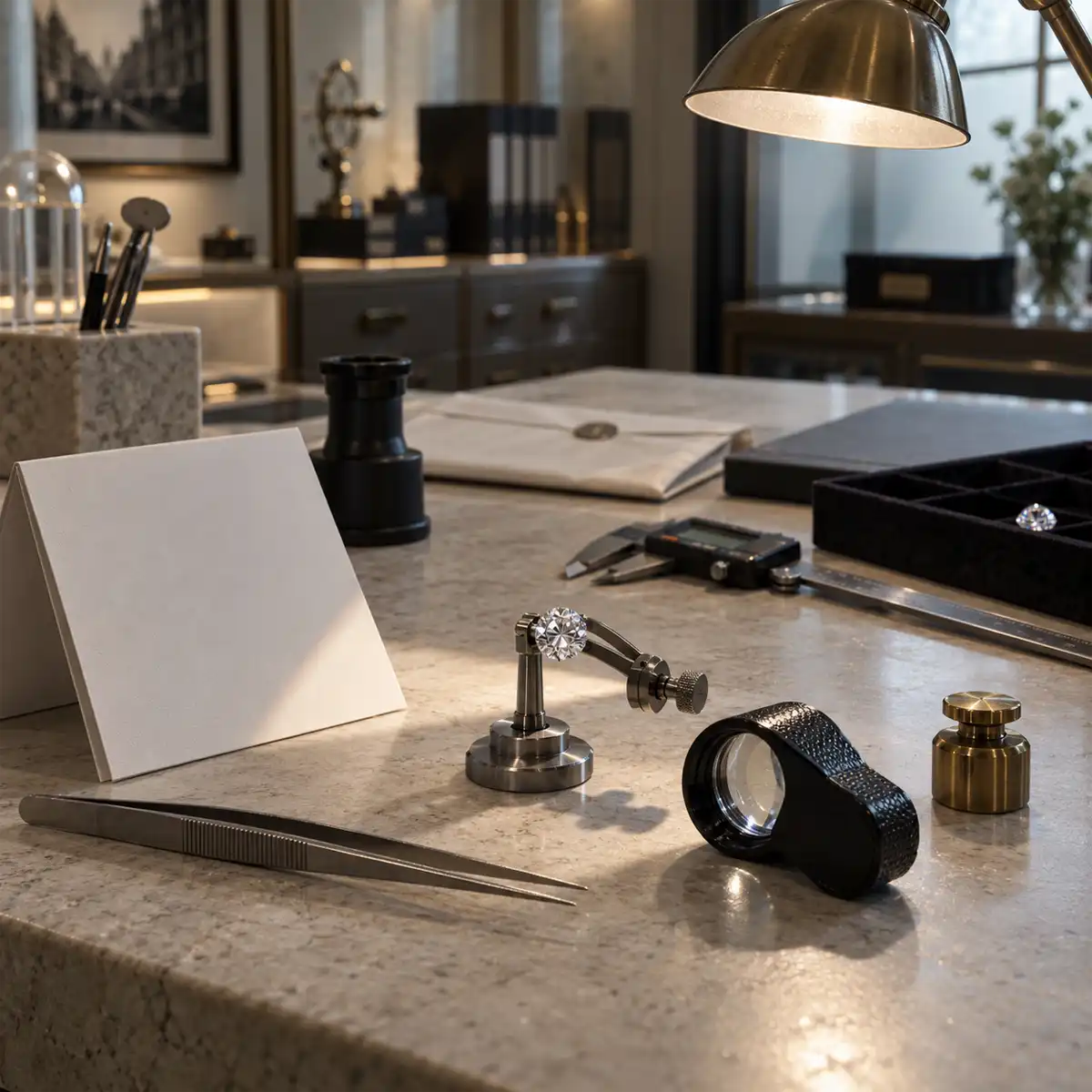
This is the step that separates checking from trusting. A report describes a specific stone, so the stone in front of you must match the paper in front of you. Confirm the carat weight, which is recorded to two decimal places, and the measurements in millimetres, which a jeweller can take with a gauge while you watch. If the report says 6.45 by 6.48 by 3.98 millimetres and the stone measures otherwise, the paper does not belong to that stone.
Fun fact: many GIA-graded diamonds carry their report number laser-inscribed on the girdle, a tiny edge of the stone, readable under magnification.
What the laser inscription tells you
That inscription is your strongest single check. Where a stone is inscribed, the report number on its girdle should match the number on the certificate exactly. A jeweller in the quarter can show it to you under the microscope or a loupe in a moment. When the number on the stone matches the number on the paper, you have linked the two together with real confidence.
Not every stone is inscribed, and a missing inscription is not in itself a problem. But where one exists, checking it costs nothing and tells you a great deal. Ask to see it. A seller comfortable with the stone will have no difficulty showing you.
How to verify the report is genuine
A certificate can be checked against the laboratory's own records, and you should do it. The major laboratories maintain online databases where you enter the report number and see the grades the laboratory actually recorded. Doing this confirms two things at once, that the report is real and that the printed copy in your hand has not been altered.
Do this while you are in the showroom, not afterwards at home. Ask the jeweller to look up the report number on the laboratory's website with you, and compare what the database shows against the certificate on the counter. A genuine report and an honest seller make this a simple, quick exercise.
What to check on the grades themselves
Once you know the report is genuine and belongs to the stone, read the detail rather than only the headline grades. The plotted diagram shows where the clarity characteristics sit, which tells you whether an inclusion will be hidden by a claw or visible in the table. The comments section is where a laboratory notes anything unusual, such as clarity treatments or additional inscriptions, so read it carefully.
A grade is a summary. The plot and the comments are where the stone's individual character is recorded, and they often explain why two stones with identical headline grades can look and cost differently.
What a dossier is and when you will see one
Smaller diamonds, typically below a certain weight, are often graded as a dossier rather than a full report. A dossier carries the grades and, frequently, the laser inscription, but usually no plotted diagram of the stone's characteristics. For a smaller stone this is normal and not a downgrade in quality, it simply reflects that a full plot adds little at that size.
What it means in practice is that you lean more heavily on the inscription and the online database check, since there is no plot to read. For a larger and more valuable stone, by contrast, you should expect a full report with a plotted diagram, and its absence on an important diamond is worth questioning before you commit.
What a certificate does not tell you
A report grades the loose stone, and only the loose stone. It does not assess the ring, the quality of the setting, or whether the price is fair. It does not tell you how the diamond looks once mounted, which is why seeing the stone matters as much as reading its paper. By 2026, with lab-grown stones widespread and convincing to the eye, the report has become the clearest way to confirm exactly what a stone is, but it remains a description, not a judgement of value.
This is worth holding onto. The certificate answers what the stone is. It does not answer whether you should buy it, which is a separate decision about appearance, setting and price.

What to do when a stone has no certificate at all
Plenty of perfectly good diamonds, particularly smaller stones and older ones, are sold without a laboratory report. This is not automatically a problem, but it changes your position. Without a report you are relying entirely on the jeweller's grading and your own eye, with no independent body standing behind the grades.
For a significant stone, you have options. You can ask the jeweller to send it for independent grading before you pay, or buy on the clear understanding that you will have it graded afterwards and can return it if it does not match what you were told. The more you are spending, the more an independent report matters, and the more reasonable it is to insist on one. For a modest stone in a larger piece, the absence of a separate report is far less of a concern.
Common red flags at the point of decision
A few warning signs deserve real caution. A seller reluctant to let you see the stone loose, a certificate offered only as a photocopy with no original, an in-house report from a laboratory you cannot verify online, or a report whose weight and measurements do not match the stone, all of these are reasons to pause before any money changes hands. Since 2025, buyers have grown more aware that not every certificate carries the same authority, which has made these checks more routine in the quarter, not less.
None of this means a stone is suspect by default. It means that a confident buyer verifies rather than assumes, and a reputable Hatton Garden jeweller expects exactly that.
A clear next step
If you take one habit into a diamond purchase, make it this: ask to see the stone loose and to check its report number on the laboratory's own website while you are still at the counter. That single action confirms the laboratory is genuine, the report belongs to the stone, and the grades are what the seller says they are. Match the inscription where there is one, read the plot and the comments, and never compare a described stone against an unseen one. A buyer who can verify a diamond certificate leaves Hatton Garden certain of what they bought, because they checked it themselves rather than taking it on faith.
Continue Reading
The Hatton Gazette
Delivered weekly to your inbox
Subscribe for the latest from Hatton.