The question buyers ask me most often is whether lab grown diamonds are real. It is the wrong question. They are real diamonds, the same crystallised carbon, the same hardness, the same fire. After 20 years around the Hatton Garden trade I can tell you the honest decision is not about authenticity at all. The choice between natural or lab grown diamonds is a decision about value over time, and it is best made with the trade facts in plain view rather than a sales pitch in either direction.
Hatton Garden, the quarter of dealers and benches between Holborn and Farringdon, is one of the few places in London where you can hold both kinds of stone, a short walk from Chancery Lane station, and see for yourself that your eye cannot tell them apart.
Why natural diamonds remain the default
Natural diamonds are still the default for most engagement buyers, and the reasons are worth stating plainly. They are formed over geological time, the supply is finite, and their prices have stayed relatively stable, anchored by mining cost and scarcity. That stability is the quiet argument in their favour. A natural stone is understood, by the trade and the wider market, as something that holds a recognised position rather than a price that only falls.
For a buyer who values that permanence, or who expects the ring to be passed on, the natural stone carries a weight of continuity that matters beyond the 4Cs. It is not a better diamond optically. It is a different proposition about the future.
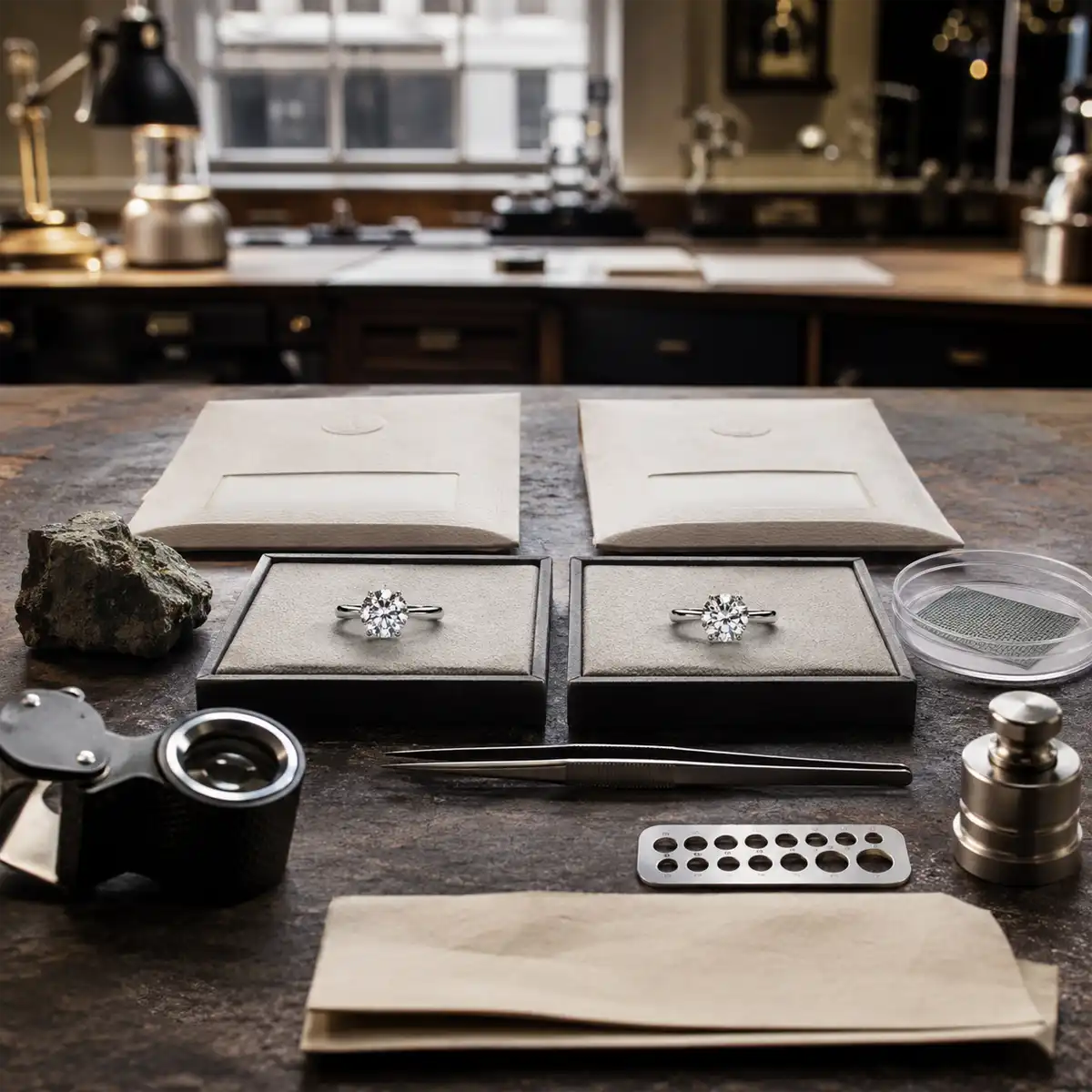
Fun fact: a standard jeweller's loupe cannot distinguish a lab grown diamond from a natural one, because they are physically identical; the difference is detectable only with specialised laboratory equipment.
Where lab grown diamonds changed the maths
Lab grown diamonds are grown in weeks, by one of two methods the trade calls HPHT and CVD, and their arrival has rewritten the pricing maths. By 2026 a lab grown stone typically costs 70% to 85% less than a natural diamond of the same specification. That is not a small discount. It is a different price tier entirely.
What that gap buys is room. A buyer choosing lab grown can reach for a larger stone, a higher colour and clarity, or a finer setting, all within the same figure that would buy a modest natural stone. The market matured through late 2025, the steep yearly price falls slowed, and a durable floor formed on premium laboratory goods, so the old habit of waiting for prices to drop further has largely ended.
How certification differs between the two
Both kinds of stone come with grading reports, but the laboratory landscape differs. Natural diamonds are most often graded by the GIA. Lab grown diamonds are very commonly graded by the IGI, which has become the dominant laboratory for laboratory-created goods. A credible report should state clearly which kind of stone it describes.
That distinction is the single most important thing to confirm on paper, and it deserves its own treatment rather than a paragraph here.
What resale and value retention really look like
Here is the difference the price gap hides, stated factually rather than as a warning. Natural diamonds retain a resale and second-hand market position. Lab grown diamonds, at present, do not hold value in the same way; their wholesale prices have fallen for years and there is little established resale market for them.
This is not a reason to avoid lab grown, and it is not a hidden flaw. It is simply the trade-off on the other side of the saving. If the ring is a purchase to be enjoyed and worn, resale may be irrelevant to you. If you think of it partly as something that holds worth to pass on, the natural stone behaves differently. Knowing which of those describes you settles most of the decision.
What buyers in the quarter are choosing in 2026
The market has moved quickly. A 2026 study from The Knot, cited in trade reporting, put the lab grown share of United States engagement rings at around 61%, a figure that signals how mainstream the choice has become, though it is a US number rather than a confirmed UK one. The direction of travel in London is similar even if the exact share is not settled.
One more 2026 factor shapes the decision. Gold and platinum prices have risen sharply this year, which means more of the total cost now sits in the metal and the setting whichever stone you choose. The snippet for a buyer in a hurry is this: a lab grown diamond costs far less and lets you upgrade size, colour or setting, while a natural diamond costs more and holds a resale position the lab grown stone does not, so the right answer depends on whether you are buying to wear or partly to keep.
A clear next step
Before you decide, ask the jeweller to state in writing whether each stone is natural or laboratory grown, and which laboratory graded it. A reputable house in the quarter will do this without hesitation, and the answer, on paper, protects you and lets you verify it later. Visit two or three jewellers, bring one budget figure, and ask to see a natural and a lab grown stone of similar appearance side by side so the price gap becomes real rather than abstract. Decide first whether resale matters to you, because that single judgement, more than the grades, tells you whether natural or lab grown is the right stone to leave Hatton Garden with.
Continue Reading
The Hatton Gazette
Delivered monthly to your inbox
Subscribe for the latest from Hatton.